My Customers Have Been My Culinary School: Gaurav Saria

With no culinary education, apprenticeship or professional kitchen experience, Gaurav Saria—owner, tea master, and Chef—built Infinitea by learning from failure, curiosity and the people who sat at his tables.
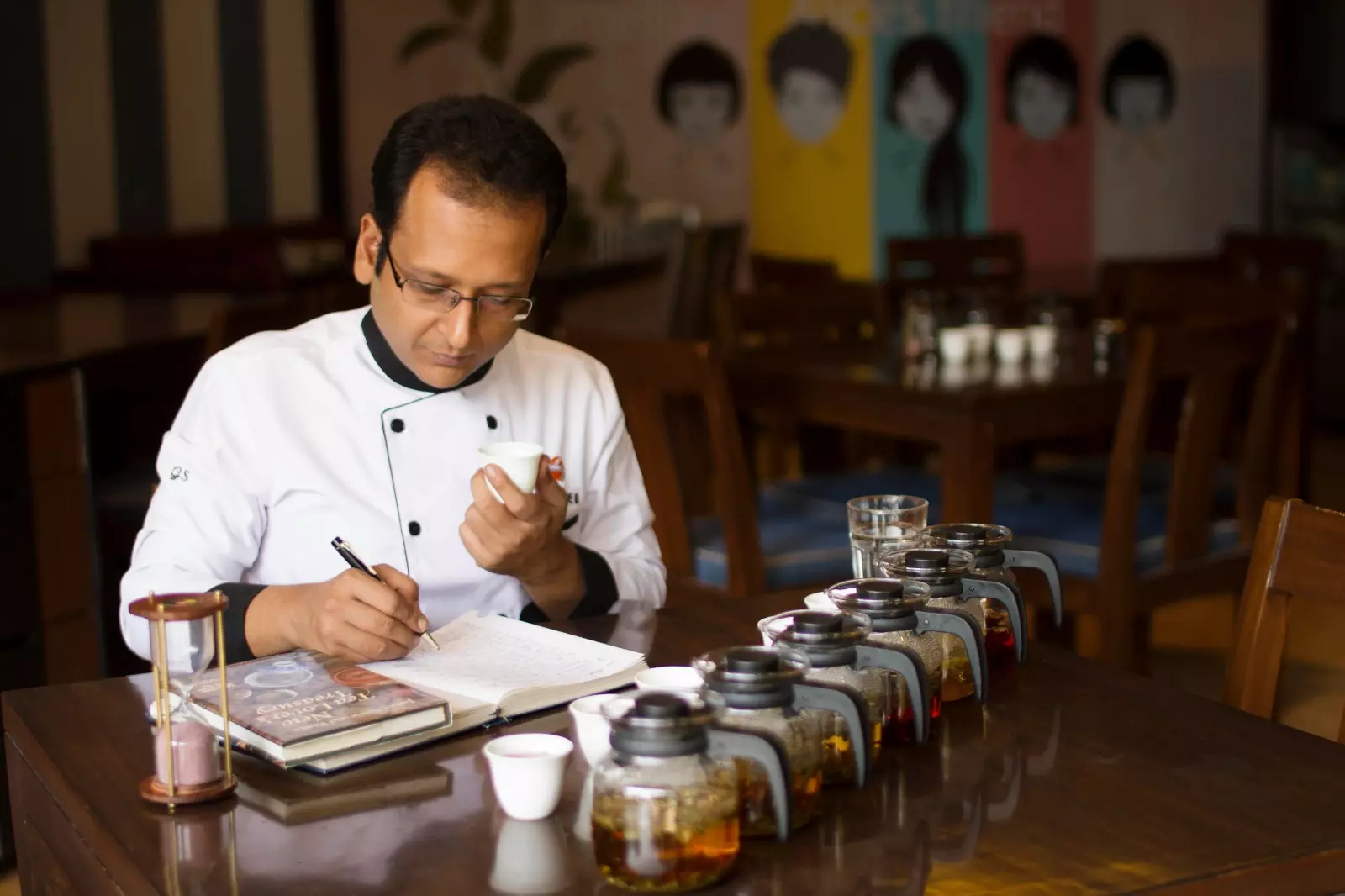
Gaurav Saria did not enter the restaurant business through the usual route. He studied computer science in Australia, returned to Bengaluru in 2003 and opened a restaurant without having worked in a professional kitchen, attended culinary school or apprenticed under a chef. Until he was 25, he was also a strict vegetarian.
Twenty-two years later, Saria runs Infinitea with a full non-vegetarian kitchen, a working bake house, an in-house fermentation programme and The French Palate, a recurring fine-dining series in which every course is paired with Darjeeling tea. His culinary education, he says, came from somewhere less conventional: the people sitting across the table.
“Both, honestly,” Saria says when asked whether entering the kitchen without formal training made him more inventive or simply made the learning curve harder. “The learning curve was significantly harder than it would have been had I started earlier with formal training. There is a reason people go to culinary school young. The fundamentals take time, and learning them through trial and error in a live kitchen is unforgiving.”
But what he lost in formal training, he believes he gained in freedom. “The flip side was that there was no box to fit into. No one had told me what a dish was supposed to look like, what flavour combinations were acceptable, or what the rules were. That absence of a rulebook turned out to be one of the most valuable things I had going for me.”
Much of what exists at Infinitea grew from that process of figuring things out for himself. The menu, the bake house, the sourdough, the sauces and flavoured butters made in-house, the flourless chocolate cake, the fermentation programme and even kombucha brewed from Darjeeling teas have been shaped by curiosity rather than a prescribed culinary syllabus.
His relationship with food became even more complicated when he moved beyond the vegetarianism of his upbringing. Going from not eating meat to running a kitchen that cooks it was not simply a matter of learning how to handle unfamiliar ingredients.
“It taught me far more about human beings than it did about food,” he says. “Cooking ingredients that were culturally taboo in my upbringing forced me to confront how deeply food is embedded in identity, history, and psychology.”
He became acutely aware of the assumptions and emotional reactions on both sides of the vegetarian and non-vegetarian divide. “The way vegetarians and non-vegetarians look at each other, the assumptions on both sides, the emotional charge around what we put on a plate — none of that had anything to do with flavour.”
More importantly, the experience forced him to examine his own boundaries. “It also taught me something about myself. How much I was capable of unlearning, and how far I could push past what I thought were my own limits. That turned out to be one of the more useful things I have ever discovered.”
Without a chef, mentor or culinary school to establish his benchmark, Saria found one in the people who walked into Infinitea.
“My customers. They have been my culinary school, my mentors, and my harshest critics all at once,” he says. “They taught me this business and they continue to push me to be better.”
For Saria, there is a limit to what books and formal training can teach. “No textbook tells you what a real person sitting across a table actually wants. That education only happens in the dining room, and it never really ends.”
After 22 years, however, there is still one thing he has not managed to master.
“Humans.”
He laughs before explaining why. “We are emotional, excitable, and deeply unpredictable creatures. You can perfect a dish technically, but you cannot predict how another person will experience it on any given day. Mood, memory, context — all of it shapes what someone tastes.”
That unpredictability, rather than frustrating him, has become part of what keeps the work interesting. “Customers continue to surprise me, challenge me, and force me to evolve in ways I never anticipated. I suspect I will never fully figure that out, and I am increasingly convinced that is the point.”
It is also perhaps why independence matters so much to him. At a time when restaurants are increasingly shaped by trends, investment and the pursuit of scale, Saria has retained control over the direction of Infinitea.
“Absolutely,” he says when asked whether independence has allowed him to remain stubborn about things that might not make commercial sense. “The moment you are answerable to investors, you are answerable to metrics. And metrics do not capture the things that make a restaurant worth going to.”
For Saria, independence means being able to make decisions based on conviction rather than what might look good on a quarterly report. “Staying independent has meant that I can forge a path based on conviction rather than a quarterly review. Some of the decisions I am most proud of at Infinitea would never have survived a boardroom conversation.”
He does not describe that freedom as a luxury. “That freedom is not a luxury. It is the condition under which good food is actually possible.”
Ironically, the man who built a culinary career without formal culinary education still has a long-standing desire to attend a serious professional culinary programme.
“Attending a serious professional culinary programme has honestly been a long-standing dream of mine,” he says. “I would love to understand how trained professionals think about cooking — the frameworks, the classical techniques, the logic behind the canon.”
There is another attraction too: the people he would meet there. “I would also love to be in a room full of young people just starting out on their culinary journeys. That energy is irreplaceable.”
But there is one part of formal training he suspects would test his patience.
“I suspect it would be the rigidity. The parts where the answer to ‘why do we do it this way’ is simply ‘because that is how it is done.’ That has never been a satisfying answer to me.”
For all the experimentation that has gone into Infinitea, Saria believes the restaurant’s longevity has less to do with any particular dish or trend and more to do with a principle that predates most of the city's current restaurant culture.
“Staying true to our values and never compromising on the principle that drives everything we do here: Atithi Devo Bhava. The guest is God.”
He acknowledges that the idea sounds simple, but maintaining it for more than two decades is anything but. “It is extraordinarily difficult to maintain consistently across 22 years, across changing tastes, economic pressures, and a city that reinvents itself every few years.”
Bengaluru may have a reputation as a coffee city, but Saria never set out to compete with that culture by chasing the next big thing. “We have never chased what was trending. We have focused on making every person who walks through the door feel that they matter.”
And perhaps that is the simplest explanation for why Infinitea has lasted.
“That is what keeps people coming back, and I believe it always will,” he signs off.
