Keeping the Soul of Tamil Cuisine Intact

From the slow kitchens of Erode to the high-pressure world of MasterChef, Chef Preethi Raghunandan is taking the lesser-known flavours of Tamil Nadu to new tables without losing the soul of where they came from.
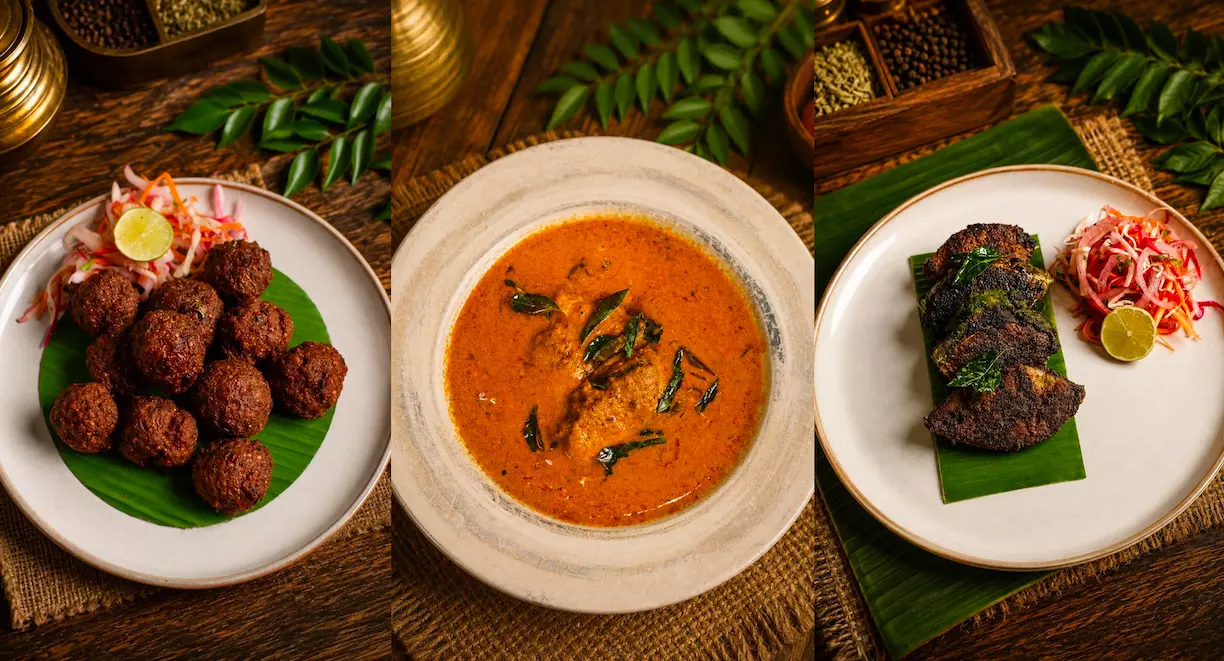
Mazzo at Marriott Executive Apartments Hyderabad hosted a Tamil Food Pop-up from August 3 to 9, curated by MasterChef India Tamil finalist Chef Preethi Raghunandan. The festival brought together dishes from across Tamil Nadu, offering a glimpse into the depth and variety of a cuisine that goes well beyond the familiar dosai and Chettinad chicken.
Chef Preethi Raghunandan.
For Preethi, however, Tamil food is not something she discovered professionally. It began much earlier, in her grandparents’ kitchen in Erode, where cooking was slow, deliberate and deeply connected to the ingredients.
“The biggest lesson was that patience and respect for ingredients are the true heart of cooking. In my grandparents’ kitchen in Erode, nothing was rushed. Spices were hand-ground on a ammikallu (grinding stone) to release their essential oils, and dishes were slow-cooked to let flavours meld naturally. They taught me that food isn’t just fuel, it is an expression of care, hospitality, and connection to our land. That mindfulness is something I carry into every professional kitchen I step into,” she says.
That sense of patience seems to have stayed with her even as her cooking has moved beyond the traditional kitchen. For Preethi, modern cooking does not mean leaving tradition behind. It is about knowing what should remain untouched and where there is room to experiment.
“The secret is to keep the soul of the flavour traditional while using modern techniques to elevate texture, digestibility, and presentation. Older generations look for deep, authentic nostalgia in taste, while younger diners appreciate lighter textures and beautiful visual storytelling,” she says.
She gives the example of retaining the exact traditional spice profile or the slow-cooked depth of a dish, while using techniques such as fine emulsification or precise temperature control to make a sauce smoother and lighter. Native ingredients, too, can be presented in a contemporary format without losing what makes them distinctive.
It is this balance that also shapes the way she looks at Tamil Nadu cuisine. Ask her about dishes that deserve more attention and the list quickly moves beyond the better-known names. She points to the micro-regional cuisines of the state, particularly those from Kongu Nadu, as a treasure trove waiting to be explored.
Dishes such as Arisi Paruppu Sadam cooked with native ghee and spices, Kongu Adai, mutton kothukari with kadalai paruppu, karuppu kozhi varuval and rustic Kollu Rasam are among the preparations she believes deserve wider recognition. There are also dishes built around native grains, including Kambu and Vargu curd rice, along with Ragi Kulzhu or Kali. For her, these are not simply traditional recipes. They carry both history and the health wisdom of the region.
The same thinking found its way into the menu she created for the Mazzo pop-up. The idea was to showcase Tamil food through a regional lens while giving the dishes enough space to speak for themselves.
Among the highlights were raw jackfruit kola urandai, which she says can stand on par with the more familiar mutton kola urandai, along with Kongu Adai served with peanut chutney. Mutton neer kozmbhu brought another regional character to the table, while Kongu-style mutton Seeraga Samba biryani brought together the warmth and familiarity of home-style cooking. Dessert took a less expected turn with black rice ice cream.
For Preethi, cooking is as much about memory as it is about technique. And some of her strongest memories are tied to the people closest to her now.
“My biggest inspiration comes my kids and my husband and close friends and also from the endless diversity of local ingredients and the joy of rediscovering lost traditions. Travelling through different regions of Tamil Nadu, exploring local markets, Combining those timeless elements with modern presentation drives my creativity,” she says.
There is also something deeply personal in the way she approaches experimentation. The excitement, she says, comes from seeing someone recognise a familiar childhood flavour, only to experience it in a completely new form. “Seeing guests light up when they experience a familiar childhood flavor reimagined in a completely new way is what keeps me constantly pushing boundaries.”
MasterChef India Tamil became another important part of that journey. The experience pushed her into an unfamiliar environment where cooking was no longer just about instinct, but also about precision, speed and performing under pressure.
“MasterChef India Tamil was a defining turning point. It pushed me out of my comfort zone and taught me how to operate with absolute precision under extreme high-pressure environments,” she says.
But the confidence she gained from the show, she says, began with her family. Her husband and children were an important part of the journey and helped her trust her own instincts. The experience ultimately showed her that her culinary instincts were strong enough to withstand the ticking clock.
More importantly, MasterChef changed how she viewed the possibilities of her own cuisine. “It expanded my horizons, showing me how traditional Tamil flavours can stand proudly alongside international techniques and fine-dining aesthetics,” she says.
Her culinary world has since grown beyond Tamil cooking too. What began with books, experimentation and the flavours she grew up with has gradually opened into other cuisines, including Pan-Asian and European cooking. Yet she sees those newer influences as branches rather than replacements for her roots.
“It transformed my vision from simply cooking great food to becoming an ambassador for our regional cuisine,” she says.
That may be the most interesting part of Preethi’s journey. For all the experimentation and contemporary techniques, the foundation remains the same kitchen in Erode, where spices were ground by hand and food was allowed to take its own time.
The pop-up at Mazzo was about reminding diners that Tamil Nadu has many food stories, many regional identities and many flavours that have yet to travel as far as they deserve.
And for Preethi, keeping those stories alive seems to begin with something quite simple: respecting where the food came from, understanding what makes it special, and then finding a way to make someone at the table fall in love with it all over again.
