Vayu Takes a Flavourful Journey Across India

A rooftop restaurant where the breeze travels from mountains to coasts, picking up flavours, memories and cooking traditions along the way.
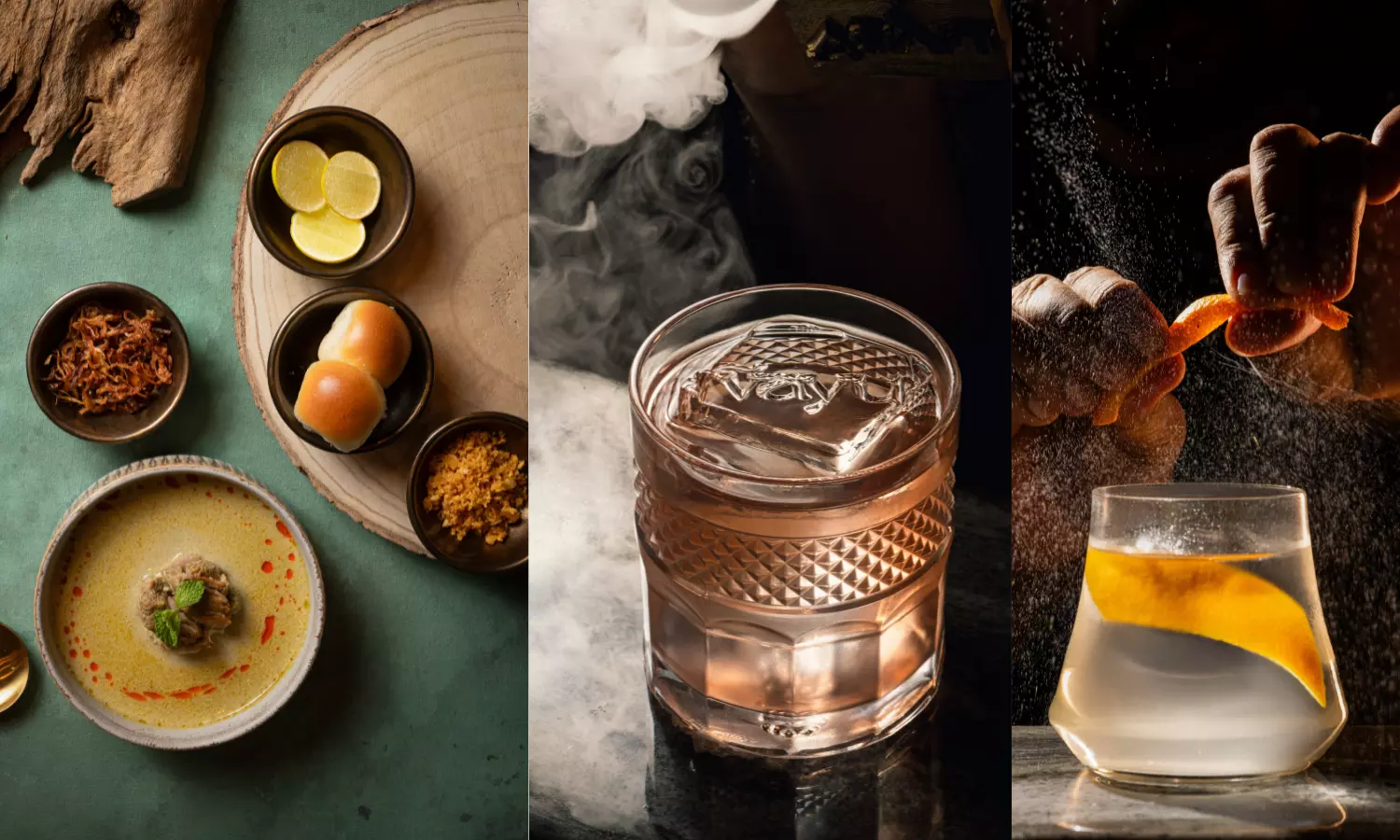
The breeze has a way of carrying stories with it. At Vayu, the new rooftop dining destination at Courtyard by Marriott Hyderabad, that idea has been turned into a menu that travels across India, picking up ingredients, regional flavours and cooking traditions along the way.
Up on the rooftop, with Hussain Sagar stretching out in the distance and the illuminated Secretariat adding another layer to the Hyderabad skyline, Vayu feels removed from the bustle below. There is music, there are cocktails and there is the easy hum of a city evening, but the food is what gives the place its sense of journey. Amardeep Singh, Multi Property General Manager, Hyderabad Marriott Hotel & Convention Centre and Courtyard by Marriott Hyderabad, says the idea began with a fairly simple question: what would work in a hotel that has generations of Hyderabad families walking through its doors? “When we were opening this restaurant, we could have simply made it as a lounge bar kind of thing, but one has to understand as to what does the market need,” he says.
The answer, he realised, had to work across generations. “The older generation still need their comfort, while another generation would also need their comfort, but okay to experiment. And the generation Z is all out for experimenting.”
That tension between familiarity and experimentation runs through Vayu. Singh believes Indian food remains the one thing that can bring everyone back to the table. “Even when you travel out of the country, when you come back, you want your fish curry, you want your dal. That soul food is what defines our food culture.”
But this isn’t a restaurant trying to pin Indian food down to one region. In fact, its identity comes from refusing to do that.
The name Vayu, meaning wind, offered the clue. “One thing is, Vayu is not stationary. It will keep moving. And then we said, let us do one thing, it’s India, 3.3 million hectare area, what can we do with that? We said, Vayu moves from mountains to deserts to coasts, wherever Vayu moves, it picks up the ingredients, it picks up the nuances, it picks up the techniques, and that is how the menu is made.”
It is an evocative way of looking at a restaurant menu. Instead of asking diners to travel from one regional cuisine to another, Vayu does the travelling for them.
The result is a menu that jumps across the country without feeling like a geography lesson. There is Bombay Bhel Granola, a contemporary take on bhelpuri, alongside Dahi Papad Ke Kebab from Rajasthan, Chicken 65 with a Hyderabadi touch, Bombay Fish Fry, Kerala Fish Curry, Chettinad flavours, Old Delhi Butter Chicken and much more.
Singh points out that the menu has been shaped by the places Vayu supposedly visits. That is perhaps the most interesting thing about the food here. It is not trying to recreate dishes exactly as they exist in their places of origin. Instead, it borrows their character and allows them to change as they travel.
The Shrimp Pickle is one such example. Rather than serving it in the familiar way with rice, the kitchen pairs it with masala broth. “We didn’t want to use the usual avakaya. Hence we serve shrimp pickle with masala broth. Again, it’s a very, very different combination.”
The menu continues in much the same spirit. There is Tomato Pappu turned into a dip and served with phulkas. There is pazham pori from Kerala, Mirapakaya bhajji from Telangana, Mushroom Iguru from Andhra, Kaddu Aur Bedmi, Kalimpong momos, Peshawri Tangdi and a series of soups and mains from Chennai, Kerala, Hyderabad, Delhi, Rajasthan and beyond.
Even the familiar dishes have been nudged into new territory. The idea is not to claim that a dish has been reinvented, but to see what happens when it is allowed to travel.
That same philosophy spills into the cocktails. Singh describes the beverage programme as another journey, inspired by regional influences. “We picked up Gongura, mango from different places and made cocktails.”
The drinks are divided into Vayu Chronicles and Vayu Reimagined. The former draws from recipes and ingredients encountered on the journey, while the latter takes classic cocktails and gives them what the GM calls the Vayu way.
There is something particularly fitting about drinking a cocktail flavoured by gongura while looking out over Hyderabad. The city outside is very much part of the restaurant’s story, even though the menu refuses to stay within its boundaries.
That balance is also evident in the space itself. Singh says the rooftop was deliberately allowed to take its identity from the city skyline rather than being overdesigned. Indoors, the mood changes.
“We had to give two worlds. One generation would probably like to chill out, while another wants to relax in a cozy environment. So there is both indoor and outdoor seating”
The food follows that same idea. You can arrive looking for something familiar and still find a reason to explore. You can come for a drink and end up lingering over dinner. Or start with something as recognisable as a samosa and discover that it has been given a completely different personality.
The Pista Patti Samosa is a good example. Patti samosa and masala chai are familiar Hyderabad comforts, but here the two have been separated and brought back together as dessert. Pistachio fills the crisp pastry while masala chai arrives as kulfi, accompanied by toffee sauce.
The Apricot Delight gets a similar treatment. Singh is quite candid about the challenge. “We are not here to replicate or compete. Hence we have a dessert called Not an Apricot Delight. It is like Apricot Delight. But, done the way the Vayu does.”
There is no attempt to pretend that the classics have been bettered. Instead, the restaurant seems to be having a conversation with them. That makes the menu more interesting than a straightforward regional Indian spread. Its pleasure lies in recognising something and then discovering that it has taken a small detour.
The meal can begin with the Bombay Bhel Granola, move through the Dahi Papad Ke Kebab and Shrimp Pickle, pause over the more substantial regional dishes like coconut stew and idiappam and end with the Pista Patti Samosa and Masala Chai Kulfi. And somewhere between courses, the skyline begins to feel like another part of the meal.
For Singh, that is ultimately what Vayu is meant to be. Not just another rooftop restaurant, but a place where food, drinks, music and conversation can coexist without one overwhelming the other.
When it comes to music, the GM was very firm that it had to keep playing without disturbing your conversations. That explains Vayu better than anything else. The restaurant wants to be lively without becoming loud, contemporary without losing its connection to Indian food, and experimental without asking diners to abandon the flavours they know.
And like the wind it is named after, the menu is never meant to stay in one place.
