Aakhol: When Homesickness Inspired an Assamese Kitchen

Missing the flavours of home inspired Alpaxee to create Aakhol, a restaurant that brings authentic Assamese food, traditions and hospitality to Hyderabad without compromising on its roots.
It all began with homesickness.
When Alpaxee moved from Delhi to Hyderabad in 2019 after her marriage, she found herself longing for the food she had grown up with in Assam. Delhi had always offered enough options to satisfy that craving, but Hyderabad was different. Despite searching, she never quite found the flavours that reminded her of home.
“I really missed homemade Assamese food,” she recalls. “We tried a few places, but I never found the taste of home. The idea stayed with me from 2020, but I wanted to complete my PhD before taking the plunge.”
A researcher with a PhD in Gender Studies, Alpaxee never imagined she would eventually open a restaurant. Yet food had always been woven into her life. Her parents run resorts in Guwahati, her grandfather once owned a food joint, and cooking was an extension of family life rather than a profession.
Instead of jumping straight into a restaurant, she decided to test the waters. In February 2025, she quietly started a home kitchen with nothing more than an Instagram page and word-of-mouth recommendations within Hyderabad’s Assamese community.
“The response was overwhelming,” she says, adding, “I initially thought only Assamese families would order from us, but almost half my customers turned out to be non-Assamese. A lot of Telugu customers especially loved our vegetarian dishes.”
As orders multiplied, so did her confidence. During Bihu celebrations, demand became impossible to handle from her home kitchen. “There was a day when I received nearly 50 orders. That was when I realised there was a market for authentic Assamese food here and it was time to grow.”
Alpaxee.
That dream has now taken shape as Aakhol, an intimate restaurant where every detail, from the décor to the recipes, reflects Assam. The interiors carry the warmth of home because they were designed by Alpaxee’s parents, both architects from Assam.
“They helped design everything. Most of the artefacts were brought from Assam. We simply hired local carpenters to execute the work,” she says.
Authenticity extends well beyond the décor. The kitchen itself is staffed almost entirely by people from Assam, including the nanny who first helped Alpaxee cook meals from her own home.
“When we started the home kitchen, it was just the two of us cooking together. Today she is one of the chefs here. The rest of the kitchen team is also from Assam,” she says.
Many of the ingredients travel nearly 2,000 kilometres before reaching Hyderabad. Her parents regularly send parcels filled with essentials that are difficult to source locally. “Horu aloo (potatoes smaller than the baby aloo available here in the market), kaji nemu (long lemons), Thekera and several other ingredients still come from Assam. Some leafy greens are difficult to find here, but we are trying to source as much as we can locally without compromising the taste,” she says.
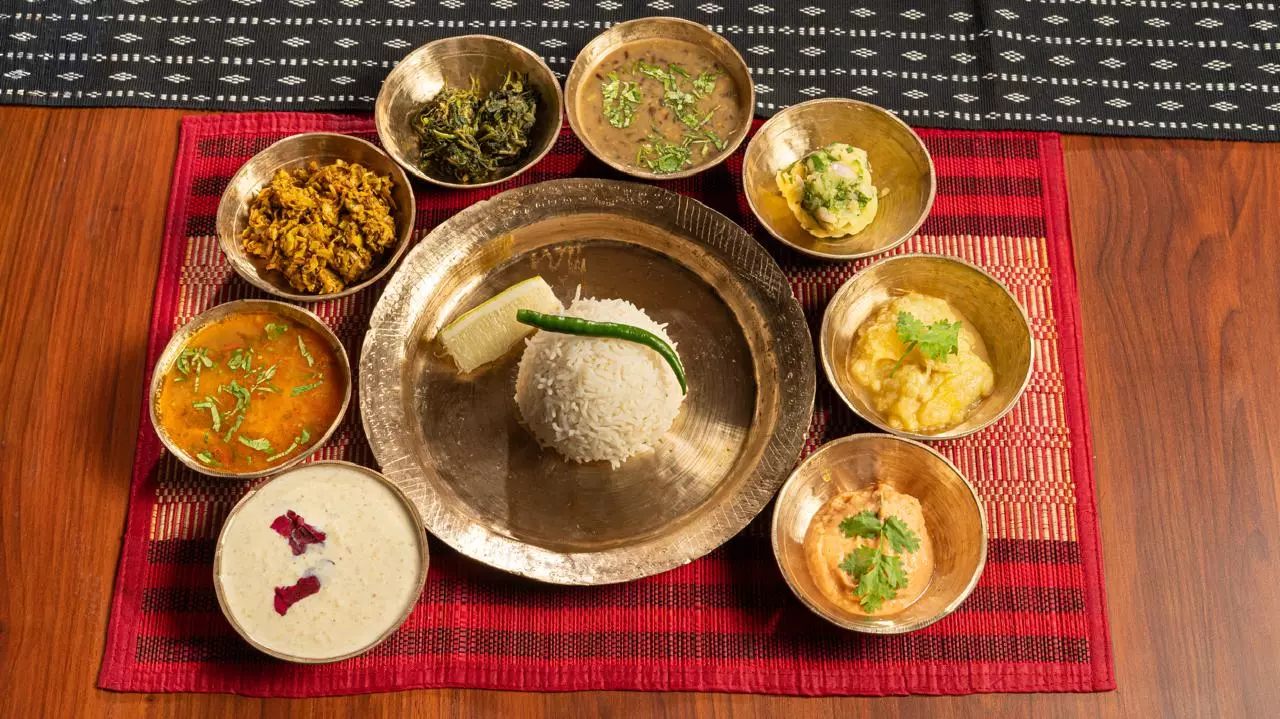
That commitment is visible on every plate. The meal begins the Assamese way with Khar, perhaps the state’s most distinctive dish. Made using an alkaline extract prepared from the ash of raw papaya, it is traditionally served at the start of a meal.
“Khar is always our first course,” Alpaxee explains. “We believe it cleanses the gut. We prepare it with vegetables, and sometimes with fish head for non-vegetarians.”
The meal then moves through saag, vegetables, dal and finally ends with Tenga, the signature tangy curry that concludes a traditional Assamese lunch.
“We always end with Tenga. Chicken comes before that, but every Assamese meal finishes with a fish or vegetable Tenga,” she says.
Even the simplest accompaniments carry cultural significance. Every plate arrives with a green chilli, garlic and Assam’s fragrant kaji nemu. “We squeeze lemon over almost everything,” she says.
The menu celebrates ingredients rarely seen in mainstream Indian restaurants. Bamboo shoots flavoured delicate chicken, fish and pork broths. Sesame finds its way into chicken preparations. Banana stem, banana flower and even banana peel are transformed into comforting dishes. Vegetarian favourites include banana stem curry, saag, Labra Torkari and vegetable Tenga with lentil dumplings.
One of the standout dishes is the humble Aloo Bhujiya, proof that comfort food rarely needs embellishment. The banana stem curry is equally memorable, while the Khar offers an introduction to a culinary tradition that feels entirely unfamiliar yet deeply comforting.
River fish remains central to the menu. “We deliberately use only river fish because Assam is shaped by the Brahmaputra. We want to stay true to that,” says the founder.
Guests frequently ask for Hyderbad’s familiar favourites such as biryani, but Alpaxee has chosen not to compromise. “There isn’t really a biryani equivalent in Assamese cuisine. We have created a bamboo shoot fried rice, but otherwise we want people to experience our food as it is.”
Desserts, too, remain rooted in tradition. Slow-cooked rice pudding made with white and black rice shares space with Patishapta Pitha (a traditional sweet crepe filled with coconut and jaggery), each prepared patiently.
The experience begins even before the first bite, with a welcome drink made from Thekera, a tangy fruit often described as Assam’s answer to kokum. Aakhol is not one of those places which attempts to reinvent or recreate Assamese cuisine or mould it to suit unfamiliar palates. Instead, it gives diners a chance to discover a food culture exactly as it has been enjoyed for generations.
For Alpaxee, that has always been the idea. “I am trying to keep it as authentic as possible,” she says. “Even today I don’t have rotis or naans on the menu because we are a rice-eating state. I want people to experience Assamese food the way we eat it at home,” she signs off.
