Tunisian Opposition Warns of Democracy’s ‘Death Knell’

13 Dec 2025 8:22 PM IST13 Dec 2025 8:22 PM IST
Rights groups have condemned the trial as politically motivated.
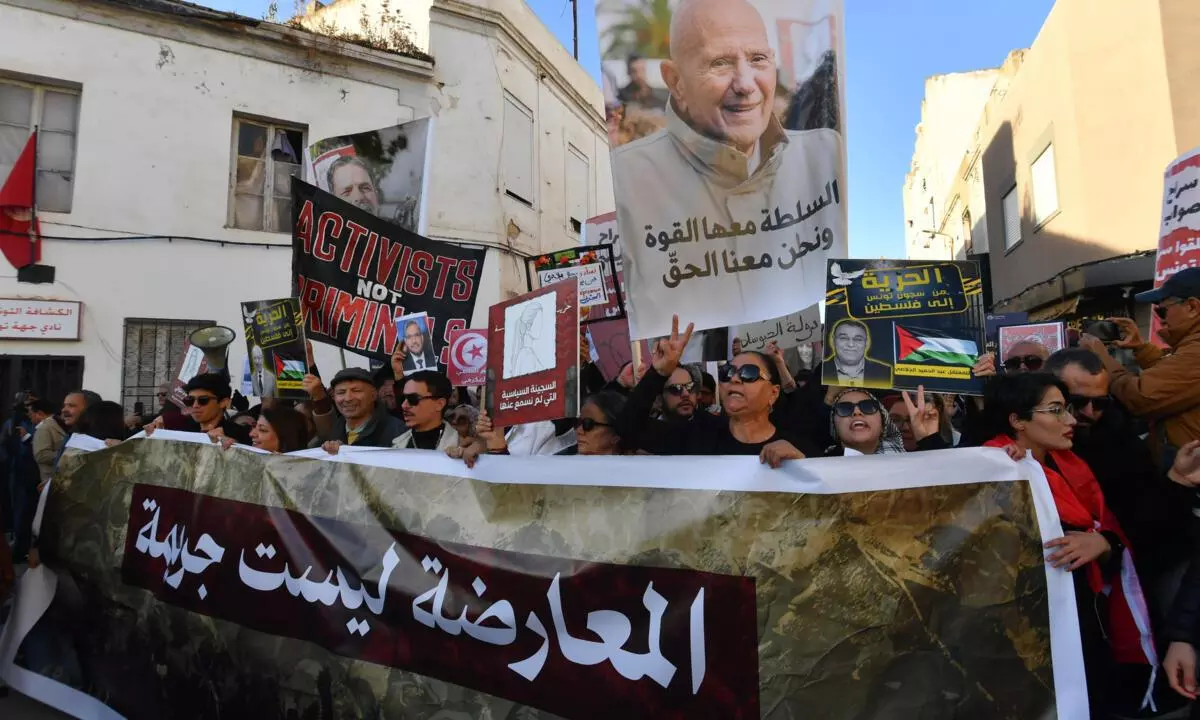
Hundreds of people demonstrated in Tunis against the government © FETHI BELAID / AFP
Paris: Fifteen years after an uprising toppled Tunisia's autocratic leader and sparked the Arab Spring, analysts say the current president is burying democracy by jailing opponents and suing activists and lawyers.
Kais Saied was elected in a landslide victory in 2019, riding a wave of disaffection at the lack of political and economic progress following the revolution.
However, two years later he staged a power grab and later began a rollback of freedoms.
"Unfortunately, we have gone from a dysfunctional democracy to an equally dysfunctional authoritarian regime," Hamza Meddeb, a fellow at the Carnegie Middle East Center, told AFP.
Meddeb himself was sentenced in absentia to 33 years in prison on charges of conspiracy against state security in a mass appeal trial last month that upheld hefty sentences handed down to some 40 public figures.
Rights groups have condemned the trial as politically motivated.
Three of those convicted were immediately arrested, among them Ahmed Nejib Chebbi, the 81-year-old co-founder of the National Salvation Front, Tunisia's main opposition coalition.
His daughter Haifa Chebbi posted on Facebook that the 12-year jail term "amounts to a death sentence".
The two others, lawyer Ayachi Hammami and poet Chaima Issa, said they had begun a hunger strike.
The opposition has accused Saied of wanting to stifle dissent. The president has said he does not interfere in judicial matters.
In recent years, Saied has branded detained political opponents and humanitarian workers "terrorists" and "traitors" respectively.
Democratic 'chapter' ends
Most of the main opposition figures in Tunisia -- whether from the left or right -- have either been detained or have fled abroad.
Among those behind bars is Rached Ghannouchi, the 84-year-old leader of the Islamist-inspired Ennahdha party and a staunch critic of Saied.
Exiled under former president Zine El Abidine Ben Ali, Ghannouchi returned to Tunisia after the 2011 revolution toppled the longtime ruler.
Ennahdha played a key role in national politics for years afterwards before Ghannouchi was hit with multiple prison terms, including a 22-year sentence for plotting against state security.
Another main opposition figure, Abir Moussi, head of the Free Destourian Party, was sentenced to an additional 12 years in prison on Friday under a law criminalising any "attack aimed at changing the form of government".
Journalist Zied Krichen said that "while the democratic transition began to collapse" with Saied's 2021 power grab, the latest convictions "undoubtedly sound the death knell for the 10-year experiment that followed the revolution".
"The Tunisian state is closing the chapter on the democratic transition," he wrote in the newspaper Al Maghreb, an independent daily founded after 2011.
Saied, 67, a former constitutional law professor, won his first term democratically in 2019 with more than 70 percent of the vote.
He ran as an independent candidate and drew support from widespread public exasperation at the political and economic deadlock that gripped the country after Ben Ali's overthrow.
When Saied sacked the prime minister and suspended parliament in 2021, thousands of Tunisians fed up with what they said were government failures took to the streets in celebration.
'Selective' repression
But Saied then followed up with a series of moves including a new constitution that gave his office unlimited powers and neutered the legislature.
He was re-elected in 2024 with more than 90 percent of votes -- yet turnout was low at below 30 percent.
"The person who was supposed to provide answers has failed" and "the problems have gotten worse", said Meddeb.
The recent release of lawyer and writer Sonia Dahmani and Tunisian Refugee Council head Mustapha Djemali -- convicted respectively of spreading false news and facilitating the illegal entry of migrants -- could have signalled a detente.
"Not at all," said Meddeb, adding that the government is simply "backing off a bit in order to regroup".
He believes the latest jailings are evidence of a more "selective" repression phase in which judicial cases "that target the political opposition" are the priority.
The historically divided opposition has tried to present a united front, with one recent meeting bringing together representatives of groups at opposite ends of the political spectrum.
There are also regular demonstrations, including one planned for Saturday, but these struggle to attract people from outside the activist circle.
( Source : AFP )

Next Story