How Trump’s 100% Movie Tariff Could Rewrite Box Office Math

30 Sept 2025 9:22 AM IST30 Sept 2025 9:22 AM IST
The American box office has seen a worrying slump in sales over the last few years, not to mention cuts in domestic film production. At the same time, foreign governments have aggressively wooed Hollywood filmmakers with lucrative incentives, pulling several big scale productions away from the country.
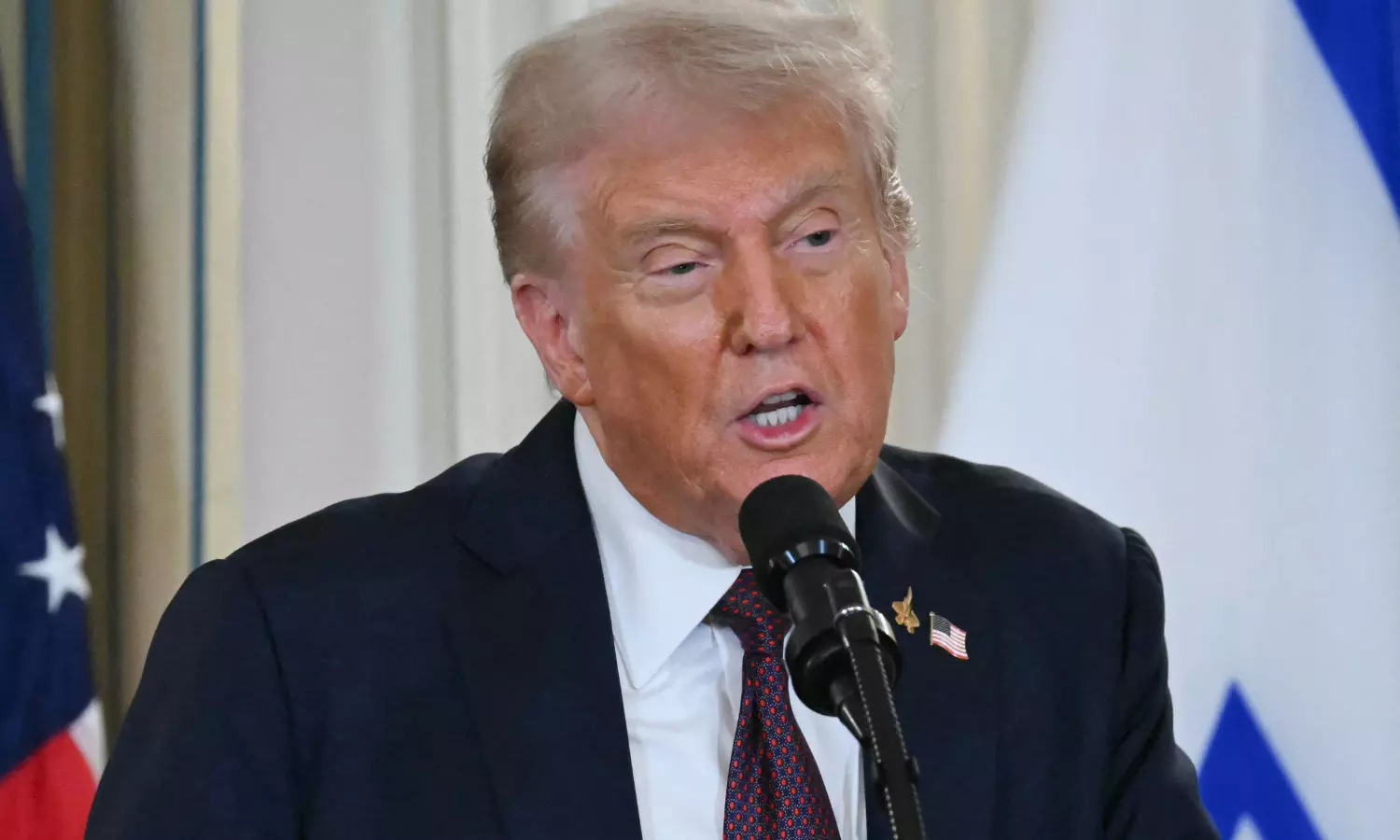
US President Donald Trump speaks during a press conference with Israeli Prime Minister Benjamin Netanyahu in the State Dining Room of the White House in Washington, DC on September 29, 2025. Gaza residents would not be forcibly displaced and President Donald Trump would head a transitional body under a peace plan released publicly Monday by the White House. (Photo by ANDREW CABALLERO-REYNOLDS / AFP)
In a development that has shook Hollywood and beyond, U.S. President Donald Trump announced a sweeping 100% tariff on all movies made outside of the US. His decision, announced via a post on his Truth Social account, marks the administration’s latest attempt to protect domestic industries it claims are under siege from international competition.
“Our movie making business has been stolen from the United States of America, by other Countries, just like stealing ‘candy from a baby,’” Trump declared. “California, with its weak and incompetent Governor, has been particularly hard hit! Therefore, in order to solve this long time, never ending problem, I will be imposing a 100% Tariff on any and all movies that are made outside of the United States. MAKE AMERICA GREAT AGAIN!” read the statement of the US President.
The move, which Trump has long hinted at, is aimed at reviving what he calls a “dying” U.S. movie industry.
The American box office has seen a worrying slump in sales over the last few years, not to mention cuts in domestic film production. At the same time, foreign governments have aggressively wooed Hollywood filmmakers with lucrative incentives, pulling several big scale productions away from the country.
It may be recalled that in May 2025, Trump issued a warning, calling out the U.K., Australia, and Canada for what he called “unfair practices” in wooing filmmakers. The U.S. Commerce Department had been asked to draw up tariff proposals to prevent business from going out.
Canada has been one of the hot favourites for Hollywood filmmakers, offering up to a 35% refundable tax credit on labour costs, coupled with skilled crews and world-class studios. Vancouver, for instance, was the backdrop for the blockbuster ‘Deadpool’. The U.K. too offered a 25% tax rebate, attracting films like ‘The Batman’, and the ‘Harry Potter’ franchise. Other countries—including Spain, Italy, Georgia, and New Zealand—too have stepped up with similar attractive packages.
Trump’s tariff is a threat to the global film business. While designed to boost domestic production, the policy could have unintended ripple effects across international markets.
Indian films, which have enjoyed significant success in the U.S., may be most hit. Director S.S. Rajamouli’s ‘Baahubali’ collected a whopping $8.46 million in the U.S., with its sequel grossing nearly $20 million. More recently, Bollywood blockbusters like ‘Pathaan’ and ‘Jawan’ too have delivered strong numbers at the U.S. box office. A punitive tariff such as this, could drastically eat into the profits of such big ticket movies.
The tariffs on foreign films could also rob the U.S. audiences of diverse content, given the increased costs for distributors and exhibitors. Besides, retaliatory measures by other countries could also stifle international box office revenues—a market they rely on heavily to recoup production budgets.
However, key questions remain unanswered now: How exactly will the tariff be applied? Will it be based on box office revenues, distribution rights, or some other mechanism? And how quickly can U.S. producers realistically scale up to fill the content gap if foreign films retreat?
( Source : Deccan Chronicle )

Next Story