Modi's first visit to China since Galwan clash; India-China ties on the mend
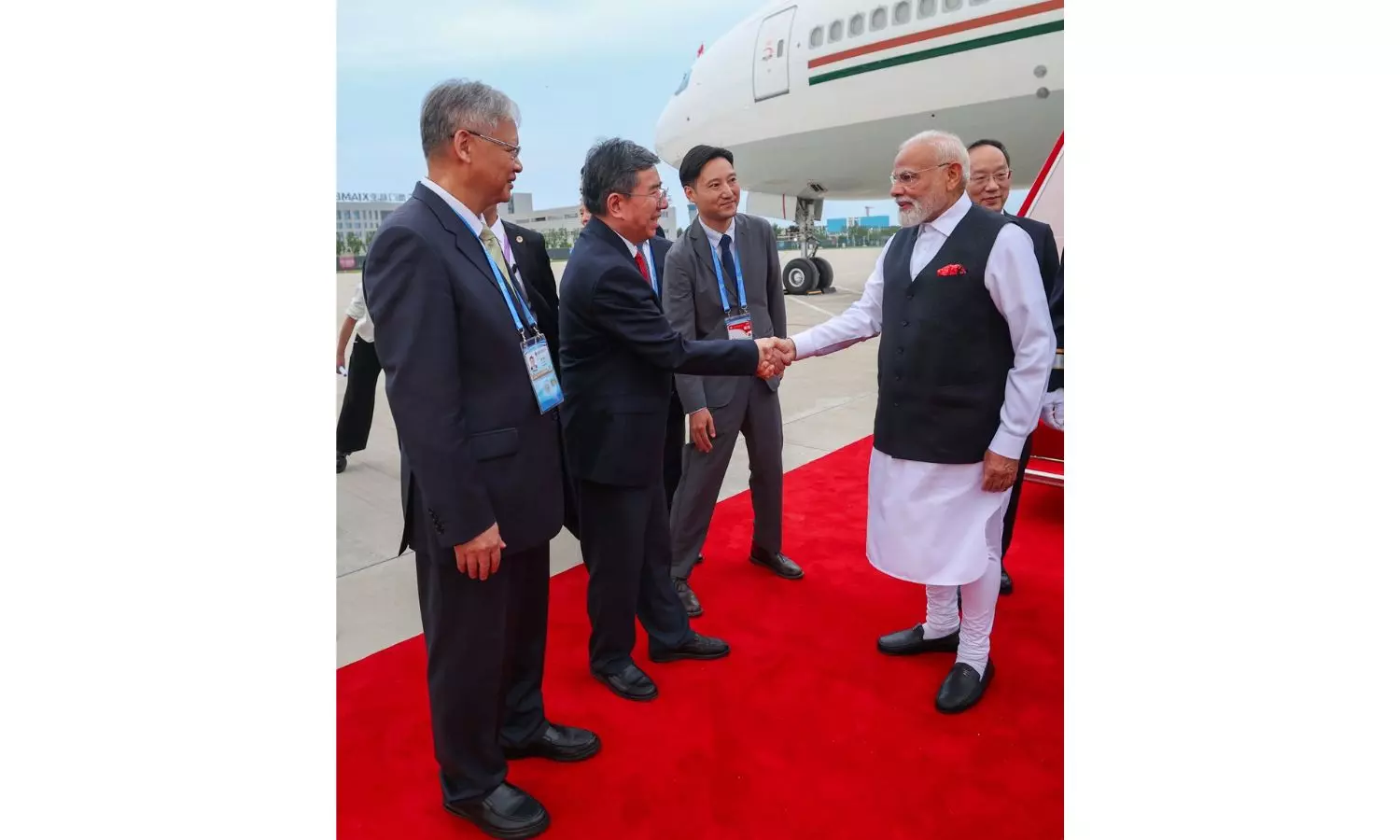
New Delhi: Prime Minister Narendra Modi landed at the Chinese port city of Tianjin from the Japanese capital, Tokyo, on Saturday evening to a “warm welcome” and is scheduled to hold an important 40-minute-long bilateral meeting with Chinese President Xi Jinping on Sunday morning. Ahead of the Shanghai Cooperation Organisation (SCO) summit on Monday, Modi will also attend a welcome banquet hosted by Xi on Sunday evening for the heads of state and government of the SCO member nations, including Pakistani PM Shehbaz Sharif.
“Landed in Tianjin, China. Looking forward to the deliberations at the SCO summit and meeting various world leaders,” Modi posted on X, adding that the Indian community in Tianjin had accorded him a “very special welcome”. The Prime Minister is visiting China after a gap of seven years.
Amid trade tensions with the United States, the Prime Minister will hold a bilateral meeting with Russian President Vladimir Putin on Monday in the Chinese port city of Tianjin, on the margins of the SCO summit on Monday.
During the Sunday meeting, Modi and Xi are expected to discuss the growing trajectory of the rapidly improving bilateral relations and the recent measures to strengthen people-to-people exchanges as well as measures to maintain peace and tranquillity at the borders. The PM is also expected to strongly convey India's concerns on Pakistan-sponsored cross-border terrorism even as New Delhi is pushing for a strong SCO summit declaration on Monday that will adequately address New Delhi's concerns on this score. The SCO summit host, China, has been a long-time benefactor of Pakistan.
The bilateral meeting is also expected to send a strong message to the United States, which has imposed a 50 per cent tariff on India, half of which is a “penalty” for importing Russian oil.
On Friday, Modi in Tokyo told the Japanese media that “given the current volatility in the world economy, it is also important for India and China, as two major economies, to work together to bring stability to the world economic order”. He further said that “India is ready to advance bilateral relations from a strategic and long-term perspective on the basis of mutual respect, mutual interest and mutual sensitivity and to enhance strategic communication to address our developmental challenges”.
The Prime Minister had added: “Since my meeting with Mr Xi (in the Russian city of Kazan in October last year on the sidelines of the Brics summit) steady and positive progress has been made in our bilateral ties… Stable, predictable and amicable bilateral relations between India and China, the two largest nations on Earth, can have a positive impact on regional and global peace and prosperity. This is also crucial for a multipolar Asia and world.”
Following the bilateral meeting in Kazan last October between Modi and Xi, the two nations had announced a breakthrough in ties by inking a pact on military disengagement in Depsang and Demchok in the Ladakh sector after several rounds of talks at both the diplomatic and military level, which set the course for improvement of ties.
The bilateral meeting to be held between the Prime Minister and the Chinese President marks a major turnaround in ties between the two Asian giants. This also comes just days after the visit of Chinese foreign minister Wang Yi to New Delhi. China has also opposed the 50 per cent tariffs levied by the US on India and has termed the United States as a bully.
India's ties with China were strained since 2020 after Chinese troops amassed at the Line of Actual Control (LAC) in the Ladakh sector in April-May that year in violation of bilateral border pacts, leading to a clash between Indian and Chinese troops in the Galwan valley in June that year during which troops on both sides were killed. Mr Modi’s visit to China will be his first since the deadly Galwan valley clash in mid-June of 2020.
In an outcome document released jointly by India and China during the visit of Mr Wang to New Delhi, "both sides agreed to resume direct flight connectivity between Chinese mainland and India at the earliest and finalise an updated Air Services Agreement".
India and China agreed on the facilitation of visas to tourists, businesses, media and other visitors in both directions. Both sides also agreed to continue and further expand the scale of the Kailash Mansarovar pilgrimage to Tibet next year. Both sides had also “agreed to facilitate trade and investment flows between the two countries through concrete measures". The two Asian giants had also agreed on the resumption of border trade at three designated trading points — the Lipulekh Pass in Uttarakhand, the Shipki La Pass in Himachal Pradesh and the Nathu La Pass in Sikkim.
After the recent conclusion of the 24th round of the special representative (SR) talks on the boundary issue in New Delhi between national security adviser Ajit Doval and Mr Wang, India had said that both nations “decided to set up an expert group to explore early harvest in boundary delimitation in the India-China border areas.

