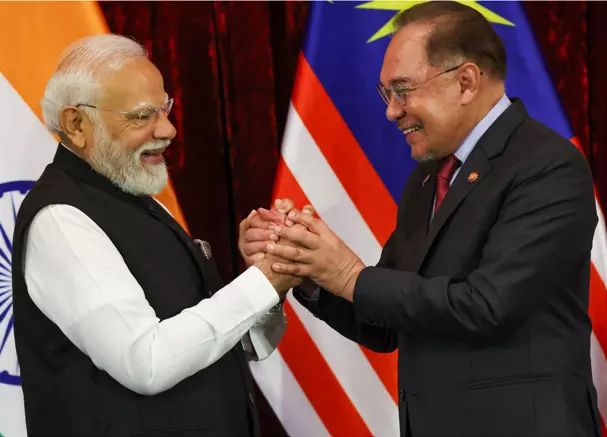
16 outcomes agreed between India and Malaysia
• 11 agreements signed.
• 5 announcements made.
• Key focus sectors: semiconductors, digital economy, AI, renewable energy, healthcare.
• Rupee–Ringgit settlement backed by RBI–Bank Negara Malaysia.
• UPI-PayNet link to expand digital payments and fintech cooperation
• Social Security Agreement to protect Indian workers in Malaysia.
• Malaysia joins International Big Cats Alliance (IBCA).
• OCI cards extended up to 6th generation Indian-origin Malaysians.
New Delhi: Prime Minister Narendra Modi and Malaysian Prime Minister Anwar Ibrahim held bilateral talks in Kuala Lumpur on Sunday, after which India and Malaysia agreed on 16 outcomes, including 11 agreements and five announcements, aimed at deepening cooperation across strategic and economic sectors.
Among the key pacts were agreements on cooperation in semiconductors, a social security arrangement for Indian citizens working in Malaysia, and cross-border payments. Both sides welcomed continued collaboration between the RBI and Bank Negara Malaysia to promote local currency settlement in bilateral trade using the Indian Rupee and Malaysian Ringgit.
The two leaders agreed to strengthen ties in defence and security, maritime cooperation, trade and investment, digital economy, science and technology, energy, agriculture, health, education, culture, tourism, youth exchanges and people-to-people contacts. India and Malaysia also announced the establishment of an Indian consulate in Kota Kinabalu, a Thiruvalluvar Centre at Universiti Malaya in Kuala Lumpur, and the institution of Thiruvalluvar Scholarships for Malaysian nationals.
A Security Cooperation agreement between the National Security Council Secretariat of India and Malaysia’s National Security Council was signed, along with a Framework Agreement on the International Big Cats Alliance, which Malaysia joined after completing formalities.
On trade, Prime Minister Modi called for an early review of the Asean-India Trade in Goods Agreement to make it more relevant and trade-facilitative. According to a joint statement, he highlighted India’s position as a key investment destination for Malaysian companies, while Prime Minister Anwar Ibrahim welcomed the role of Indian manufacturing and technology firms in generating high-skilled employment in Malaysia.
Both leaders strongly condemned terrorism “in all its forms and manifestations, including cross-border terrorism”. Prime Minister Modi thanked his Malaysian counterpart for condemning the Pahalgam terror attack and the Red Fort blast last year and called for continued cooperation in counter-terrorism, stating, “Our message on terrorism is clear: No double standards. No compromise.”
In remarks seen as a signal on regional security, the two leaders reaffirmed their commitment to freedom of navigation and overflight under international law, including the United Nations Convention on the Law of the Sea, and urged peaceful resolution of disputes. They encouraged expanding maritime cooperation through regular deployments and naval exercises and reiterated support for Asean centrality and stability in the Indo-Pacific.
Addressing the media, Prime Minister Anwar Ibrahim praised India’s “spectacular rise” and described India and Malaysia as “true friends”. He also commended Prime Minister Modi’s efforts towards peace in West Asia and the Russia-Ukraine conflict and welcomed closer cooperation in local currency trade and education.
Modi said Malaysia was the destination of his first overseas visit of 2026 and highlighted the historical and cultural bonds between the two nations, noting that Malaysia hosts the second-largest population of people of Indian origin globally. He said recent agreements on social security, digital payments through UPI, and e-visas would ease mobility and strengthen ties. He also underlined the shared cultural bond through the Tamil language and welcomed cooperation in audio-visual production.
Additional agreements signed covered health, disaster management, combating corruption, audio-visual co-production, technical and vocational education, and UN peacekeeping. The leaders welcomed progress under the bilateral Digital Council and an agreement between UPI and PayNet to expand fintech cooperation.
Modi also met members of the Indian diaspora in Malaysia, including veterans of Netaji Subhas Chandra Bose’s Indian National Army, and held interactions with leading Malaysian industry figures. India recently replenished the Indian Scholarships Trust Fund with RM 3 million and extended OCI card eligibility up to the sixth generation for people of Indian origin in Malaysia.
Both sides agreed to enhance trade facilitation and expand cooperation in sectors including semiconductors, digital economy and advanced manufacturing. They emphasised effective utilisation of the Malaysia-India Comprehensive Economic Cooperation Agreement and welcomed the convening of the 10th India-Malaysia CEO Forum in Kuala Lumpur.
The two leaders also reviewed cooperation between academic and research institutions, including IIT Madras and Malaysian semiconductor institutes, and exchanged views on regional and global issues, including global governance reforms and the India-Asean partnership.