Jaishankar Meets Xi Jinping, Discusses India-China Ties

The external affairs minister landed in China on Monday on a two-day visit to attend a conclave of the Shanghai Cooperation Organisation (SCO).
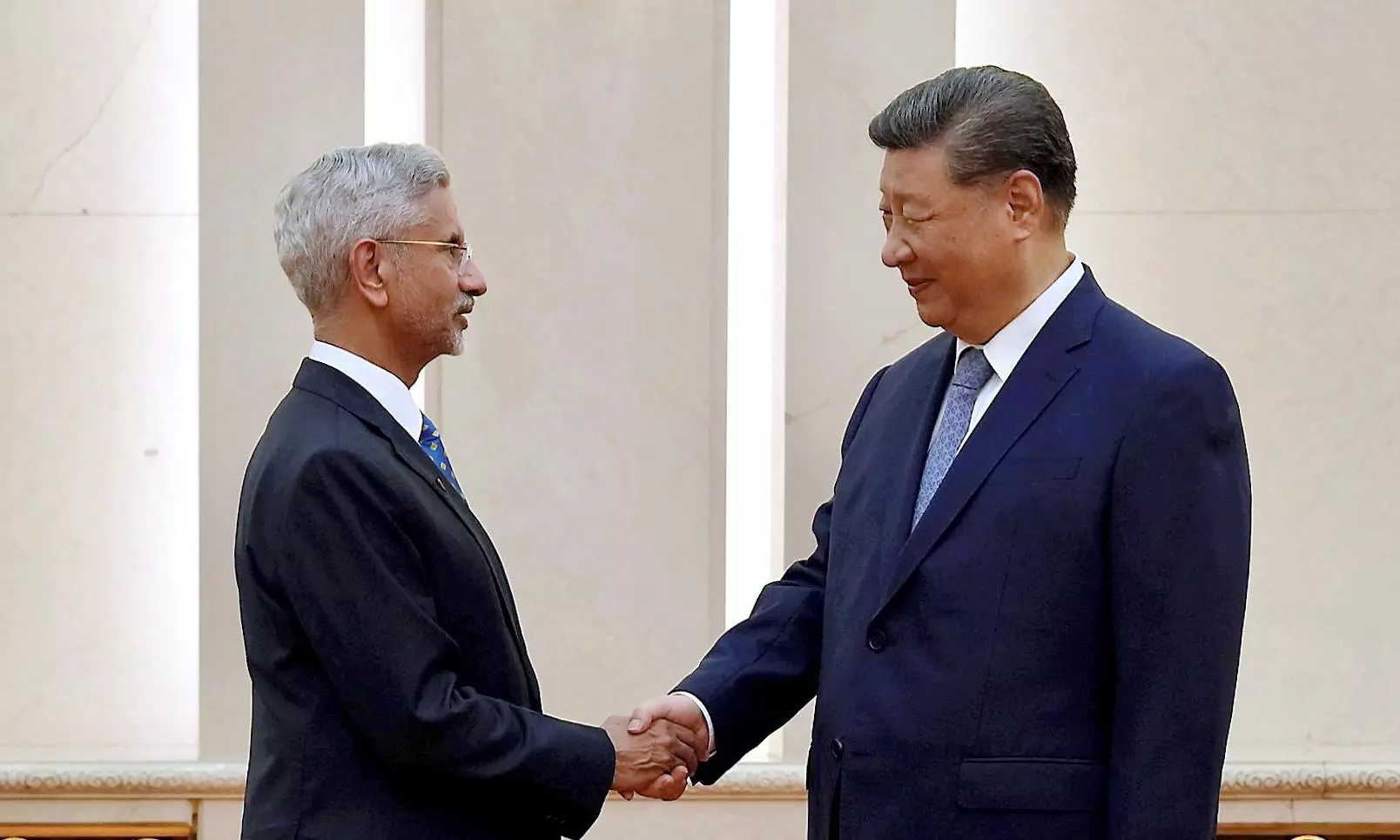
New Delhi: Slamming fellow SCO member nation Pakistan without mentioning it at the Shanghai Cooperation Organisation (SCO) foreign ministers’ meeting in the Chinese port city of Tianjin on Tuesday, external affairs minister S. Jaishankar raised the terrorist attack in Pahalgam in April this year and said it was "deliberately conducted" and India will continue its punitive measures against terror to bring the perpetrators to justice. Earlier, Mr Jaishankar, along with the foreign ministers of participating SCO nations, called on Chinese President Xi Jinping.
Sources late on Tuesday evening said there was no joint statement issued by the member nations at the end of the meeting at Tianjin since the SCO foreign ministers’ meetings have not done so for the past many years.
According to Chinese media reports, the meeting “served as a political preparation for the SCO summit, set to be held in Tianjin August 31 - September 1, and a series of resolutions and official documents were also signed”.
The foreign ministers are understood to have worked on the agenda for the summit that is expected to be attended by the heads of government/state of the SCO member nations, including Prime Minister Narendra Modi.
A press statement was issued after the meeting by the SCO that stated that “during the meeting, the parties exchanged views on key areas of cooperation among SCO member states under the new situation and international and regional hot issues, discussed the current situation and prospects of SCO cooperation in the political, economic, trade, cultural and other fields and the key directions for improving the SCO's work”.
It added that “the parties focused on discussing the preparations for the outcomes of the SCO heads of state council meeting to be held in Tianjin this fall, reviewed the Tianjin Declaration, relevant heads of state council statements and other summit outcome documents and resolutions, and decided to continue discussing relevant documents on this basis”.
Pointing out that the SCO was founded to combat terrorism, separatism and extremism, the foreign minister said it is “imperative that the SCO remain true to its founding objectives and take an uncompromising position" against the three evils.
Referring to the Pahalgam terror attack, Mr Jaishankar said it was "deliberately conducted to undermine the tourism economy of Jammu and Kashmir while sowing a religious divide”. Justifying Operation Sindoor, which was launched in May, he said India had “done exactly” what the UN Security Council (UNSC) had mandated to bring those responsible to justice and added that India “will continue doing so”.
“Recently, we in India witnessed a graphic example in the terrorist attack in Pahalgam on April 22. It was deliberately conducted to undermine the tourism economy of Jammu and Kashmir, while sowing a religious divide. The UN Security Council, of which some of us are currently members, issued a statement that condemned it in the strongest terms and ‘underlined the need to hold perpetrators, organisers, financiers and sponsors of this reprehensible act of terrorism accountable and bring them to justice’. We have since done exactly that and will continue doing so,”
Mr Jaishankar said.
In another veiled jab at Pakistan for blocking use of its territory for trade and connectivity from India to Afghanistan and Central Asia and taking a dig at China over the China-Pakistan Economic Corridor (CPEC) that passes through Pakistan-occupied Kashmir (PoK), the foreign minister pointed out that “it is essential that such cooperation be based on mutual respect, sovereign equality and in accordance with the territorial integrity and sovereignty of member states”.
Mr Jaishankar said: “Deepening collaboration within the SCO naturally requires more trade, investment and exchanges. For that to move to the next level, it is imperative that we address some current issues. One of them is the lack of assured transit within the SCO space. Its absence undermines the seriousness of advocating cooperation in economic areas.”
The SCO comprises nine member nations — India, Russia, China, Pakistan, Iran, Tajikistan, Uzbekistan, Kazakhstan and Kyrgyzstan. Belarus is slated to join as the 10th member of the SCO, which is seen by many observers as a China-Russia-led bloc. The SCO meeting is hosted by Chinese foreign minister Wang Yi and is attended by Pakistani deputy prime minister and foreign minister Ishaq Dar.
Earlier in the day, the participating foreign ministers, including Mr Jaishankar, called on the Chinese President. Soon after the meeting, the foreign minister posted on X, “Called on President Xi Jinping this morning in Beijing along with my fellow SCO foreign ministers. Conveyed the greetings of President Droupadi Murmu & Prime Minister Narendra Modi. Apprised President Xi of the recent development of our bilateral ties. Value the guidance of our leaders in that regard.”
On the sidelines of the meeting, the foreign minister also held important bilateral meetings with foreign ministers of Russia, Sergey Lavrov, and Iran, Seyed Abbas Araghchi.
In his remarks at the SCO meeting, Mr Jaishankar said, “India has taken several initiatives in the SCO in domains ranging from startup and innovation to traditional medicine and digital public infrastructure… Deepening collaboration within the SCO naturally requires more trade, investment and exchanges. For that to move to the next level, it is imperative that we address some current issues. One of them is the lack of assured transit within the SCO space...”
The foreign minister pointed out: “We meet at a time of considerable disorder in the international system. In the last few years, we have seen more conflicts, competition and coercion. Economic instability is also visibly on the rise. The challenge before us is to stabilise the global order, de-risk various dimensions, and, through it all, address longstanding challenges that threaten our collective interests.
Mr Jaishankar added: "Afghanistan has been long on the SCO agenda. The compulsions of regional stability are buttressed by our longstanding concern for the well-being of the Afghan people. The international community, particularly SCO members, must therefore step up with development assistance. India, for its part, will certainly do so…"
