Navigational Rights Must Not Be Subject to Coercion, Threats: India Tells UNSC

He said disruptions had implications across the world, particularly for energy and food security.
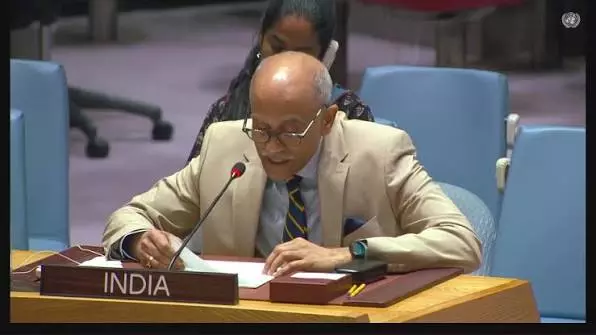
United Nations: India has told a United Nations Security Council meeting that navigational rights must not be subjected to coercion, threats, unlawful restrictions or arbitrary interference, stressing that maritime insecurity has consequences far beyond the immediate threat.
“Recent disruptions to significant global maritime routes have underlined a fundamental reality: the security of maritime routes is vital to international peace, security and global prosperity,” India’s Permanent Representative to the UN, Ambassador Harish Parvathaneni, said.
He said disruptions had implications across the world, particularly for energy and food security.
Addressing an Arria-formula meeting of the Security Council on “Safe Seas, Shared Security: Protecting Freedom of Navigation in an Evolving Security Environment” on Thursday, Parvathaneni also called for coordinated frameworks to evacuate seafarers from conflict zones, with clearly defined responsibilities for states and international organisations.
Against the backdrop of the continuing US-Israel conflict with Iran and disruptions around the Strait of Hormuz, he said recent events had demonstrated the wider consequences of maritime insecurity.
“Disruptions at one chokepoint can increase pressure on alternative routes, raise freight and insurance costs, disrupt energy and food supplies and adversely affect developing countries,” he said.
Parvathaneni said the international community must move beyond responding to individual incidents and devise practical arrangements to maintain the movement of essential commercial and humanitarian supplies during crises.
“The objective should not merely be to restore navigation after a crisis, but to build a maritime system capable of withstanding shocks before they cascade into wider economic and humanitarian crises,” he said.
India reaffirmed its support for a free, open, secure and rules-based maritime domain.
“Rights and freedoms of navigation and overflight should be consistent with international law, including the United Nations Convention on the Law of the Sea, and must be fully respected. Commercial vessels must not become targets of geopolitical tensions,” Parvathaneni said.
Referring to attacks on seafarers during the conflict and the deaths of several Indian crew members, he said their safety must remain at the centre of international efforts.
Their evacuation, medical care, crew changes and repatriation required effective contingency planning and international cooperation, he said.
Parvathaneni called on countries with major interests in the safety of shipping and seafarers to work together.
He said India also recognised the growing threat posed by unmanned systems, cyberattacks and interference with navigation and communications. International cooperation, capacity-building and the responsible use of technology would be crucial to addressing these challenges, he added.
