To double bilateral trade to $200 bn by 2032
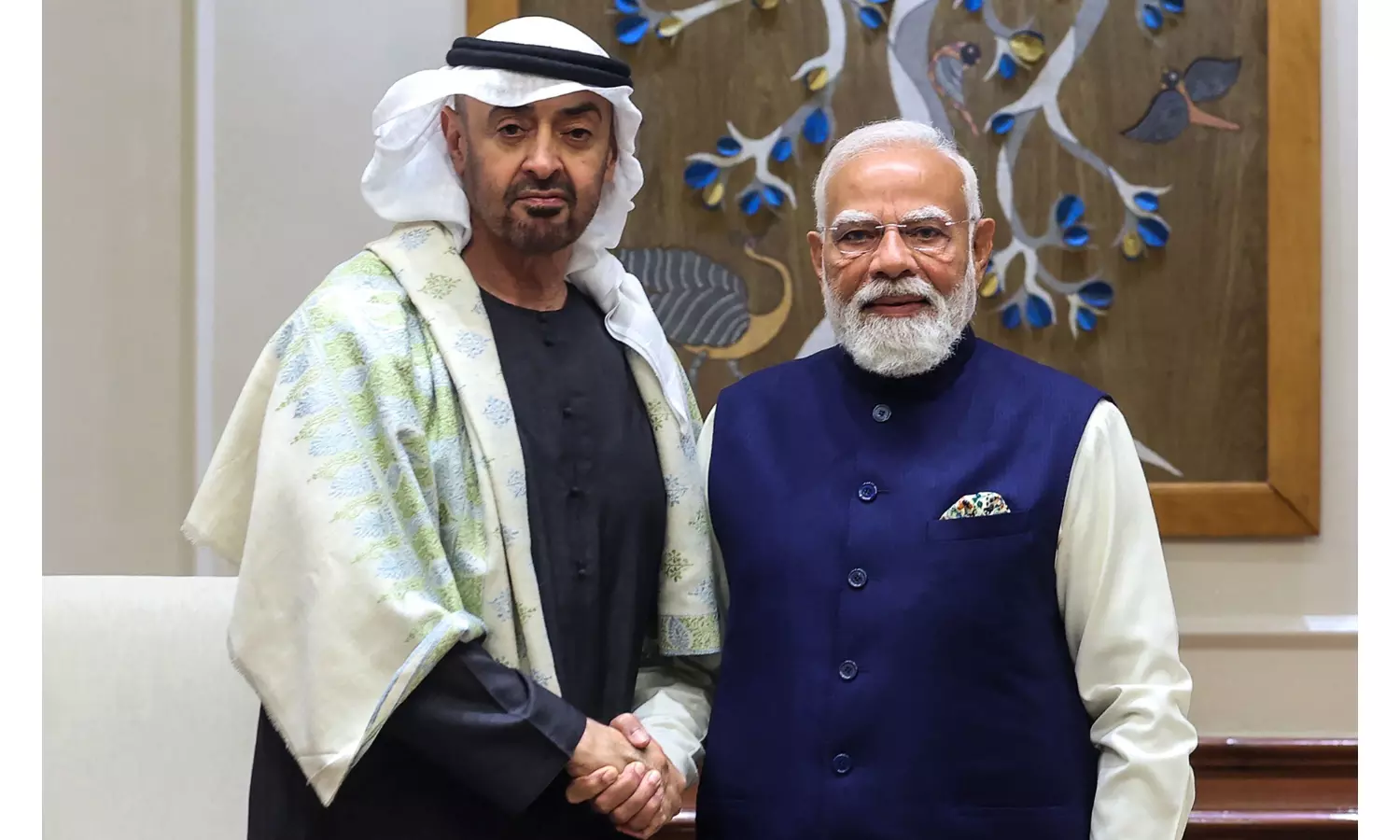
This handout photograph taken and released by the Indian Press Information Bureau (PIB) on January 19, 2026 shows UAE President Sheikh Mohamed bin Zayed al-Nahyan (L) shaking hands with India's Prime Minister Narendra Modi during their meeting in New Delhi. (Photo by PIB / AFP)
New Delhi: Prime Minister Narendra Modi on Monday evening held talks at his residence in New Delhi with United Arab Emirates President Sheikh Mohamed bin Zayed Al Nahyan. The three-and-a-half hours visit culminated in seven major announcements and the signing of five key agreements, significantly expanding the India-UAE Comprehensive Strategic Partnership.
Among the pacts was a Letter of Intent for a Strategic Defence Partnership, envisaging a framework agreement covering defence industrial collaboration, defence innovation and advanced technologies.
The announcements included civil nuclear cooperation covering large reactors and small modular reactors, a commitment to double bilateral trade to $200 billion by 2032, establishment of a supercomputing cluster in India, creation of digital and data embassies for strategic data storage, and the setting up of a "House of India" as a cultural initiative in Abu Dhabi.
Another agreement provided for the long-term purchase of 0.5 million metric tonnes of liquefied natural gas (LNG) annually for 10 years starting in 2028, with the UAE already being India's second-largest LNG supplier. Other agreements included cooperation in space infrastructure development, investment collaboration, and UAE participation in developing the Special Investment Region at Dholera in Gujarat, encompassing a port, airport and a maintenance, repair and overhaul (MRO) facility. An agriculture-related pact aims to promote exports of rice, food and other agricultural products from India to the UAE, benefiting Indian farmers while contributing to the UAE's food security.
It was also announced that First Abu Dhabi Bank will open a branch in Gujarat's GIFT City, while DP World will operate from GIFT City, including ship-leasing for its global operations. The two leaders directed their teams to work towards interlinking national payment platforms to enable faster, efficient and cost-effective cross-border payments.
In a special gesture, Prime Minister Modi personally received the UAE President at the airport, and the two leaders travelled together to the Prime Minister's residence for talks held in restricted and delegation-level formats. Senior ministers and members of the royal families of Abu Dhabi and Dubai accompanied the UAE President. "Went to the airport to welcome my brother, His Highness Sheikh Mohamed bin Zayed Al Nahyan… His visit illustrates the importance he attaches to a strong India-UAE friendship," the Prime Minister said in a post on X.
Foreign secretary Vikram Misri said the short state visit, lasting about, produced substantive outcomes. The leaders also discussed global issues, including developments related to Gaza and Iran.
The Strategic Defence Partnership was described as a natural evolution of bilateral defence ties, with cooperation to expand across areas such as defence manufacturing, training, special operations, cyber security, counter-terrorism and interoperability. The Joint Statement reiterated mutual respect for sovereignty and territorial integrity and strongly condemned terrorism in all its forms, including cross-border terrorism, stressing that no country should provide safe haven to terrorists.
The Dholera investment partnership will include development of an international airport, pilot training school, MRO facility, greenfield port, smart urban township, rail connectivity and energy infrastructure. The space cooperation pact envisages joint launch complexes, manufacturing zones, incubation centres, training institutes and exchange programmes, aimed at creating an integrated India-UAE space ecosystem. Civil nuclear cooperation will build on India's SHANTI Act, focusing on advanced reactor technologies, nuclear plant operations and safety.
The leaders welcomed robust growth in trade since the signing of the Comprehensive Economic Partnership Agreement in 2022, noting that bilateral trade touched $100 billion in FY 2024-25. They agreed to double trade to $200 billion by 2032 and reaffirmed their commitment to the India-Middle East-Europe Economic Corridor, describing it as strategically important for enhancing commerce and energy flows.
( Source : Deccan Chronicle )


Next Story