India, Mauritius to Promote Bilateral Trade in Local Currencies: PM Modi

The prime minister said that a free, open, secure, stable and prosperous Indian Ocean is a shared priority of both India and Mauritius.
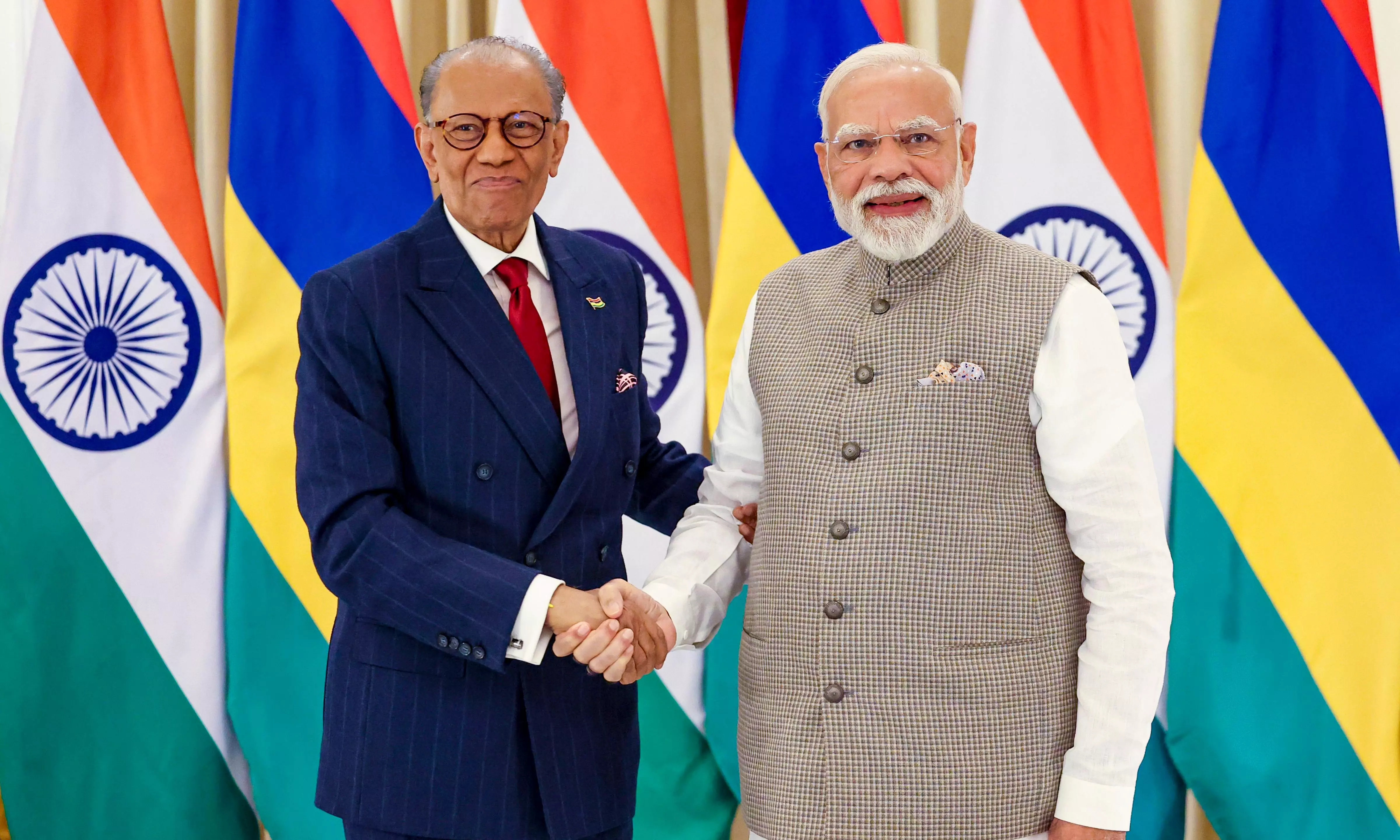
New Delhi:India unveiled an over $680 million special economic package for Mauritius after Prime Minister Narendra Modi held talks with the PM of the Indian Ocean nation Navinchandra Ramgoolam in his Lok Sabha constituency of Varanasi on Thursday. The two nations also inked seven pacts to further expand bilateral ties in several critical sectors.
Hailing Mauritius as “family”, Mr Modi said that “India and Mauritius are two nations, but our dreams and destiny are one”. “Mauritius is a key part of India’s Neighbourhood First policy,” he said, adding that during the talks all areas of cooperation were discussed in detail and views were also exchanged on regional and global matters.
The Prime Minister pointed out that last year, UPI and RuPay cards were launched in Mauritius and said, “We will work towards enabling trade in local currencies.”
Mr. Ramgoolam brought up the discussions with India regarding the double taxation avoidance treaty, expressing his belief that the treaty has room for improvement. He spoke about “shared values, common vision and enduring friendship” with India and thanked India for its “generous assistance and expertise” in several fields. He said bilateral ties have entered a “more dynamic and forward-looking phase”.
Commenting on the special economic package, Mr Modi said, “India takes pride in being a trusted primary partner in Mauritius’ development. Today, we have announced a special economic package designed to support Mauritius’ needs and priorities. This will strengthen infrastructure, create new employment opportunities, and further enhance healthcare facilities… This package is not an assistance. It is an investment in our shared future.”
One segment of the SEP is the development assistance projects undertaken completely on a grant basis of $215 million that will comprise the New Sir Seewoosagur Ramgoolam National Hospital, an Ayush Centre of Excellence, a veterinary school and animal hospital and a “provision of helicopters”.
The second segment comprises India-assisted projects to be undertaken on a grant cum line of credit (LoC) basis that will be upwards of $440 million that includes “completion of construction work of new ATC tower at SSR International Airport, development of motorway M4, development of Ring Road Phase II and acquisition of port equipment by CHCL in the Indian Ocean nation.
Apart from all of this, India will also assist in two “strategic” projects—redevelopment and restructuring of the port in Mauritius and assistance in development and surveillance of the Chagos Marine Protected Area. The two nations also decided in principle that India will “extend budgetary assistance of $25 million in the current financial year to Mauritius.
Terming the conclusion of the Chagos Agreement between Britain and Mauritius in May this year a “historic milestone”, Mr Modi pointed out that “India has always supported decolonisation and the full recognition of Mauritius’ sovereignty”.
"A free, open, secure, stable, and prosperous Indian Ocean is our shared priority. In this context, India remains fully committed to strengthening the security of Mauritius’s Exclusive Economic Zone (EEZ) and enhancing its maritime capacity. India has always stood as the first responder and a net security provider in the Indian Ocean region,” the Prime Minister said.
At a special briefing later, foreign secretary Vikram Misri pointed out that following the Chagos pact, the EEZ of Mauritius had expanded “manifold”. He added that India is the “preferred partner” for Mauritius for strengthening its EEZ security in the face of threats such as piracy, drug trafficking and illegal fishing. The refitting of the Mauritius Coast Guard ship is being undertaken in India, where 120 Mauritius Coast Guard officers are also being trained.
The Mauritius Prime Minister said that his country is looking to India for assistance in improving the entire structure of training of the police forces in his country. He said India’s timely support to Mauritius in several domains has given “tangible outcomes” that have improved living standards in his country.
In a reference to the movement of indentured labour largely from northern India to Mauritius during the British Raj, Mr Modi said, “When we are welcoming friends from Mauritius in Kashi (as Varanasi is also referred to), it is not just a formality but a spiritual union. That is why I proudly say that India and Mauritius are not just partners but a family… It is a matter of pride for me to welcome you (Mr Ramgoolam) to my parliamentary constituency. Kashi has always been a symbol of India’s civilisation and cultural heritage.”
Other pacts inked on Thursday included ones on science and technology, training of civil servants, the power sector and space.
Terming energy security as an important pillar of India-Mauritius partnership, Mr Modi said, “The comprehensive partnership agreement concluded in the field of energy will further strengthen this cooperation. We have also decided to extend support in the establishment of a 17.5 MW floating solar power plant at Tamarind Falls.”
On the “long-standing partnership in the field of human resource development”, the Prime Minister added, “More than 5,000 citizens of Mauritius have already received training in India. During my visit in March, it was decided to provide training to 500 civil servants. I am very pleased to note that the first batch is currently undergoing training in Mussoorie.”
“This year, we are commemorating the 125th birth anniversary of Sir Seewoosagur Ramgoolam. He is not only the Father of the Nation of Mauritius but also the founding architect of the enduring bridge between India and Mauritius. His anniversary will continue to inspire us to work together to take our relationship to greater heights,” the Prime Minister said.
Mr Ramgoolam is on an eight-day visit to the country that started earlier this week on Tuesday when he visited Mumbai for meetings with business leaders and captains of industry. After Varanasi, he will also visit the Ram temple in Ayodhya and then head southwards to visit the famous Tirupati temple. After that he will visit Delhi, where he will call on President Droupadi Murmu.
Asked about the significance of Varanasi being the site for bilateral talks and not New Delhi, the foreign secretary said the Prime Minister is keen to take diplomacy and foreign affairs out of the national capital and to other cities across the country.
