Tens of Thousands Join Spain Nationwide Strike Over Housing Costs

12 Nov 2026 6:53 AM IST12 Nov 2026 6:53 AM IST
Braving heavy rain, tens of thousands of demonstrators marched through central Madrid carrying placards shaped like houses
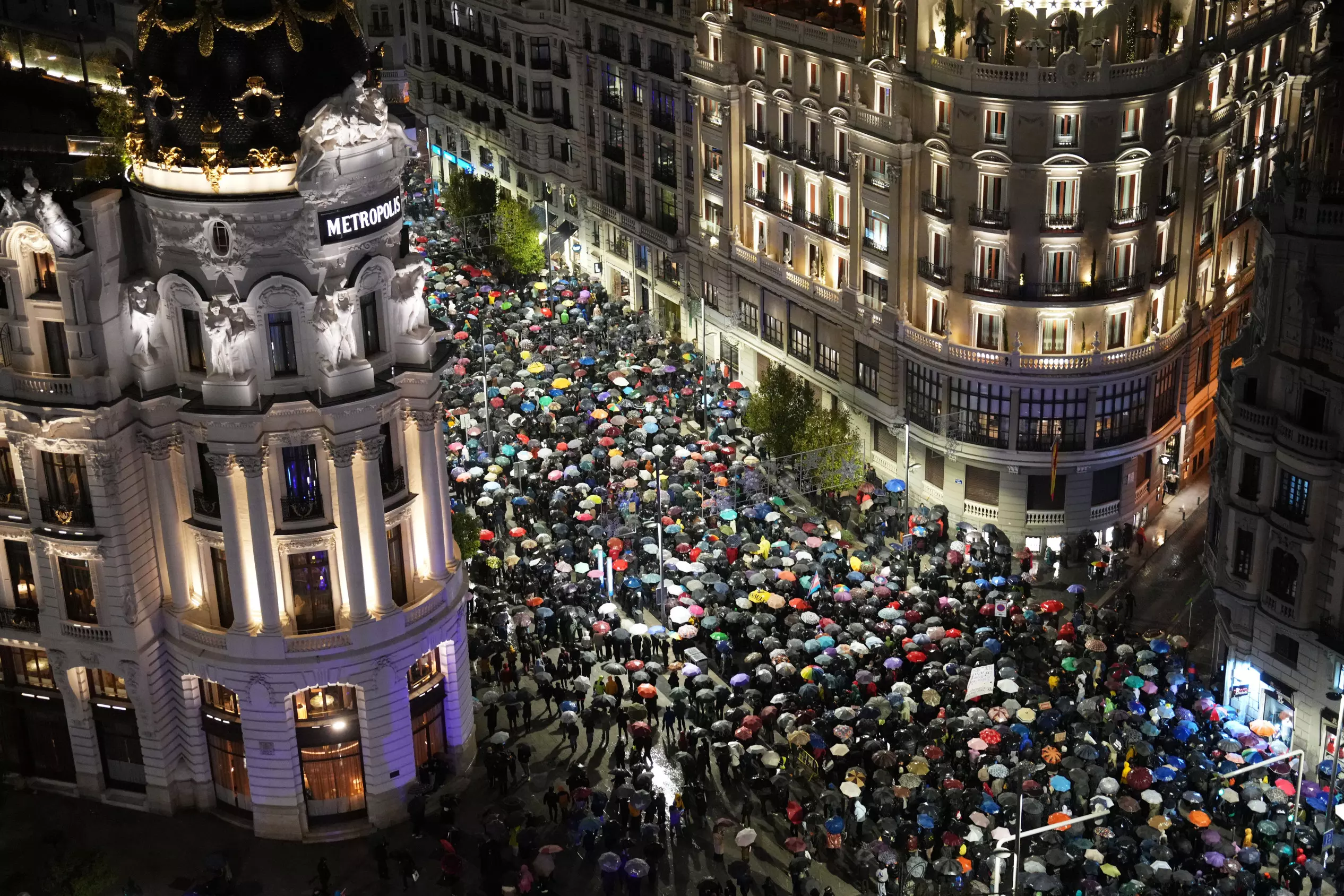
Protestors march through central Madrid during a nationwide general strike in Spain. (AP Photo/Francisco Seco)
MADRID: Tens of thousands of protesters marched across Spain on Wednesday during a general strike over housing affordability and purchasing power just weeks before an early general election.
Unions reported a significant response in some sectors in Spain's first nationwide 24-hour stoppage since 2012, but business leaders played down the participation.
Braving heavy rain, tens of thousands of demonstrators marched through central Madrid carrying placards shaped like houses and chanting "We have no home" as they called for more affordable housing.
"People work a lot and it isn't enough to pay the rent, to pay for a house," Paula Diaz, a 25-year-old theatre technician who lives with her parents, told AFP at the Madrid protest.
"I hope a government that benefits us comes to power, especially the working class," she added.
In Barcelona, where the authorities estimated 55,000 people marched through the city's luxury Passeig de Gracia commercial thoroughfare, Maria Pinana told AFP "the law of supply and demand does not apply to housing".
"The price of rents should be regulated," said the 34-year-old microbiologist, who lives with three friends in a flat where parts of the roof have collapsed.
Protests were held in other cities across Spain, including Bilbao, Valencia and Zaragoza.
The size of the demonstrations will be seen as an indicator of public discontent before the snap election, which the right-wing opposition is predicted to win.
- 'Failure' -
In Madrid, where many shops opened as normal, demonstrators earlier on Wednesday blocked some roads, picket action that was replicated across the country.
Public transport suffered disruption even with the implementation of minimum service requirements for commuter trains, metros and buses, especially in and around Barcelona.
In contrast, Madrid's metro reported that 93 percent of its trains ran in the early morning, although passenger numbers were down by around half.
UGT union leader Pepe Alvarez told public broadcaster RTVE that the participation was "massive", with a "total" stoppage in some regions making the strike "a huge success".
But his union acknowledged participation was "uneven", with large mobilisation in the car manufacturing, petrochemicals and meat sectors and in coastal regions.
The CEOE organisation, which represents business leaders, called the strike "a failure", adding in a statement that activity had gone ahead normally in most sectors.
Electricity demand had fallen by around five percent, "significantly lower" than in previous strikes, the CEOE said.
- 'New cycle' -
The main UGT and CCOO unions called the strike following a wave of nationwide protests over access to housing, sparked by the eviction in September of an 87-year-old Madrid pensioner.
Valeria Racu, spokeswoman for the Madrid Tenants' Union which has been at the forefront of protests for weeks, vowed to "put an end to the housing business in this country".
"A new cycle is beginning with trade unionism and conflict at its centre. This day of strikes has been a resounding success," she said.
Socialist Prime Minister Pedro Sanchez called the election, initially scheduled for 2027, after his minority government failed to secure parliamentary approval for a package of housing measures proposed in response to the demonstrations.
Business groups and the right have rejected the strike, seeing it as an election-related gambit rather than a genuine labour dispute.
But the unions have insisted the strike is directed against all levels of the state and not only the right, which voted down the government's housing decrees.
They have defended the walkout as an exceptional measure intended to generate broad social pressure for action on soaring housing costs.
Living costs are another major concern, with inflation hitting 4.9 percent in September and October -- its highest level in more than three years.
Isabel Iglesias, a nurse who lives in Madrid, said housing was the issue "that is affecting me the most". She pays a rent of 1,000 euros ($1,100) with her partner but earns just 1,700 euros a month.
Iglesias, 27, said Sanchez, who has been in power since 2018, "could have done much more" on housing, urging the next government "to listen to everyone and get their act together".
( Source : AFP )

Next Story