Australian PM: Islamic State Ideology Drove Bondi Beach Gunmen

16 Dec 2025 6:57 PM IST16 Dec 2025 6:57 PM IST
Sajid Akram and his son Naveed opened fire on people thronging the famous beach for the Jewish festival of Hanukkah, killing 15 people
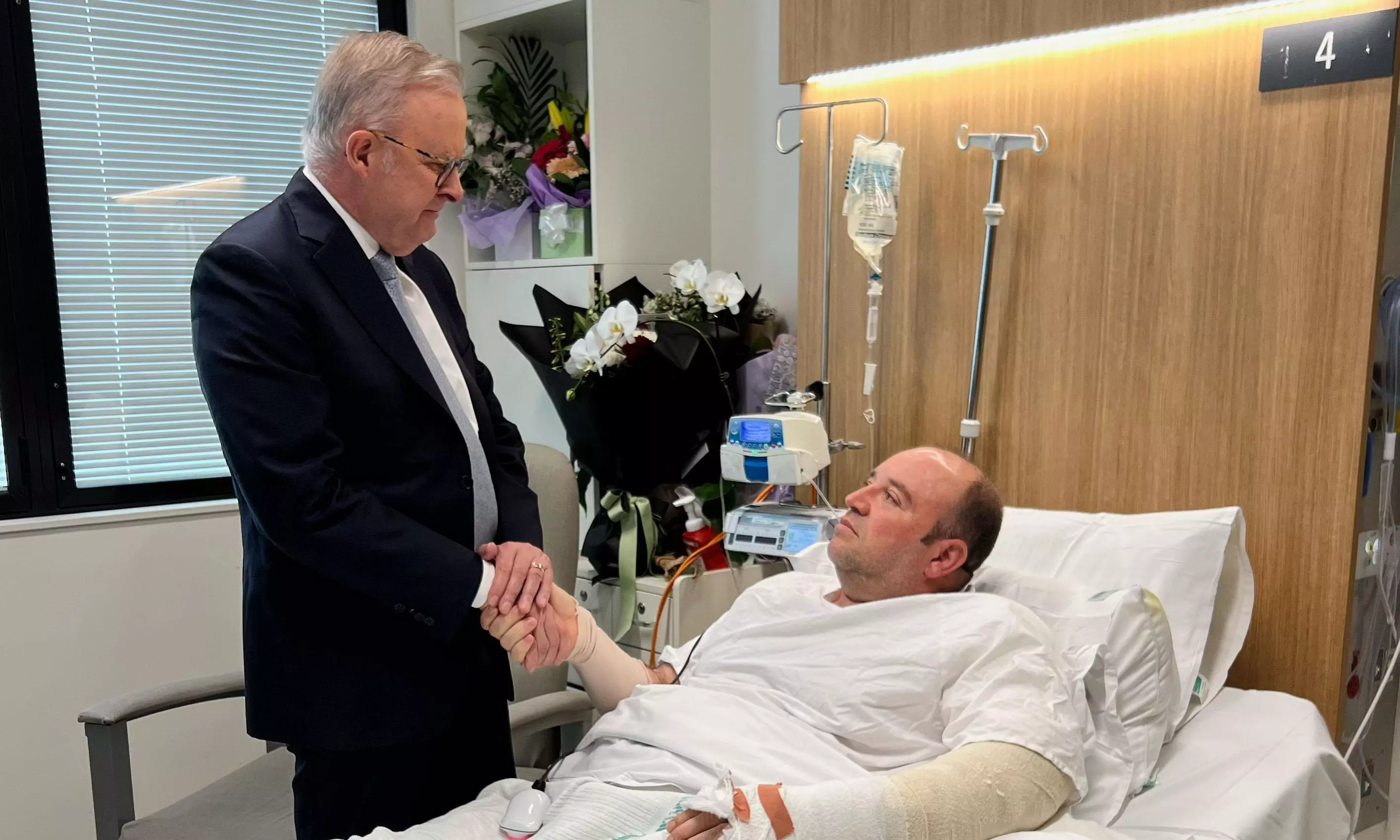
Australian Prime Minister Anthony Albanese meets Ahmed al Ahmed at St George Hospital in Sydney (Australian Prime Minister Office via AP)
SYDNEY: A father and son were driven by "Islamic State ideology" when they fired on crowds at Bondi Beach in one of Australia's deadliest mass shootings, Prime Minister Anthony Albanese said on Tuesday.
Sajid Akram and his son Naveed opened fire on people thronging the famous beach for the Jewish festival of Hanukkah on Sunday evening, killing 15 people and wounding dozens more.
Authorities said the attack was designed to sow panic among the nation's Jews, but have so far given little detail about the gunmen's deeper motivations.
Albanese gave one of the first hints that the pair had been radicalised by an "ideology of hate".
"It would appear that this was motivated by Islamic State ideology," Albanese told national broadcaster ABC.
The pair travelled to the Philippines before the shootings and authorities are investigating whether they met Islamist extremists during the trip, Australian media reported.
Manila's immigration department confirmed to AFP that the pair spent almost all of November in the Philippines, with their final destination listed as Davao.
The province, on the southern island of Mindanao, has a long history of Islamist insurgencies against central government rule.
Indian police said that Sajid was an Indian citizen, who had left his city of Hyderabad in the southern state of Telangana in 1998, saying in a statement that he had had "limited contact with his family" since.
His son Naveed is an Australian citizen, Indian police said.
Indian Foreign Minister Subrahmanyam Jaishankar, visiting Israel on Tuesday, offered his "very sincere, deep condolences" and said New Delhi condemns the attack "in the strongest possible terms".
- Authorities knew of attacker -
Police found a car registered to Naveed Akram parked near the beach, with improvised bombs and two "homemade" Islamic State group flags inside, New South Wales Police Commissioner Mal Lanyon said.
Authorities are also facing mounting questions over whether they could have acted earlier to foil the attack.
Albanese said Naveed Akram, reportedly an unemployed bricklayer, had come to the attention of Australia's intelligence agency in 2019 but was not considered an imminent threat at the time.
"They interviewed him, they interviewed his family members, they interviewed people around him," Albanese said.
"He was not seen at that time to be a person of interest."
Naveed reportedly told his mother on the day of the attack that he was heading out of the city on a fishing trip.
Instead, authorities believe that he was holed up in a rental apartment with his father.
Carrying long-barrelled guns, they peppered the beach and a nearby park with bullets for 10 minutes before police shot and killed 50-year-old Sajid.
Naveed, 24, remains in a coma in hospital under police guard.
- Stricter gun control? -
A 10-year-old girl and two Holocaust survivors were among those killed, while 42 others were rushed to hospital with gunshot wounds and other injuries.
Australia's leaders agreed on Monday to toughen laws that allowed father Sajid to own six guns.
Mass shootings have been rare in Australia since a lone gunman killed 35 people in the tourist town of Port Arthur in 1996.
That attack sparked a world-leading crackdown that included a gun buyback scheme and limits on semi-automatic weapons.
However, many Australians are now questioning whether those laws are equipped to deal with online sales and a steady rise in privately owned guns.
"This horrific situation now, it does make me personally feel that they need to be stricter," David Sovyer, 43, told AFP at Bondi Beach.
Retiree Allan McRae, 75, said that "not a lot of people need a gun".
"It would've reduced the possibility of it happening if more people had reduced access to a gun," he told AFP.
The attack has also revived allegations that Australia is dragging its feet in the fight against antisemitism.
"The last four years, I was very clear. And I was very clear about the dangers of the rise in antisemitism," Israel's ambassador to Australia, Amir Maimon, said while visiting a memorial to the victims on Tuesday.
Israeli Prime Minister Benjamin Netanyahu said Australia's decision to recognise Palestinian statehood this year had poured "oil on the fire of antisemitism".
Australians have lined up to give blood in record numbers, with more than 7,000 donors on Monday, according to Red Cross Australia.
A makeshift flower memorial next to Bondi Beach has grown, with mourners gathering to pay tribute to the victims.
( Source : AFP )

Next Story