The Türkiye-Pakistan Axis and India’s Geopolitical Response: A New South Asian Power Play

2 Jun 2025 4:25 PM IST2 Jun 2025 4:25 PM IST
By aligning with Pakistan, Türkiye risks alienating India, which is now engaging Ankara’s rivals with urgency.
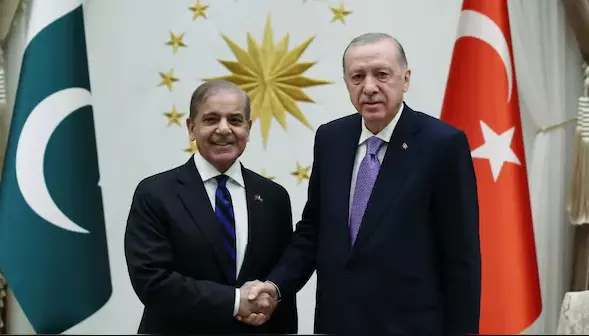
Türkiye president with Pakistan Prime Minister Shehbaz Sharif
Türkiye’s growing alignment with Pakistan has reshaped South Asian power dynamics. While India once sought pragmatic ties with Ankara, Türkiye’s deepening defense and ideological bonds with Islamabad have hardened New Delhi’s stance, prompting a strategic counterbalance.
A Calculated Alignment
Türkiye’s enthusiastic support for Pakistan, especially during India-Pakistan tensions, is evident. President Erdogan has condemned India’s revocation of Article 370 in Jammu and Kashmir and backed Pakistan at the UN. Reports of Turkish military supplies to Pakistan during sensitive times reinforce Türkiye’s partiality.
This support extends beyond symbolism. Türkiye and Pakistan conduct joint military exercises, collaborate on defense manufacturing, and share intelligence. Ankara is aiding Islamabad’s naval and drone capabilities, bolstering Pakistan’s regional presence.
For both nations, this partnership stems from post-Cold War isolation from Western defense systems. Türkiye faced reduced NATO aid after acquiring Russia’s S-400 missiles, while Pakistan’s terror-linked reputation and China tilt distanced it from Western contracts, making Ankara a key ally.
India-Türkiye: A Lost Opportunity?
India, pursuing strategic autonomy, once aimed to strengthen ties with Türkiye through trade, energy, and cultural diplomacy. However, Erdogan’s Kashmir remarks and anti-India panels with Pakistani groups strained relations. Despite India’s efforts to separate Türkiye’s Kashmir stance from bilateral ties, Ankara’s public positions, especially post-2019 Kashmir reorganization, fueled media wars and disinformation.
India’s Geostrategic Counter
India has responded by engaging Türkiye’s rivals—Greece, Cyprus, Armenia, and Israel. Naval cooperation with Greece has expanded to defense talks, while India has deepened diplomatic ties with Cyprus on sovereignty and terrorism issues. Armenia, after the 2020 Nagorno-Karabakh war, became a key defense client, receiving India’s Pinaka rocket launchers, Akash missiles, and anti-tank projectiles—a symbolic move against Türkiye’s support for Azerbaijan.
These steps reflect India’s shift to a realist, interest-driven foreign policy.
India’s Shift: From Gujral Doctrine to ‘India First’
Under PM Modi, India’s foreign policy has moved from the Gujral Doctrine’s goodwill to an assertive “India First” approach, viewing India as a civilizational power with global interests. India’s retreat from SAARC, where Pakistan plays a spoiler, has allowed competitors like China, Türkiye, and the U.S. to fill the void. Türkiye’s influence in South Asia, via Pakistan and overtures to Bangladesh and the Maldives, underscores this shift.
This “securitized South Asia” threatens India’s role as the region’s stabilizer.
A New Great Game in South Asia?
Türkiye’s alignment with Pakistan, driven by shared post-colonial grievances and Western defense exclusion, is reshaping security dynamics. Erdogan’s ideological leadership finds a partner in Pakistan’s military. Meanwhile, Saudi Arabia and the UAE balance ties with India and Pakistan, unlike Türkiye’s clear stance. India counters by strengthening ties with Saudi Arabia, Iran, and Indonesia, alongside Indo-Pacific and Middle Eastern alliances like QUAD and I2U2.
Without a clear Türkiye policy beyond trade and disengagement, India risks losing regional and global influence.
What Lies Ahead?
Türkiye’s defense exports, drone diplomacy, and ideological alignment with Pakistan are unlikely to wane. India’s engagement with Türkiye’s rivals and firm stance on Kashmir suggest reconciliation is uncertain. New Delhi must view the Türkiye-Pakistan axis within a broader global realignment, where ideological blocs and defense alliances overshadow multilateralism.
The future of Türkiye-India relations hinges on finding pragmatic common ground. For now, South Asia remains a stage where Türkiye and India’s responses shape the subcontinent’s power dynamics.
Written by Hariom, University of Hyderabad, Intern.
( Source : Deccan Chronicle )

Next Story