After SC Snub, Trump Slaps 10% More, Exempts India

US President Strikes Back Supreme Court Invalidates His Powers to Tax
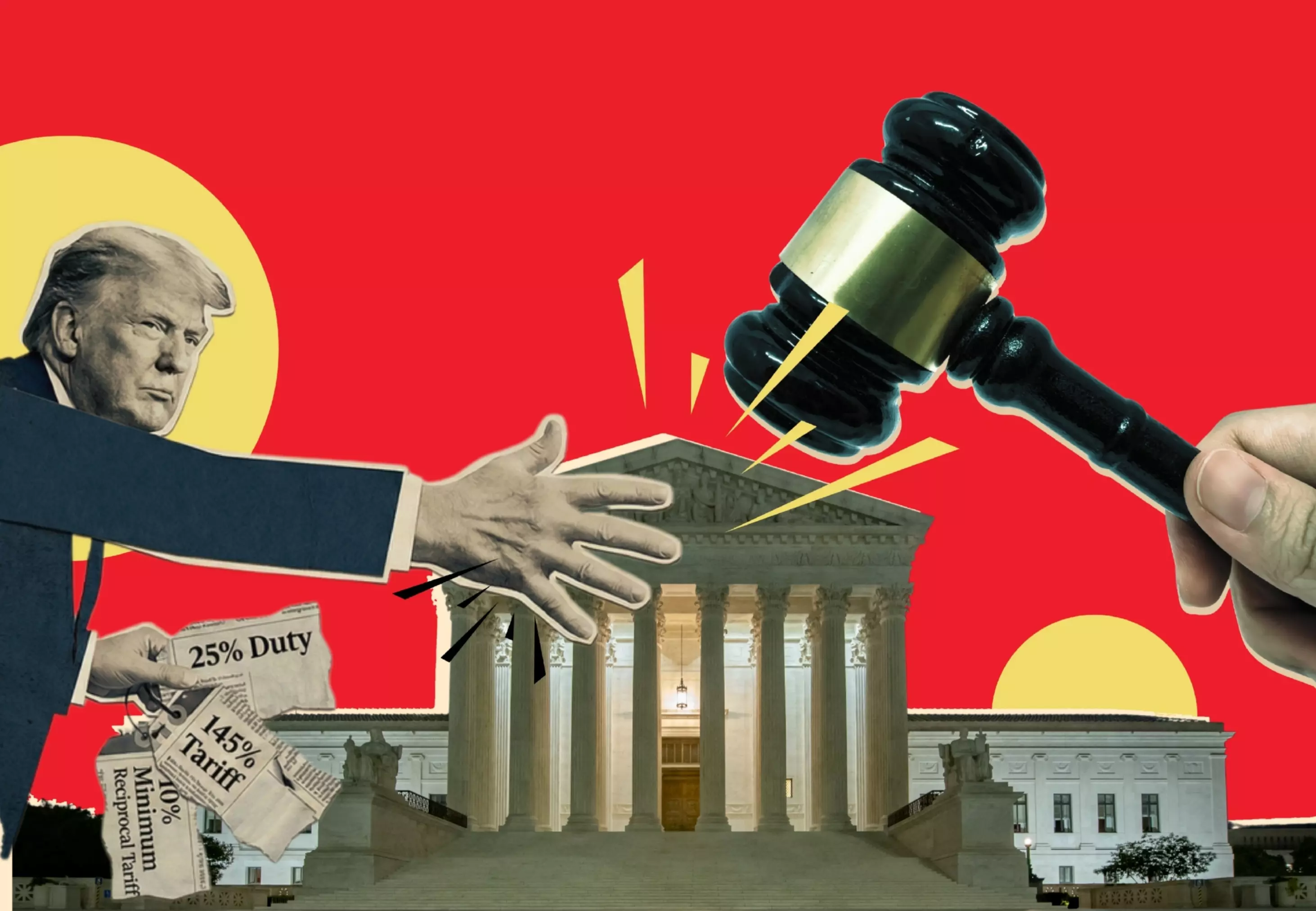
Washington: US President Donald Trump on Friday imposed an additional 10 per cent reciprocal tariffs on all countries after the US Supreme Court invalidated the imposition of tariffs from April 2, 2025, under emergency provisions of a 1977 law. India, he insisted, will continue to pay an 18 per cent tariff.
"Today, I will sign an order to impose a 10 per cent global tariff under Section 122, over and above our normal tariffs already being charged," Trump said, calling the US court judgment a disgrace. He also said all national security tariffs under a US law known as Section 301 would remain in place, and several investigations will be initiated.
Stating that tariffs were vital for US economic security and that the country would be defenceless and ruined without them, Trump said, "Foreign countries that have been ripping us off for years are ecstatic.. They're so happy, and they're dancing in the streets, but they won't be dancing for long that, I can assure you."
Asked about the impact of the Supreme Court verdict on the India-US trade deal that is in the works, Trump said there was no change in the trade deal with India and emphasised that the “India deal is on”.
"Nothing changes. They will be paying tariffs. We will not be paying tariffs… This is a reversal of what it used to be." He called Prime Minister Narendra Modi "a great gentleman, a great man". “But he (Modi) is much smarter than the people he was against in terms of the United States. He was ripping us off. So we made a deal with India, it is a fair deal and we are not paying tariffs to them. We did a little flip.”
“I think my relationship with India is fantastic and we're doing trade with India. India pulled out of Russia. India was getting its oil from Russia. And they pulled way back at my request, because we want to settle that horrible war where 25,000 people are dying every month,” Trump said.
He said his relationship with Prime Minister Narendra Modi “is, I would say, great.”
During the press conference, Trump also gave credit to his tariff powers for stopping a war between India and Pakistan - repeating a claim that India denied for the second time in 24 hours.
Earlier in the day, the US Supreme Court struck down Trump's global tariffs on Friday, upending his economic agenda that led to America imposing tariffs on almost all countries. The US has collected $133 billion in import taxes in "reciprocal tariffs" from countries in what was a centrepiece of Trump's election campaign.
Six out of the nine-judge bench of the US court, including two out of three appointed by Trump, found that it was unconstitutional for the US President to unilaterally set and change tariffs because the taxation power clearly belonged to the US Congress. "The framers (of the US Constitution) did not vest any part of the taxing power in the executive branch," Chief Justice John Roberts wrote.
While other US Presidents have used the law - the 1977 International Emergency Economic Powers Act - dozens of times, often to impose sanctions, Trump was the first to invoke it on import taxes. The law contains no mention of tariffs.
Trump in his defence had said the US trade deficit was so serious, it too qualified as an emergency, a contention the court dismissed.
In a minority, three judges held the tariff lawful. "The tariffs at issue here may or may not be wise policy. But as a matter of text, history, and precedent, they are clearly lawful," Justice Brett Kavanaugh wrote.
In his first reaction, Trump called the majority decision "a disgrace", after he was handed a note informing him of the Supreme Court decision during a private meeting with several US governors
The Supreme Court did not address whether the companies and individuals who paid those tariffs could be refunded. Many companies, including the big-box warehouse chain Costco, have lined up to demand refunds in lower courts.
Asked about the refund process for the tariff revenue, Trump at his press conference said the US could end up being in court "the next five years."
The Supreme Court decision doesn't stop Trump from imposing duties under other laws. While those have more limitations on the speed and severity of Trump's actions, top administration officials have said they expect to keep the tariff framework in place under other authorities.
While it wasn't immediately clear how the judgment might affect trade deals with other countries, the invalidation of Trump's sweeping tariffs could open floodgates of refund pleas. The court, however, did not address whether companies could get refunded for the billions they have collectively paid in tariffs.
The White House plans to use alternative laws to preserve its tariffs, but those policies will only prolong the debate and keep alive an issue that is largely unpopular with voters.
At various points during Trump's second term, at least seven senators from the president's party have voiced their concerns. Earlier this month, six House Republicans joined with Democrats to vote for a resolution against Trump's tariffs on Canada.
Trump has claimed that his tariffs were the difference between national prosperity and deep poverty, a pitch he made on Thursday night to voters in the swing state of Georgia.
The President used the word "tariff" 28 times in his speech on Thursday at a Georgia steel company, Coosa Steel, which credited the import taxes as making its products more competitive with goods from China. "Without tariffs, this country would be in such trouble right now," Trump charged.
India will continue to 18 per cent tariff, as per the trade deal, and the US will pay zero per cent.
India was slapped with 50 per cent tariffs under the emergency law in two tranches - a 25 per cent tariff as a reciprocal tariff and a 25 per cent tariff as a secondary tariff for India purchasing Russian oil.
After months-long negotiations, Trump reduced the reciprocal tariff on India recently to 18 per cent and ended the secondary tariff, citing India's commitment to lower its Russian oil purchases. The judgment will invalidate the 18 per cent tariff currently being levied on India. Trump insisted the tariff will continue but New Delhi would not have to pay the additional 10 per cent that he proposed. Tariffs on steel and other metals imposed under laws will continue.
Live Updates
- 20 Feb 2026 11:22 PM IST
Trump addresses press after Supreme Court strikes down his sweeping tariffs
The Supreme Court struck down President Donald Trump’s far-reaching global tariffs on Friday, handing him a significant loss on an issue crucial to his economic agenda.
The 6-3 decision centers on the tariffs Trump unilaterally imposed under an emergency powers law, including the sweeping “reciprocal” tariffs levied on nearly every other country.
It’s the first major piece of Trump’s broad agenda to come squarely before the nation’s highest court, which he helped shape with the appointments of three conservative jurists in his first term.
The majority found that the Constitution “very clearly” gives Congress the power to impose taxes, which include tariffs. “The Framers did not vest any part of the taxing power in the Executive Branch,” Chief Justice John Roberts wrote.
“The tariffs at issue here may or may not be wise policy. But as a matter of text, history, and precedent, they are clearly lawful,” Kavanaugh wrote in the dissent.
The Latest:
Democratic senator calls on Trump administration for tariff refund plan Friday’s Supreme Court decision did not address whether businesses could get refunded for the billions they have collectively paid in IEEPA tariffs imposed by Trump. U.S. Senator Maria Cantwell, a Democrat from Washington state, is asking Treasury Secretary Scott Bessent for a plan.
“Many American businesses, especially small and medium-sized businesses, have struggled to pay these illegal tariffs and, for some, the financial strain has placed them on the brink of bankruptcy,” Cantwell wrote in a letter published Friday addressed to Bessent. “It is essential Treasury implement an expeditious and transparent process to remediate the financial harm that resulted from these illegal tariffs.”
Trump to speak about tariff ruling White House press secretary Karoline Leavitt said on social media that the president would hold a news conference about the ruling at 12:45 p.m.
United Steelworkers union urges Congress to revamp the US trade system The United Steelworkers, the labor union whose members work at U.S. Steel and Cleveland-Cliffs plants, urged Congress to revamp the U.S. trade system by using tariffs “strategically.”
It said tariffs should be used to protect American workers, not to punish allies like Canada. It also called on Congress to restore funding to programs to help American workers who lose their jobs because of unfair foreign trade.
“It’s an excess of short-term thinking and free trade ideology that got us into this mess. Now, we need sustainable solutions,” the union said in a statement.
The U.S. steel industry has enjoyed a period of expansion under tariffs adopted by the Biden and Trump administrations, analysts say.
Behind the case is a nonprofit that typically allies with conservative causes. The Liberty Justice Center, which represented the businesses challenging Trump’s tariffs, is a libertarian-leaning public interest law firm with about $3 million on hand. Sara Albrecht, the group’s chairman, pledged to help small businesses navigate the refund process in a statement posted on X.
“The Liberty Justice Center’s work is just beginning,” she said.
The Supreme Court previously sided with the Liberty Justice Center in 2018 when the justices ruled that public-sector unions could not require non-member employees to pay collective bargaining fees. The group has also challenged “critical race theory” teachings in school districts and defended state school choice initiatives.
Among its donors are the Walton Family Foundation, the Republican Governors Public Policy Committee and the NRA Civil Rights Defense Fund. Other funders include the Club for Growth, an influential anti-tax group, and the State Policy Network, a conservative nonprofit coalition linked to Charles and David Koch.
Major technology trade groups hail the Supreme Court decision They predicted the decision will help minimize price increases and disruptions in the intricate supply chains for the computers, smartphones, televisions and other gadgets ingrained in modern life.
“Innovation thrives on predictability, and this common-sense decision brings much-needed clarity for American businesses and consumers,” said Gary Shapiro, CEO of the Consumer Technology Association, which represents more than 2,000 companies. “Now, the government must act quickly to refund retailers and importers without red tape or delay.”
The Computer & Communications Industry Association, which represents a spectrum of technology companies employing more than 1.6 million people, also expressed hope that the decision will ease the trade tensions that have been tormenting tech.
“This Supreme Court decision caps a year of turbulence in trade policy that we are all working to adapt to. With this decision behind us, we look forward to bringing more stability to trade policy,” said Jonathan McHale, the Computer & Communications Industry Association’s vice president for digital trade.
Tariff elimination on distilled spirits could provide needed certainty for American spirits exporters Chris Swonger, president and CEO of the Distilled Spirits Council urged the Trump administration to use the Supreme Court ruling as an opportunity to return to “zero-for-zero tariffs” on spirits products with major trading partners including the United Kingdom and European Union.
“The elimination of tariffs on distilled spirits would provide much needed certainty for American spirits exporters while helping ease financial pressures on bars, restaurants and retailers at a time when affordability remains a major concern for consumers.”
Soybean farmers hope Trump will refrain from imposing new tariffs on the things they need Soybean farmers hope that they might get some relief from rising costs as a result of Friday’s ruling. The price of fertilizer, seeds, pesticides and tractors and parts have been steadily increasing starting even before Trump’s tariffs.
American Soybean Association President Scott Metzger, who farms in Ohio, said farmers hope Congress and the administration will work to open additional markets for their crops.
“Moving forward, certainty and dependable market access are essential for U.S. soy to remain competitive globally. Because farmers are caught in a cost-price squeeze and ag input costs remain high, we urge the President to refrain from imposing tariffs on agricultural inputs using other authorities,” Metzger said.
Many Americans felt Trump had overstepped on tariffs: poll About 6 in 10 Americans said Trump had “gone too far” on imposing new tariffs on other countries, according to an AP-NORC poll from January .
About 9 in 10 Democrats and roughly 6 in 10 independents said Trump had overstepped, compared to 25% of Republicans.
The tariffs have been unpopular for much of Trump’s first year back in office. Roughly half of U.S. adults said they were opposed to imposing tariffs on all goods brought into the U.S. in an AP-NORC poll from last April. Only about 3 in 10 favored them, and roughly 2 in 10 were neutral.
Possibly more worrisome for a president elected on the promise of fixing Americans’ affordability concerns, 76% in the April poll thought Trump’s tariff policies would increase the cost of U.S. consumer goods.
Which of Trump’s tariffs are being struck down by the Supreme Court? Friday’s decision upends a core set of tariffs that Trump imposed using the 1977 International Emergency Economic Powers Act, or IEEPA. That includes the “Liberation Day” tariffs the president slapped on nearly every country in the world last spring — as well as and other IEEPA-based levies he imposed on Canada, Mexico and China. Trump also cited IEEPA to impose additional tariffs on Brazil over the trial of former President Jair Bolsonaro, and on India over its purchases of Russian oil.
Despite Friday’s ruling, other sweeping levies remain in place. Trump used another law — Section 232 of the 1962 Trade Expansion Act — to slap sectoral tariffs on steel and aluminum , cars , copper, lumber and products like kitchen cabinets worldwide. And the president has plenty of other options to keep taxing imports aggressively.
Trump still has other tariff options to tax imports President Trump still has options to keep taxing imports aggressively even after the Supreme Court struck down the tariffs he imposed last year on nearly every country on earth.
The Justices didn’t buy the president’s sweeping claims of authority to impose tariffs as he sees fit. But Trump can re-use tariff powers he deployed in his first term and can reach for others, including one that dates back to the Great Depression.
“It’s hard to see any pathway here where tariffs end,” said Georgetown trade law professor Kathleen Claussen. “I am pretty convinced he could rebuild the tariff landscape he has now using other authorities.”
- 20 Feb 2026 10:09 PM IST
SC ruling on Trump's tariffs: Judge refers to tariffs imposed on India for buying Russian oil in dissenting note
New York/Washington: As the US Supreme Court on Friday struck down President Donald Trump's sweeping tariffs, Justice Brett Kavanaugh referred to the tariffs imposed on India for Russian oil purchases in his dissenting opinion.Trump had imposed 25 per cent reciprocal tariffs on India and an additional 25 per cent punitive tariff for Delhi's purchases of Russian oil.
While he slashed the reciprocal tariffs to 18 per cent, the 25 per cent levies imposed for Russian oil purchases were removed, with Trump noting the commitment by India to stop directly or indirectly importing energy from Moscow and purchasing American energy products.
In a 6-3 vote on Friday, the judges found that the International Emergency Economic Powers Act (IEEPA) does not authorise the imposition of duties.
Justices Clarence Thomas, Samuel A. Alito Jr. and Kavanaugh dissented in the court's decision.
"As with tariffs on foreign imports historically, the IEEPA tariffs on foreign imports at issue in this case implicate foreign affairs. According to the Government, the President has leveraged the IEEPA tariffs into trade deals with major trading partners, including China, the United Kingdom, and Japan, among other countries.
"The Government says that the tariffs have helped make certain foreign markets more accessible to American businesses and have contributed to trade deals with foreign nations worth trillions of dollars," Kavanaugh wrote in his opinion in the case.
"Moreover, consistent with history and the traditional uses of tariffs, the President 'is exercising his IEEPA authority in connection with highly sensitive negotiations he is conducting to end the conflict between the Russian Federation and Ukraine'," he wrote.
"….To that end, on August 6, 2025, the President imposed tariffs on India for "directly or indirectly importing Russian Federation oil"... And on February 6, 2026, the President reduced the tariffs on India because, according to the Government, India had "committed to stop directly or indirectly importing Russian Federation oil."
"To be sure, most foreign affairs and national security actions -- whether war, international agreements, trade deals, or tariffs -- lead to significant domestic ramifications within the United States. And this case is no exception. Nonetheless, in the foreign affairs field, courts interpret statutes as written, with appropriate respect to Congress and the President and without a major questions doctrine weight on the scale against the President," he wrote. — PTI
- 20 Feb 2026 9:58 PM IST
Hats off to US Supreme Court for striking down Trump's tariff strategy: Congress
New Delhi: The Congress on Friday hailed the US Supreme Court decision striking down President Donald Trump's global tariffs and said the American system of checks and balances still seems to be working.In a post on X, Congress general secretary in-charge communications, Jairam Ramesh, said, "Hats off to the US Supreme Court for striking down President Trump's entire tariff strategy! Quite an amazing decision given its ideological composition.
"A 6-3 verdict is decisive. The American system of checks and balances still seems to be working."
The US Supreme Court on Friday struck down President Donald Trump's far-reaching global tariffs, handing him a significant loss on an issue crucial to his economic agenda.
The 6-3 decision centred on tariffs imposed under an emergency powers law, including the sweeping reciprocal tariffs Trump levied on nearly every other country.
The majority found that the Constitution very clearly gives the Congress the power to impose taxes, which include tariffs. — PTI


