US SC Verdict: Trump Called The Majority Decision “A Disgrace”

While other US Presidents have used the law — the 1977 International Emergency Economic Powers Act — dozens of times, often to impose sanctions, Trump was the first to invoke it on import taxes. The law contains no mention of tariffs
Washington: The US Supreme Court struck down President Donald Trump's global tariffs on Friday, upending his economic agenda that led to America imposing tariffs on almost all countries, including India. The United States has collected $133 billion in import taxes in “reciprocal tariffs” from countries, including India, in what was a centrepiece of Trump’s election campaign.
Six out of the nine-judge bench of the US court, including two out of three appointed by Trump, found that it was unconstitutional for the US President to unilaterally set and change tariffs because the taxation power clearly belonged to US Congress. “The framers (of the US Constitution) did not vest any part of the taxing power in the executive branch,” Chief Justice John Roberts wrote.
While other US Presidents have used the law — the 1977 International Emergency Economic Powers Act — dozens of times, often to impose sanctions, Trump was the first to invoke it on import taxes. The law contains no mention of tariffs.
Trump said the US trade deficit was so serious, it too qualified as an emergency, a contention the court dismissed.
In a minority, three judges held the tariff lawful. “The tariffs at issue here may or may not be wise policy. But as a matter of text, history, and precedent, they are clearly lawful,” Justice Brett Kavanaugh wrote.
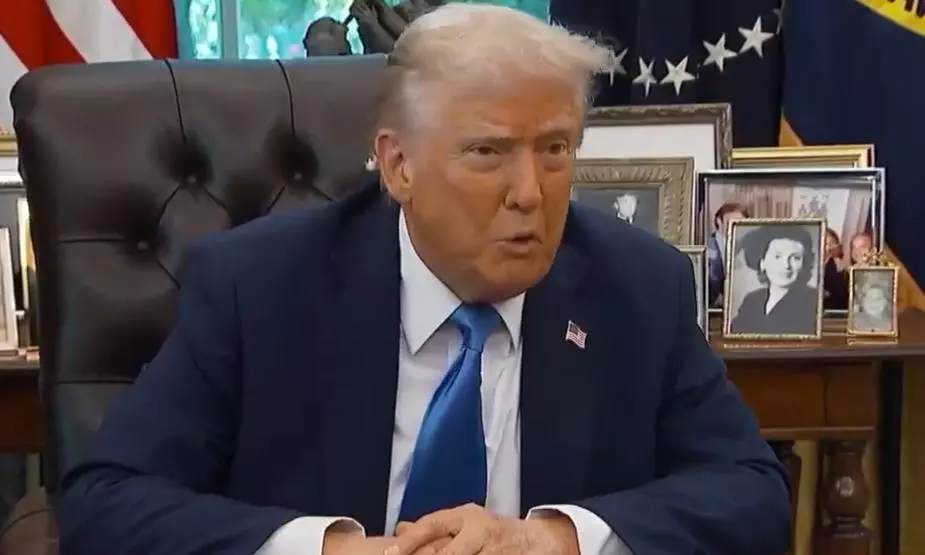
In his first reaction, Trump called the majority decision “a disgrace”, after he was handed a note informing him of the Supreme Court decision during a private meeting with several US governors.
The Supreme Court did not address whether the companies and individuals who paid those tariffs could be refunded. Many companies, including the big-box warehouse chain Costco, have lined up to demand refunds in lower courts.
The Supreme Court decision doesn't stop Trump from imposing duties under other laws. While those have more limitations on the speed and severity of Trump's actions, top administration officials have said they expect to keep the tariff framework in place under other authorities.
India was slapped with 50 per cent tariffs under the emergency law in two tranches — a 25 per cent tariff as a reciprocal tariff and a 25 per cent tariff as a secondary tariff for India purchasing Russian oil.
After months-long negotiations, Trump reduced the reciprocal tariff on India recently to 18 per cent and ended the secondary tariff, citing India’s commitment to lower its Russian oil purchases. The judgment will invalidate the 18 per cent tariff currently being levied on India. However, tariffs on steel and other metals imposed under laws will continue.
The US judgment also doesn't stop Trump from imposing duties under other laws. While those have more limitations on the speed and severity of Trump's actions, top administration officials have said they expect to keep the tariff framework in place under other provisions.
While it wasn't immediately clear how the judgment might affect trade deals with other countries, the invalidation of Trump’s sweeping tariffs could open floodgates of refund pleas. The court, however, did not address whether companies could get refunded for the billions they have collectively paid in tariffs.
The White House plans to use alternative laws to preserve its tariffs, but those policies will only prolong the debate and keep alive an issue that is largely unpopular with voters.
At various points during Trump's second term, at least seven senators from the president's party have voiced their concerns. Earlier this month, six House Republicans joined with Democrats to vote for a resolution against Trump's tariffs on Canada.
Trump has claimed that his tariffs were the difference between national prosperity and deep poverty, a pitch he made on Thursday night to voters in the swing state of Georgia.
The President used the word “tariff” 28 times in his speech on Thursday at a Georgia steel company, Coosa Steel, which credited the import taxes as making its products more competitive with goods from China. “Without tariffs, this country would be in such trouble right now,” Trump charged.
