18 Countries Pledge Support for Haiti Anti-Gang Force: OAS Chief

13 Dec 2025 10:48 PM IST13 Dec 2025 10:48 PM IST
African countries will be particularly involved, alongside Sri Lanka and Bangladesh. Some Latin American countries have also expressed their willingness to contribute to the force.
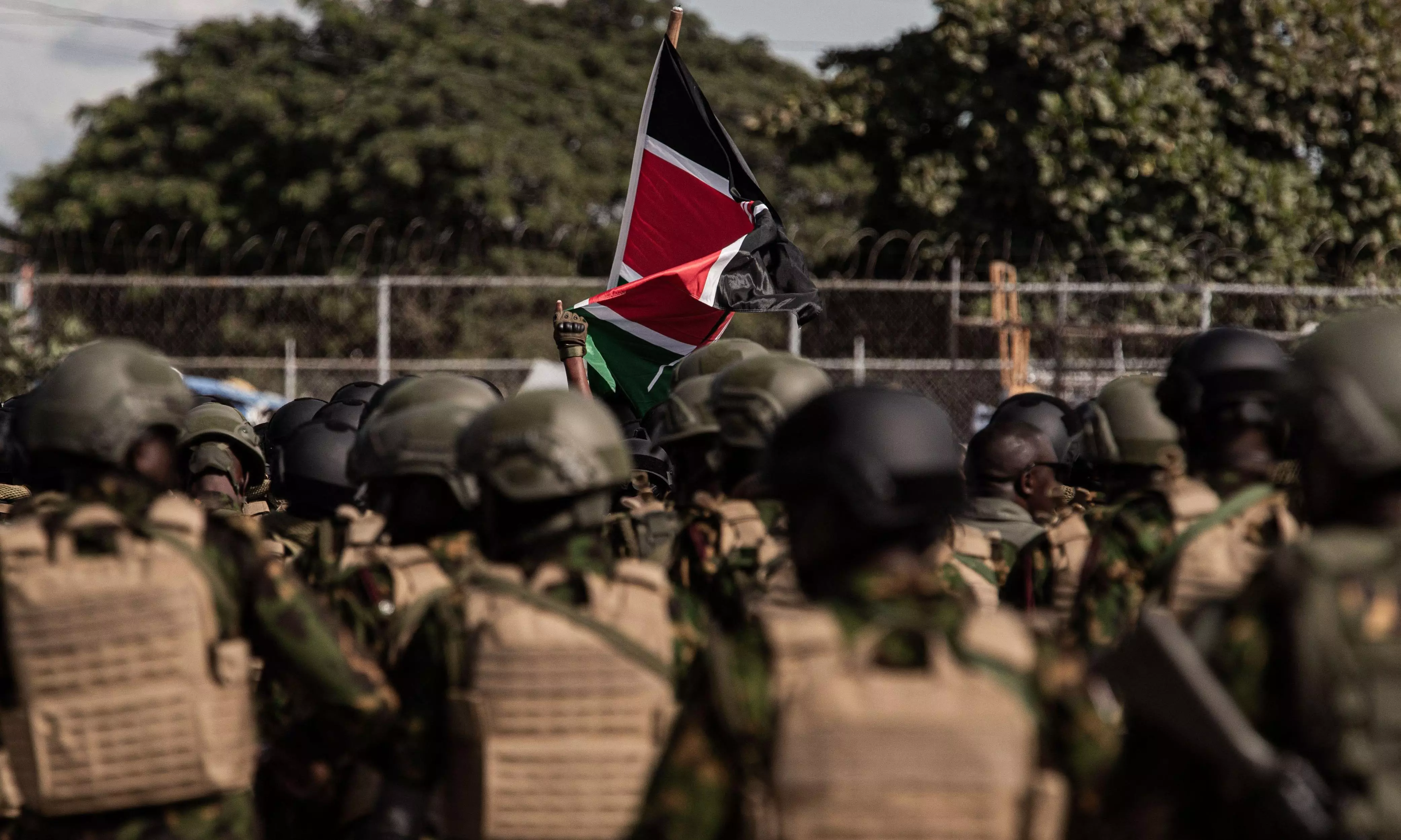
Kenyan police officers hold a Kenyan flag as they arrive at Toussaint Louverture International Airport in Port-au-Prince, Haiti, on December 8, 2025. Kenya announced on December 8th that it had deployed more than 230 highly specialized police officers. They arrive at a critical moment, following the expansion of the Gang Suppression Force's (GSF) mandate published on October 3, 2025. (Photo by Clarens SIFFROY / AFP)
Washington: Eighteen nations have committed to sending personnel to Haiti as part of a beefed up anti-gang security force, according to Organization of American States (OAS) Secretary General Albert Ramdin.
With large parts of Haiti still controlled by powerful armed groups, the UN Security Council in September gave the greenlight for the transition of a Kenyan-led security support mission into a more robust gang-fighting force.
Speaking at a press briefing Friday, Ramdin said "18 countries... have committed to provide forces" to the effort, which will deploy in phases next year.
"I think the first thousand will be going in soon, hopefully in January," he said.
If all goes to plan, the first half of the new multinational force should be deployed by April 1, the date when a UN support office will be established, Ramdin said.
"The key thing is to have them all work together in unity and according to the same rules and regulations," Ramdin said. "That's why it's taking so long. Some of them have to be trained."
African countries will be particularly involved, alongside Sri Lanka and Bangladesh. Some Latin American countries have also expressed their willingness to contribute to the force.
On Monday, Kenya deployed around 100 additional police officers to Haiti as part of the international support mission it leads.
However, the under-equipped, underfunded team -- which has only about 1,000 of the 2,500 officers it expected -- has fallen short of addressing the colossal challenge.
"The idea is to act fast" to mitigate the impact of Haitian gangs, Ramdin said of the new force.
"That means fighting the gangs" and "also capturing the gang leaders and imprisoning them."
"The gang leaders," he added, "certainly need to be captured and neutralized."
The head of the Washington-based OAS traveled to Haiti this week.
"We were limited in where we went, but the fact that I could be in Port-au-Prince, it's a sign that the government is still very active and in charge, but maybe not in all areas of Port-au-Prince," Ramdin said.
Haiti, the poorest country in the Americas, has been destabilized by gangs, which, according to UN estimates, control 90 percent of the capital Port-au-Prince.
Gangs are committing murders, rapes, looting, and kidnappings against the backdrop of chronic political instability.
Haiti has not held elections in nine years and is currently led by a tenuous Transitional Presidential Council.
The country's electoral council recently announced the aim to hold a vote in August 2026.
( Source : AFP )

Next Story