Trump: Iran Leader's Fate Unclear as Gulf War Widens

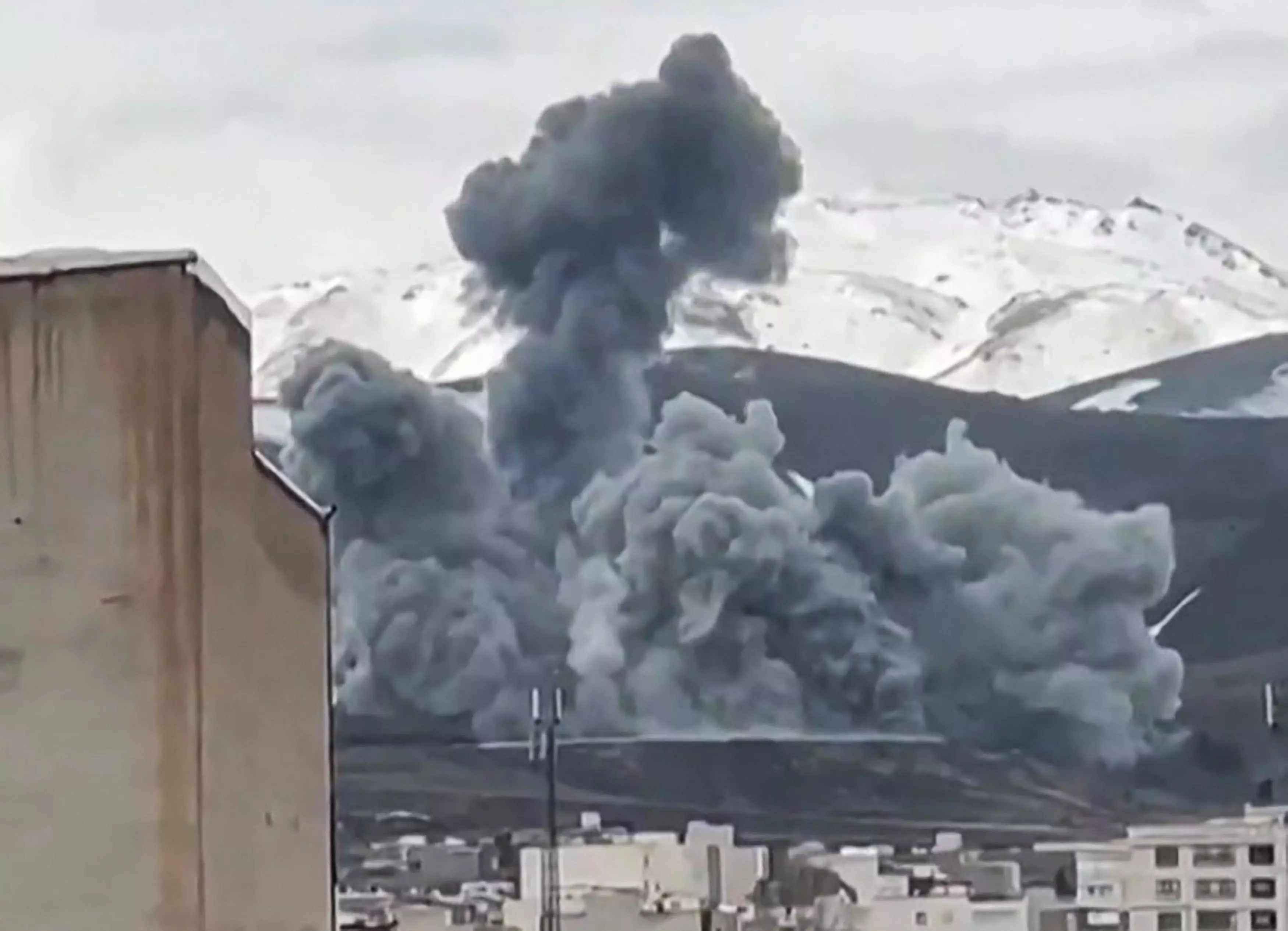
Lebanon’s Health Ministry says an Israeli airstrike on the southern village of Qantara killed four people, including two children
PARIS, France, March 16, 2026 (AFP) - Here are the latest developments Monday in the Middle East war:
- Baghdad hotel attack -
A fire broke out late Monday on the roof of a hotel in Baghdad's Green Zone, witnesses told AFP, with the interior ministry saying there were no casualties or damage after a "projectile" landed on the building.
The Green Zone houses the US embassy and other diplomatic missions, as well as international institutions and government offices.
- Fire at major UAE oil field -
A drone strike caused a fire at a major oil field in the United Arab Emirates, authorities said, as Iran continued its drone and missile strikes across the Gulf.
Authorities in the emirate of Abu Dhabi said they were still responding to the fire at the Shah oil field, without reporting injuries.
- Hezbollah targets Israeli troops -
Hezbollah said it targeted Israeli troops and vehicles in at least three Lebanese border towns, after the Israeli army announced it had begun limited ground operations in Lebanon.
- Iraq's Kataeb Hezbollah commander killed -
Iraq's powerful armed group Kataeb Hezbollah said its senior security commander Abu Ali al-Askari had been killed, without providing details on the circumstances of his death.
He was also the spokesperson in charge of issuing all key statements in the group's name.
- Drone targets Iraqi oil field -
Two drones targeted a major southern Iraqi oil field late Monday, an oil ministry spokesperson told AFP, after the second attack in four days.
Majnoon oil field was "targeted by two drones, one hit a telecommunication tower," oil ministry spokesperson Saheb Bazoun said, adding that there had been no damage.
- Hezbollah targets Israeli city -
Hezbollah said it launched an attack on Monday targeting the northern Israeli city of Nahariya, where Israeli first responders reported a man was wounded.
- Trump: unclear if new Iran leader 'dead or not' -
US President Donald Trump said that he does not know whether Iran's new supreme leader Mojtaba Khamenei is still alive, adding that Washington was unclear whom it could negotiate with in Tehran.
"We don't know... if he's dead or not," Trump told reporters at the White House.
- Trump pushes allies to help secure Hormuz -
Trump demanded US allies join an effort to secure the Strait of Hormuz, as European powers ruled out a NATO mission to reopen the vital waterway shut by Iran during the Middle East war.
He urged more "enthusiasm" from other countries, as he said he believed France and Britain would somewhat reluctantly get involved.
- 1 million displaced in Lebanon -
Lebanese authorities said more than one million people had registered as displaced since war erupted on March 2 between Israel and Hezbollah.
- Shrapnel falls on Jerusalem holy sites -
Israeli police said they found missile and interceptor fragments at holy sites in Jerusalem's Old City, including areas near the Al-Aqsa mosque and the Church of the Holy Sepulchre.
"During the recent missile salvo fired from Iran toward Jerusalem, several intercepts occurred over the city," the police said.
- Merz: Israel's Lebanon ground offensive an 'error' -
German Chancellor Friedrich Merz warned that an Israeli ground offensive in Lebanon was an "error" which would "further exacerbate the already highly tense humanitarian situation" in the country.
"We urgently call on our Israeli friends: Do not take this path -- it would be an error," Merz said.
- UAE key oil port suspends oil loading -
The UAE's state-owned energy giant ADNOC halted the loading of oil into storage tanks at their Fujairah facility, a source with knowledge of the operations told AFP, following repeated strikes on the energy installation.
Fujairah is home to a major port where Iranian attacks have already targeted oil storage tanks. The port is also home to a key oil export terminal just at the entrance of the Strait of Hormuz.
- Iran Guards threaten US companies -
Iran's Revolutionary Guards threatened to target US companies across the region, calling on employees to evacuate the sites.
"Employees of American companies... are requested to leave these areas immediately. These areas will soon be targeted by the Islamic Revolutionary Guard Corps," said the Guards in on their official Sepah News website.
- Lebanon toll climbs -
Lebanon's health ministry said that Israeli attacks have killed 886 people in the country since war erupted between Israel and Hezbollah on March 2, raising a previous toll of 850 a day earlier.
- Four Iraqi fighters killed -
A strike near Iraq's western border with Syria killed at least four fighters from the former paramilitary coalition Hashed al-Shaabi, two security officials said.
A Popular Mobilisation Forces (PMF) official blamed the United States for the strike targeting a checkpoint housing personnel from the PMF -- which includes pro-Iranian groups -- alongside army and police forces.
Lebanon’s Health Ministry says an Israeli airstrike on the southern village of Qantara killed four people, including two children.
- Flights were gradually resuming at Dubai airport on Monday, previously the world's busiest for international flights, the airport operator said, after a "drone-related incident" sparked a fuel tank fire nearby, as Iran kept up its Gulf attacks. Earlier, flights were temporarily suspended at Dubai's airport, previously one of the world's busiest, after a "drone-related incident" sparked a fire nearby, city authorities said on Monday.
Live Updates
- 17 March 2026 12:04 AM IST
Iraq's Kataeb Hezbollah says security spokesperson killed
Iraq's Kataeb Hezbollah says security spokesperson killed
BAGHDAD, March 16, 2026 (AFP) - Iraq's powerful Kataeb Hezbollah on Monday said its senior commander and security spokesperson Abu Ali al-Askari had been killed.The group's leader Ahmad al-Hamidawi, also known as Abu Hussein al-Hamidawi, said on Monday in a statement "we announce the martyrdom of Haj Abu Ali al-Askari", without providing any details on how and when Askari was killed.A security official told AFP that "Abu Ali al-Askari is Abu Ali al-Amiri, the commander who was killed in a strike on Baghdad on Saturday". - 16 March 2026 7:51 PM IST
Hormuz alternative oil routes inadequate to cope with demand
Hormuz alternative oil routes inadequate to cope with demand
PARIS, France, March 16, 2026 (AFP) - Iran's threats against oil tankers transiting the Strait of Hormuz -- a chokepoint through which some 20 percent of global exports pass in peacetime -- has forced countries in the region to seek alternative routes.But analysts warn those routes are not yet sufficient to deal fully with global oil demand."Saudi Arabia and the UAE can reroute some crude output to terminals outside the Gulf," the International Energy Agency stated in its latest monthly oil report, saying that this can "help offset lost crude flows via Hormuz."But data intelligence firm Kpler warns that alternative export routes "remain insufficient, with record loadings from Fujairah (UAE) and Yanbu (Saudi Arabia) still leaving effective Middle Eastern exports at only about one-third of normal levels."Kpler says Asian refiners are expected to step up purchases of long-haul cargoes from the Atlantic Basin with no quick reopening of Strait of Hormuz traffic likely.Almost 20 million barrels per day (mb/d), or about 20 percent of global oil consumption, typically pass through the Strait of Hormuz, mostly bound for China, India, South Korea and Japan.According to the IEA, some 350 oil tankers, some loaded and some empty, are currently stranded in the area.Iran views those belonging to the United States and its allies as "legitimate targets."Only some 80 ships have been able to pass through the strait since the start of the war on February 28.- Partial strait bypass -In a study published on March 9 the Standard Chartered bank indicated that Bahrain, Iraq, Kuwait and Qatar must export almost the entirety of their crude through the Strait of Hormuz whereas Saudi Arabia and the United Arab Emirates can partially offset the blockage via alternative pipelines.Saudi Arabia's East-West pipeline connects Abqaiq, near the Gulf, to the port of Yanbu on the Red Sea.On March 9, the Saudis set a record for daily exports from its western ports of 5.9 mb/d, compared to an average of just 1.7 in 2025, according to the IEA.This pipeline will reach full capacity of 7 mb/d "in the coming days," Amin Nasser, CEO of Saudi Aramco, promised on March 10.The UAE, meanwhile, is shipping crude through its port of Fujairah on the Gulf of Oman to avoid the Strait of Hormuz, albeit with modest volumes."Usually 1.5 mb/d, they can be increased to 1.8 mb/d," according to the IEA.Together, Saudi Arabia and the UAE have additional crude transport capacity of up to 5.5 million mb/d, according to the IEA.Yet "despite record shipments from Fujairah and Yanbu, actual exports from the Middle East still account for only about a third of their normal level," according to Kpler.Iranian drone and missile attacks pose a constant threat to these sites as well.Other routes are possible, such as an Iraq-Turkey pipeline, but it has been out of service for years.Elsewhere, in Kazakhstan and Azerbaijan, capacity is constrained, while Iran targeted the Baku-Tbilisi-Ceyhan pipeline, which terminates in Turkey, at the start of the conflict.- Long distances -Russia's oil export infrastructure is regularly targeted by Ukraine, and volumes remain insufficient to meet global demand despite the partial lifting of sanctions by the United States.Although demand for Russian oil may increase owing to major supply disruptions in the Middle East, the IEA says its forecasts for the country remain unchanged for the time being with average production of 9.3 mb/d through to the end of 2026.Alternative routes for oil from the United States, West Africa and Latin America are longer and the global tanker market is already tight. Furthermore, those countries' ability to quickly jack up production does not exceed a few hundred thousand additional barrels per day.The Middle East war is bringing severe strain to the entire energy system, according to the think tank Rystad Energy."Under the pre-war scenario, we had expected Brent to average $60 per barrel in 2026, as the market faced a substantial surplus of 2.6 million barrels per day," says Rystad.Since the conflict began the price of black gold has fluctuated between $80 and $120 and Monday was floating around the $100 mark. - 16 March 2026 7:21 PM IST
Easing of crude oil prices sends US stocks higher
Easing of crude oil prices sends US stocks higher
NEW YORK (AP) — Oil prices are down, and stocks are up, though such moves have been quick to change since the war in Iran began. The S&P 500 rose 0.8% early Monday. The index is coming off its third straight losing week, its longest such streak in a year. The Dow Jones Industrial Average rose 364 points, and the Nasdaq composite climbed 1%. The driver for markets once again was the price of oil. A barrel of U.S. crude fell 3.4%, easing some pressure off the economy. Oil prices have been mostly ripping higher since the United States and Israel began their attacks on Iran.THIS IS A BREAKING NEWS UPDATE. AP’s earlier story follows below.U.S. markets climbed into positive territory early Monday and the price of oil dipped but remained elevated at around $100 a barrel as the Iran war entered its third week.Futures for the S&P 500 gained 0.6% while Dow Jones Industrial Average futures rose 0.4%. Nasdaq futures rose 0.8%.U.S. benchmark crude fell 1.5% to $97.21 per barrel. It's up about 45% since the war began. A barrel of Brent crude, the international standard, ticked up a fraction of a percent to $103.35. It’s climbed more than 40% since the war began.Since being attacked by the United States and Israel more than two weeks ago, Iran has been regularly hitting Israel, American bases and its Gulf Arab neighbors’ energy infrastructure with drones and missiles. It has also retaliated by effectively stopping cargo traffic through the narrow Strait of Hormuz , where a fifth of the world’s oil typically sails. That has oil producers cutting production because their crude has nowhere to go.In just over a week since the closure of the Strait of Hormuz, more than 12 million barrels of oil equivalent per day have been taken offline, according to independent research firm Rystad Energy.Only handful of tankers have reportedly passed through the strait.“The truth is that at this point, much of the market is operating in the fog,” Stephen Innes of SPI Asset Management said in a commentary. “For context, the strait normally handles roughly 25 oil and LNG tankers every single day.”If the war continues to hamper the production and transportation of oil from the Persian Gulf, it could cause a damaging surge in inflation.Members of the International Energy Agency are making a record 400 million barrels of oil available from emergency reserves, though it appears to have done little to reassure markets.In early equities trading Monday, a handful of chip and data storage stocks led the way. Micron, Western Digital, SanDisk and Intel all rose between 3% and 5% before markets opened.A deal between companies in the business of physical self-storage units was also moving shares. National Storage Affiliates soared 26% in premarket after it announced that it was being bought by Public Storage in an all-stock deal worth about $10.5 billion. Public Storage was down about 3.5% on the news.At midday in Europe, Germany's DAX edged 0.2% higher while the CAC 40 in Paris was unchanged. Britain's FTSE 100 gained 0.5%.In Asia, Tokyo's Nikkei 225 edged 0.1% lower to 53,751.15, while the Kospi in South Korea climbed 1.1% to 5,549.85.Hong Kong's Hang Seng rose 1.5% to 25,834.02 after the Chinese government reported stronger than forecast economic data for February. The Shanghai Composite index shed 0.3%, however, to 4,084.79.In Australia, the S&P/ASX 200 gave up 0.4% to 8,583.40.Taiwan's Taiex edged 0.2% lower, while India's Sensex was little changed.Back in the U.S., higher expectations for inflation complicate the Federal Reserve's efforts to bring interest rates lower to help the economy. The U.S. central bank is not expected to cut rates at its policy meeting this week.A new snapshot of consumer spending Friday showed that inflation crept higher in January, even before the Iran war caused oil and gas prices to spike.The Commerce Department reported Friday that consumer prices rose 2.8% in January compared with a year earlier. But excluding volatile food and energy, core prices rose 3.1%, the highest jump in nearly two years. - 16 March 2026 7:19 PM IST
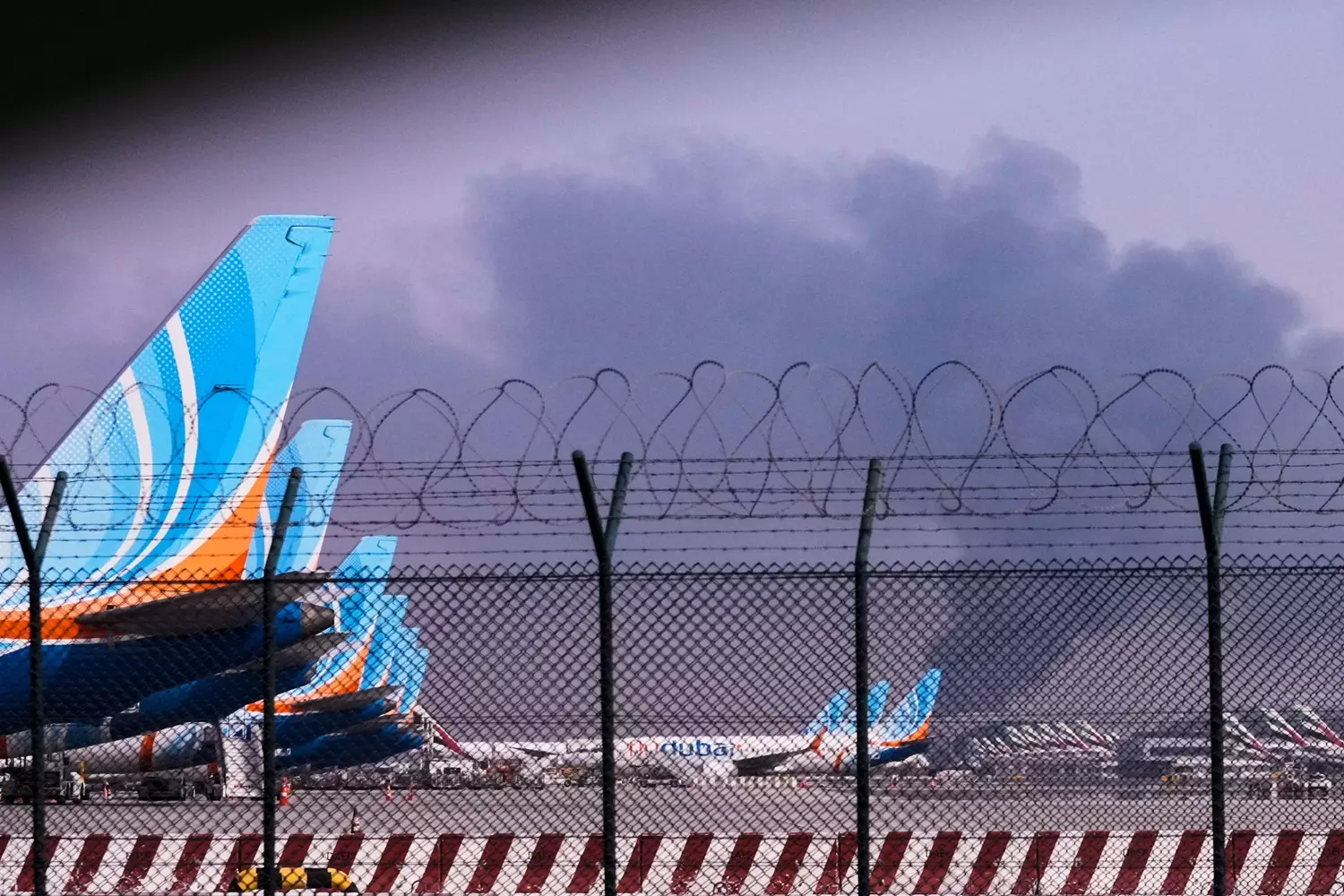 FlyDubai planeS is parked at Dubai International Airport as smoke rises in the background after a drone struck a fuel tank early morning, forcing the temporary suspension of flights, in Dubai, United Arab Emirates, Monday, March 16, 2026. (AP Photo)
 - 16 March 2026 6:42 PM IST
US Treasury Secretary Scott Bessent downplays oil price surge
The treasury secretary followed Trump’s lead Monday and dismissed concerns about rising oil prices since the start of the Iran war.
Bessent accused the media of “trying to make it into some crisis that it’s not,” and he insisted prices would come down after the conflict ends.
“I don’t know how many weeks it will be, but on the other side of this, the world will be safer, and we will be better supplied,” Bessent said on CNBC.
He said the Treasury Department hasn’t traded oil futures to try to cap prices. Asked whether it would going forward, the secretary said: “I’m not sure under what authority or what auspices” that would happen.
Trump’s Interior Secretary Doug Burgum told Bloomberg Television over the weekend that the administration has talked about that strategy. — AP
- 16 March 2026 6:41 PM IST
British Prime Minister Keir Starmer defends decision to differ with Trump
Starmer has defended resisting President Trump’s pressure for the U.K. to join the war against Iran, saying he has “stood by my principles.”
Trump has berated the British leader for limiting the use of U.K. bases by American warplanes and declining to send an aircraft carrier to the Middle East. Trump complained to the Financial Times that “when I asked for them to come, they didn’t want to come.”
Starmer said at a news conference Monday that British troops should only be sent into action that is legal and has “a proper thought-through plan.”
He said U.K. opposition politicians who’ve criticized his stance “would have rushed the U.K. headlong into this war without the full picture of what they’re sending our forces into, and without a plan to get us out. That is not leading. It’s following.” — AP
- 16 March 2026 6:40 PM IST
Iraq’s oil minister says new route for oil exports set to open
Iraqi Oil Minister Hayan Abdul-Ghani said Monday in a video statement that a pipeline from the northern city of Kirkuk to Turkey will be operational within a week, allowing the country to resume oil exports interrupted by the ongoing regional war.
Iraq previously exported around 3.4 million barrels of oil a day through its southern port of Basra, he said, but “in light of the military operations and the closure of the Strait of Hormuz, Iraqi oil exports stopped two or three days after the beginning of the war in the region.”
Abdul-Ghani said the pipeline from Kirkuk to Turkey, with a capacity of 200,000 to 250,000 barrels a day, is currently undergoing hydrostatic testing. The route will bypass the semi-autonomous Kurdish area in northern Iraq after Baghdad could not reach an agreement with local authorities over conditions for exporting via another pipeline in the Kurdish region. — AP
- 16 March 2026 5:38 PM IST
Italy signals reluctance to Trump’s call to help open Strait of Hormuz
Italy is the latest country to react cautiously to Trump’s demand that allies help open the Strait of Hormuz.
Italian Foreign Minister Antonio Tajani told reporters in Brussels on Monday that Italy backs reinforcing EU naval missions in the Red Sea.
But he added: “However, I don’t think these missions can be expanded to include the Strait of Hormuz, especially since they are anti-piracy and defensive missions.”
- 16 March 2026 4:48 PM IST
Iran FM says ready to take war with Israel, US 'as far as' necessary
Iran's Foreign Minister Abbas Araghchi said on Monday that Tehran had shown it was ready to take the war with Israel and the United States as far as necessary.
"I think by now they have learned a good lesson and understood what kind of nation they are dealing with, one that does not hesitate to defend itself and is ready to continue the war wherever it may lead, and take it as far as necessary," said Araghchi during a weekly foreign ministry briefing.
- 16 March 2026 4:46 PM IST
Non-Iran tanker transits Hormuz with transponder on: MarineTraffic
A non-Iranian oil tanker transited the Strait of Hormuz with its automatic transponder system activated, despite major disruption to shipping in the crucial waterway from the Middle East war, monitor Marine Traffic said Monday.
"The Aframax tanker Karachi, carrying Abu Dhabi's Das crude, has become the first non-Iranian cargo to transit the chokepoint while broadcasting its AIS signal, suggesting that select shipments may be receiving negotiated safe passage," Marine Traffic said in a statement.


