Gadi Eisenkot: From Israel's Top General to Contender for Top Political Office

28 Oct 2026 1:19 PM IST28 Oct 2026 1:19 PM IST
Eisenkot described the exit polls as evidence of a loss of confidence in Netanyahu's leadership and said he would work to replace his government.
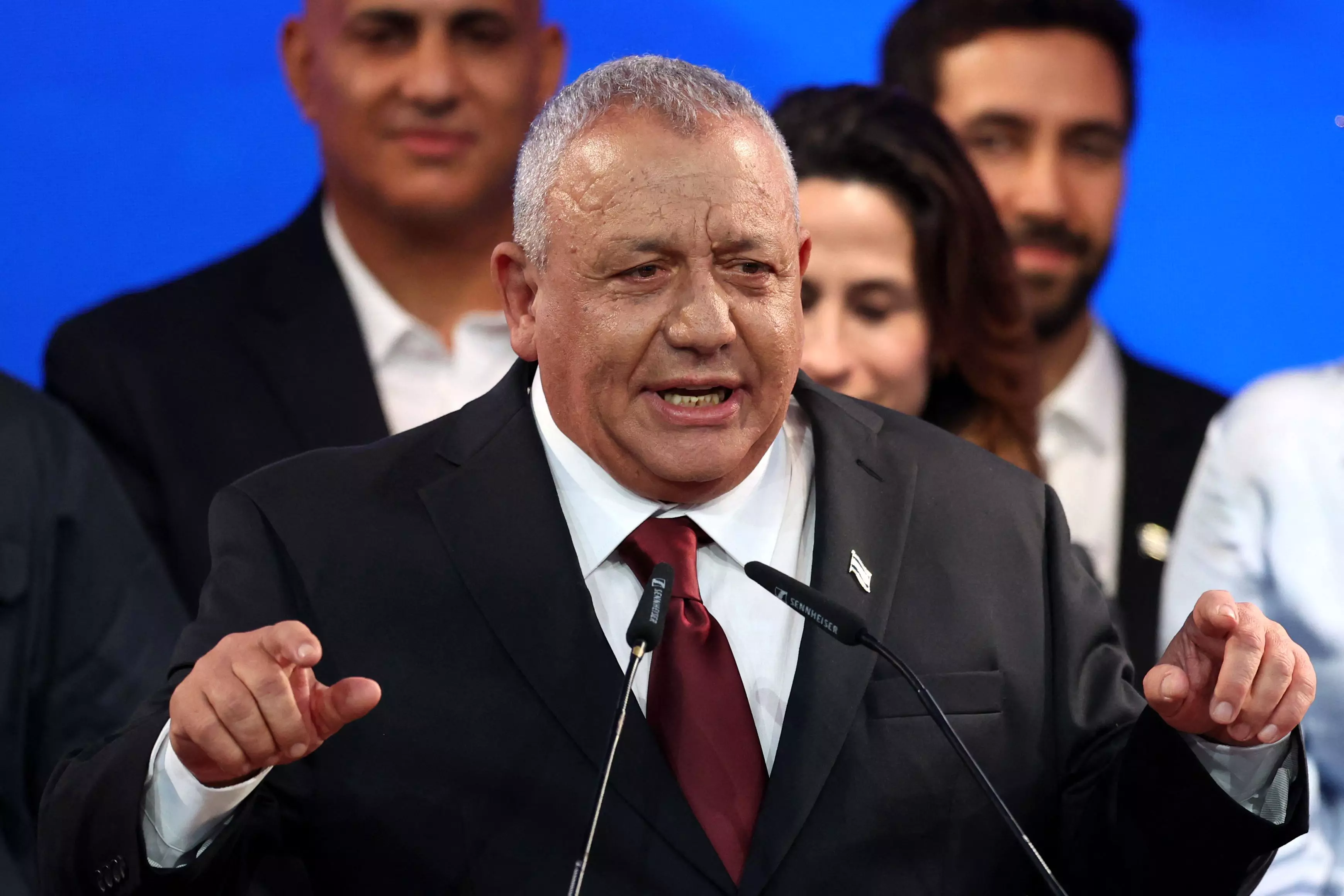
Yashar party leader Gadi Eisenkot addresses his supporters at the election night rally after the first exit polls were announced, in Tel Aviv, during Israel's legislative elections. (Jack GUEZ / AFP)
Tel Aviv: After four decades in uniform, Gadi Eisenkot is seeking to translate his military credentials into political power, challenging Prime Minister Benjamin Netanyahu after an election that has left Israel's rival political blocs short of a clear parliamentary majority. The 66-year-old leader of the Yashar party has emerged as a central figure in the effort to replace Netanyahu, Israel's longest-serving prime minister.
Exit polls released after Tuesday's election projected neither camp securing the 61 seats needed for a majority in the 120-member Knesset.
Depending on the broadcaster, Netanyahu's right-wing bloc was projected to win 50-52 seats, while the opposition bloc was estimated to have 49-53. Arab-led parties were projected to win around 17-18 seats.
The figures were projections, not final results, with the official count still under way.
Turnout reached 77.7 per cent, the highest since 1999, according to election authorities.
Eisenkot described the exit polls as evidence of a loss of confidence in Netanyahu's leadership and said he would work to replace his government. But the former military chief faces a difficult task in assembling a coalition, particularly because he has ruled out including Arab parties in a government he leads.
Born in Tiberias to a family of Moroccan Jewish immigrants, Eisenkot grew up in Tiberias and Eilat. He enlisted in the Israel Defence Forces (IDF) in 1978, joining the Golani Brigade, and served for 41 years before retiring.
He became the IDF's chief of general staff in February 2015 and held the position until January 2019. His military career included senior operational and command roles, including during periods of heightened tensions along Israel's borders.
Eisenkot entered national politics in 2022, joining Benny Gantz's National Unity alliance.
His political profile rose further after Hamas' October 7, 2023, attack on Israel, in which around 1,200 people were killed and hostages were taken into Gaza.
The former military chief joined the emergency war cabinet formed by Netanyahu as an observer, alongside other opposition figures brought into the wartime government.
He left the emergency government in June 2024, criticising the absence of a clear strategy for the war and accusing Netanyahu of allowing political considerations to take precedence over the country's security and the return of hostages.
The conflict has also affected his family. His son and two nephews were killed while serving in the military during the war.
Eisenkot has pledged to establish a state commission of inquiry into the security failures surrounding the October 7 attack. Netanyahu has resisted calls for such an inquiry while the country remains engaged in conflict.
The former IDF chief of staff has built his campaign around security, governance and a more disciplined approach to military decision-making. He takes a hard line against Hamas and Hezbollah and has argued that Israel must prevent Iran from acquiring nuclear weapons.
At the same time, Eisenkot has stressed that military operations must be accompanied by a political strategy capable of translating battlefield gains into a durable outcome.
He has pledged to end Hamas' rule in Gaza within 18 months of taking office, through the implementation of US President Donald Trump's Gaza framework or military action. This remains a campaign commitment, rather than a guaranteed outcome.
His position on the Palestinians is also hawkish. In the aftermath of the October 7 attack, he has described the two-state solution as unrealistic and opposed the establishment of a Palestinian state.
The former military chief has, however, criticised Israel's planned E1 settlement expansion in the occupied West Bank, warning of the international costs, and called for action against settler violence and illegal outposts. He has also opposed formal annexation of the West Bank.
These positions place him within Israel's security-oriented political mainstream, while his criticism of Netanyahu's handling of the war and the hostage issue has helped distinguish him from the incumbent.
Eisenkot's biggest challenge may be forming a government in a fragmented parliament.
Arab-led parties could hold enough seats to influence which candidate can assemble a majority. But Eisenkot has ruled out including Arab parties in a government he leads, limiting his options if the exit-poll projections hold.
He has framed the government he wants to form as a Zionist government committed to universal military service and dismantling Hamas.
His position on national service is particularly significant because ultra-Orthodox parties have traditionally secured exemptions from military conscription for many religious seminary students, and their support has been central to Netanyahu's coalition.
Eisenkot argues that the burden of national service should be shared more broadly. That stance could complicate negotiations with ultra-Orthodox parties, even as he seeks support from political rivals with different priorities.
His Moroccan Jewish background is another part of his political profile. Mizrahi Jews, whose families originated in the Middle East and North Africa, have historically had a complicated relationship with Israel's political establishment, including grievances over discrimination and social exclusion.
Many have supported Likud over the decades, though voting preferences vary and should not be treated as uniform.
The former IDF chief's military record gives him credibility on security, but it does not guarantee political success.
With neither major bloc projected to command a majority on its own, Eisenkot's prospects will depend on whether he can bridge ideological differences and assemble enough parliamentary support to replace Netanyahu.
For a former army chief seeking the country's highest political office, the election has opened a path to power but has not yet provided a clear route to the prime minister's residence.
( Source : PTI )

Next Story