Where Robots and Engineers Build India’s Smart Displays

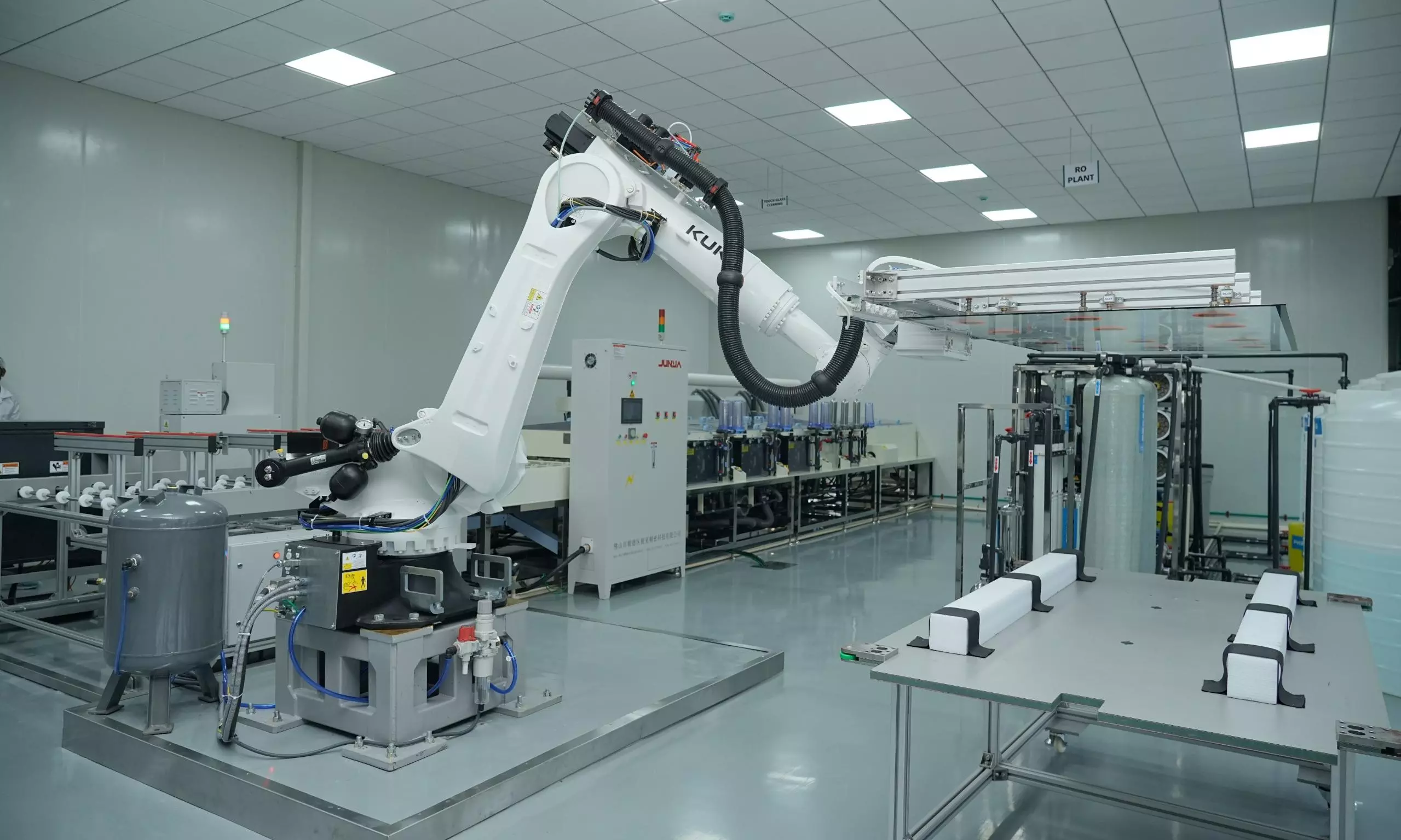
The production floor is almost evenly split between robotics and skilled technicians. While robots handle precision tasks such as glass dispensing, cutting and lifting, every display still relies on trained workers who spend months learning specialised assembly and quality processes
Bengaluru: Located inside an industrial estate in Dobbaspet, about 50 km from Bengaluru, a new interactive display rolls off the production line every two minutes.
The pace is impressive, but what stands out even more is the precision behind it. Every display passes through, believe me or not, nearly 70 stages of manufacturing and quality inspection, from robotic glass handling and motherboard programming to software installation, colour calibration, ageing tests and final inspection, before it is packed and shipped.
As India pushes to become a global electronics manufacturing destination under the ‘Make in India’ initiative, facilities like this are attempting to do more than assemble imported products. They represent a gradual shift towards domestic manufacturing of sophisticated enterprise electronics that have traditionally relied heavily on imports.
The plant, operated by Bengaluru-based Online Instruments (India) Limited, is dedicated to manufacturing interactive displays used in classrooms, boardrooms and enterprise collaboration spaces. The company says it is India’s first Completely Knocked Down (CKD) manufacturing facility for interactive displays, where products are assembled from individual components rather than imported as semi-finished units. As India works towards strengthening domestic electronics manufacturing, facilities like this could play an important role in reducing the country’s dependence on imported finished products.
The factory currently produces around 250 to 350 displays per shift. While a single unit takes nearly two hours to move from raw glass to final packaging, the assembly line is designed so that a finished display emerges every two minutes.
Automation plays a significant role throughout the production floor. Robots undertake precision tasks such as glass dispensing, cutting and heavy lifting, operations where consistency and accuracy are critical. Human expertise, however, remains equally important. Around 35 to 40 trained technicians oversee assembly, inspection, software loading and quality validation, creating a manufacturing model where robotics and skilled labour complement rather than replace one another.
Quality control dominates every stage of production. Displays undergo thermal ageing at 45 degrees Celsius for two hours to simulate demanding climatic conditions found in cities such as Delhi and Dubai. They are subjected to surge voltage testing, colour calibration, touch accuracy verification, Android software loading and multiple functional inspections before leaving the facility.
Every component, operator, production batch and quality parameter is digitally recorded, allowing the company to trace products years after they have been deployed if any field issue arises. The displays are designed for an operational life of approximately 50,000 hours and are backed by a three-year warranty.
Despite the manufacturing capability, India’s electronics ecosystem continues to face a familiar challenge: component dependency.
The company estimates that nearly 80 per cent of its electronic components are currently sourced from China, with only around 20 per cent procured domestically. The long-term objective is to progressively increase local sourcing as India’s electronics supply chain matures.
Industry experts believe this remains one of the biggest hurdles for India’s electronics ambitions. While assembly capabilities have expanded significantly over the past decade, developing a robust domestic ecosystem for high-value electronic components is still a work in progress.
After visiting the manufacturing unit, this correspondent also toured the company’s AV Experience Centre in Bengaluru. Rather than functioning as a conventional showroom, the facility demonstrates how the finished products are deployed in real-world settings, including AI-enabled meeting rooms, interactive collaboration spaces, immersive conferencing systems and smart workplace environments. It offers visitors a practical understanding of where the technology built at the Dobbaspet plant eventually finds application.
Inside the factory, however, the emphasis is less on futuristic technology and more on disciplined manufacturing. Workers undergo months of structured training before joining the production line, while clean-room protocols, electrostatic discharge controls and standardised operating procedures govern nearly every process.
The story unfolding here is larger than one company’s production capacity. It reflects the gradual evolution of India’s electronics manufacturing ecosystem, from assembling imported technologies to building increasingly sophisticated products through engineering, automation and quality systems. If India hopes to reduce its dependence on imported electronics and emerge as a globally competitive manufacturing hub, factories like this may become an increasingly important part of that journey.
