Hugging Face Unveils $400 Duck-Like Robot That Can Sing and Skate

28 Aug 2026 5:10 PM IST28 Aug 2026 5:10 PM IST
The launch comes a day after multiple media outlets reported that Nvidia Corp. is nearing a deal to buy Hugging Face for roughly $13 billion.
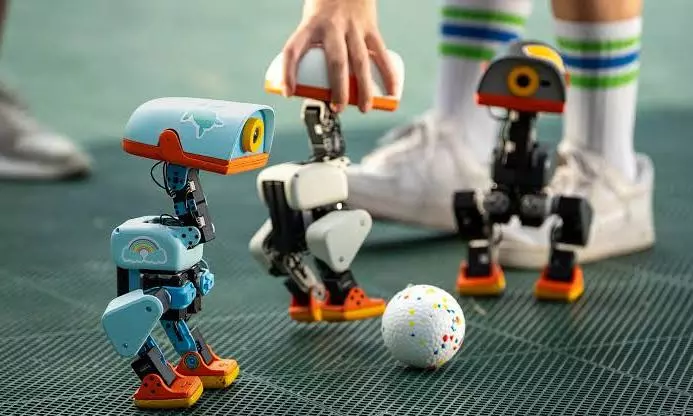
The Hugging Face Microduck. (Image/Hugging Face Inc. via Bloomberg)
Artificial intelligence platform Hugging Face Inc. unveiled a singing $400 bipedal robot that can be taught tricks, the latest in the company’s ongoing effort to make AI and robotics more approachable to the general public.
The cute robot — aptly named Microduck — takes clear inspiration from its namesake bird, except that it has only one eye. It will go on sale later this year, Hugging Face said Thursday, making it the second robot from the company.
Both beginner and more advanced developers will be able to teach new physical skills to the robot using reinforcement learning, simulation and open-source software, letting them code new behaviors through programming languages like Python and JavaScript. The robot was developed in part by Pollen Robotics, the Bordeaux, France-based company Hugging Face acquired last year.
The new robot is already benefiting from consumer buzz, the company said. Since opening up preorders on Thursday, Hugging Face has been selling one Microduck every four seconds, translating to about half a million dollars in sales, Hugging Face co-founder and Chief Science Officer Thomas Wolf said in an interview on the Bloomberg Tech show.
The launch comes a day after multiple media outlets reported that Nvidia Corp. is nearing a deal to buy Hugging Face for roughly $13 billion. Wolf declined to comment on the reports, saying the company often receives “offers of acquisition and investment.” Nvidia didn’t immediately respond to a request for comment.
Hugging Face isn’t alone in attempting to put a friendlier face on artificial intelligence. Companies large and small across the humanoid and AI sectors face growing scrutiny over ethical concerns, as well as the sometimes unsettling appearance of their robots. Fauna Robotics, for example, which was acquired by Amazon.com Inc. earlier this year, has opted for more consumer-focused designs.
The Microduck concept is reminiscent of the discontinued Lego Mindstorms series, and builds on existing platforms like Raspberry Pi, which has long allowed developers to program and tinker with hardware. The Microduck, however, also has built-in behavior that lets it interact with its surroundings without needing custom code: Users can, for example, walk it around or trigger movements using a laser pointer or a game controller.
“We want to show that AI is actually very accessible,” Wolf said in a separate interview before the announcement. It needn’t be expensive or scary, he said, but rather, “It’s something anyone can build and do.” The company, he said, wanted to “show a bit more positive, cute, vision of AI. A lot of the humanoid robots are not always as friendly looking and a bit dystopian, but they can also be very cute and a nice AI.”
The Microduck robot, which measures nearly 10 inches and weighs about 1.7 pounds, can perform a series of complex behaviors. In a video demo seen by Bloomberg, it was able to roller skate, carry small objects such as socks and sing alongside other Microducks. It includes integrated sensors such as a camera, microphone, speaker, lidar, Bluetooth, Wi-Fi connectivity and two NFC readers that allow it to interact with external accessories. The company also plans to launch an expansion pack for more advanced developers.
“We’re creating a new category of consumer robots here, which is AI native and kind of playful but also education tools,” Wolf said. “We’re basically discovering and learning with the user how to do that with the best interface and how to combine all of these levels, which is from very easy to use to super advanced.”
The company said it’s aiming to sell more than 20,000 Microducks, with the first shipments expected before Christmas. The robot is manufactured in China with Shenzhen-based open-source hardware provider Seeed Studio.
Last year, Hugging Face and Pollen Robotics introduced their first robot, called the Reachy Mini, another doe-eyed open-source robot, which the companies say has already sold about 10,000 units.
( Source : Bloomberg )


Next Story