Gunjan Vasant Ramteke: Where Cloud Strategy Meets Cutting-Edge AI Research

Most people publishing in IEEE journals are not also managing hundred-million-dollar partner ecosystems at AWS.
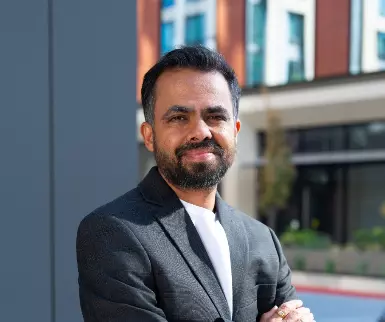
Not many people can walk out of a partner strategy meeting at one of the world's biggest cloud companies and then go home to debug a graph neural network model they are building for hepatitis C detection. That is a strange sentence to write, but it is also just an accurate description of how Gunjan Vasant Ramteke spends his time.
He is based in Fremont, out in the Bay Area, and his background is the kind that takes a few minutes to fully absorb. Cloud partnerships. Biomedical research. Graph machine learning. Multi-omics data. Enterprise go-to-market strategy. An MBA, an M.Tech in Biotechnology, and a doctoral program he is currently finishing up at the University of the Cumberlands. Most people who work in enterprise tech do not have a biotechnology degree. Most people publishing in IEEE journals are not also managing hundred-million-dollar partner ecosystems at AWS. He sits in that gap, somewhat unusually, and seems to have made it work.
Building at the Intersection of Cloud and Enterprise Strategy
His day-to-day at Amazon Web Services revolves around Data and Analytics partnerships — specifically, working with independent software vendors to build the kind of go-to-market strategies that get sophisticated analytics products in front of enterprise customers at real scale. It is not glamorous work to describe, but the stakes are high. The decisions he makes around positioning, partnerships, and market entry affect how significant chunks of cloud-enabled analytics value actually flow through the market. Before AWS, he was doing something similar at another major cloud platform, and before that he was working across Bangalore and Singapore.
That last part is worth pausing on. Working across India, Southeast Asia, and the United States is not just a resume line. Those are markets that think about technology adoption very differently, different procurement cycles, different risk tolerances, different infrastructure starting points. Having genuinely operated across all three gives him a sense of how the global technology market actually behaves, rather than how it looks from one vantage point.
The Research That Runs Alongside It All
Somewhere alongside all of this, he has been doing PhD-level research in AI and its applications in medicine. His published IEEE work on diagnosing hepatitis C using graph contrastive learning and multi-omics data integration is the most concrete output of that so far.
Biological datasets are stubborn things. Genomic, transcriptomic, and proteomic data were never designed to talk to each other, they come out of different instruments, different labs, built on different assumptions about what is even worth measuring. The gaps between them are not exceptions you work around. They are just the reality of the data, and most modeling approaches quietly fall apart when they hit them. Graph-based methods have always had a certain advantage in that kind of territory because they do not demand clean, uniform inputs the way traditional approaches do. His research pushed that further, showing that contrastive learning on top of graph architectures could still produce reliable diagnostic results even when the underlying data was patchy and inconsistent. Other researchers have started citing the work, which is usually how you know something landed. Given that the paper came out of an unfinished dissertation, that kind of uptake says something.
And the practical relevance of the work is hard to dismiss. Hepatitis C disproportionately burdens healthcare systems in parts of the world where clinical resources are already under enormous pressure. Better diagnostic models that hold up under imperfect real-world data conditions are not an abstract contribution — they connect directly to whether someone in an under-resourced clinic gets an accurate result or not.
Emerging Focus Areas and Future Trajectory
The doctoral work is now pulling him toward agentic AI, and not in the way the term gets thrown around at conferences. The specific question that interests him is how you build systems that can actually hold a complex problem together across multiple steps — clinical workflows, for instance, where the decision at step four depends on what happened at step one, and where a model that just answers individual prompts in isolation is not much use. Enterprise environments have the same problem, just with different stakes. There are not many people working on this who have both the research foundation and the practical experience of watching these systems behave in real deployments. That combination is rarer than the field sometimes makes it sound.
He is also eyeing the higher education and research institution market, where he sees real opportunity for AI platforms that help universities compete for grants and manage the increasingly complicated business of academic funding.
Both of these, when you trace them back, come from the same instinct that the most durable technology is not the loudest or the flashiest, but the kind that makes something genuinely hard a little more manageable for the people doing the actual work. That is a quieter ambition than most people in this industry tend to advertise. But it tends to age better too.
