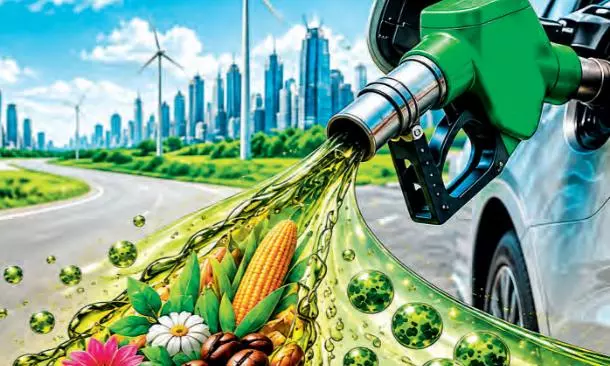
At a petrol pump in Nagpur, a driver watches the nozzle click off and wonders what exactly he just put in his tank. The answer, increasingly, is not simple petrol at all, but a blend shaped by chemistry, agriculture, and policy, one chapter in a much larger global search for fuel beyond crude oil.
India’s own chapter arrived early: 20% ethanol blended into petrol nationwide, made largely from sugarcane, corn, and surplus grain. Officials count it as a win: a smaller oil import bill and steady new demand for farmers.
Ethanol is hygroscopic, drawing moisture from the air, which can occasionally cause phase separation in fuel tanks, and regulators point to testing across more than 150 quality parameters as their answer.
But ethanol is only one entry in a much stranger catalogue. Airlines are beginning to fly on sustainable aviation fuel distilled from used cooking oil and municipal waste. Diesel engines are running, with barely a modification, on biodiesel made from animal fats and vegetable oil. In ponds and wastewater, microalgae are being cultivated as a ‘super fuel,’ yielding far more oil per hectare than any crop, without competing for farmland.
Rice straw and sugarcane bagasse, once burned as stubble, are being reimagined as feedstock for ethanol. Researchers have even turned to temple flower waste as a biomass source, while others chase something more elemental still: hydrogen coaxed from algae and bacteria, a fuel with no carbon at all.
10 STRANGE FUELS YOU WON’T BELIEVE HUMANS HAVE TRIED!
1. Water-powered cars: Science or myth?
Stanley Meyer’s 1990s ‘water fuel cell’ claimed to run a dune buggy on water using minimal electricity; a 1996 Ohio court found it was ordinary electrolysis and convicted him of fraud. Japan’s Genepax (2008) unveiled a similarly water-powered car, but the real fuel was expensive, self-consuming metal plates releasing hydrogen. DIY HHO kits promise better mileage from tap water, yet engineers find the added alternator load actually worsens fuel economy. To date, no water-fuel claim has survived independent scientific scrutiny; each has been debunked, discredited, or quietly abandoned.
2. Moon dust to rocket fuel
Lunar dust contains locked-up oxygen, which scientists extract using heat, electricity, or chemical reactions with astronaut-generated carbon dioxide. Since liquid oxygen makes up most of a rocket’s launch weight, mining it directly from the Moon means rockets wouldn’t need to carry it from Earth. This could turn the Moon into a refueling station, making missions to Mars lighter and far cheaper.
3. Brewtroleum: The beer that powered cars
In 2015, New Zealand’s DB Export turned leftover brewing yeast into ‘Brewtroleum,’ an E10 fuel sold at 60 Gull stations nationwide. Partnering with Refining NZ, they fermented and distilled residual sugars from spent yeast slurry into bioethanol, producing over 5 million liters at standard market prices. The campaign, “Save the World by Drinking Beer,” won Cannes Lions' Grand Prix in 2016. Though commercially successful, limited yeast supply and logistics kept it a one-run showcase of circular-economy fuel.
4. Your morning coffee could fuel tomorrow’s cars
Spent coffee grounds, dense with residual oil, are being converted into biodiesel through extraction and transesterification, meeting European and American fuel standards. London’s Bio-Bean processes up to 50,000 tonnes annually, partnering with Shell to power city buses with a B20 blend. Leftover grounds become high-heat biomass pellets. Unlike palm or soy biofuels, coffee waste competes with no food crop, offering cities a hyper-local, low-carbon fuel sourced entirely from their own daily habit.
5. From rabbits to radiators
In 2009, Stockholm faced a rabbit overpopulation crisis damaging city parks. Officials culled thousands annually, routing carcasses to a Karlskoga heating plant instead of landfills. Blended with other bio-waste, they were incinerated for district heating, sparking backlash from animal rights groups, while city officials defended it as pragmatic, zero-waste infrastructure.
6. The science of “chocolate diesel”
Confectionery waste, rich in cocoa fats, was refined and blended with vegetable oil, then transesterified into biodiesel. In a famous UK demonstration, researchers powered a modified diesel car across Europe on “chocolate fuel,” proving sugary factory scraps could sustain long-distance travel, all while its exhaust carried a faint aroma of roasted cocoa.
7. From cigarette butts to fuel blends
Cigarette filters, made of slow-degrading cellulose acetate, are being converted through pyrolysis into triacetin-rich bio-oil, a valuable diesel additive, while other processes yield bioethanol and biodiesel catalysts. Despite proven lab chemistry, scaling remains hard: butts are scattered across cities, contain thousands of toxic chemicals, and require huge volumes for meaningful fuel output.
8. The mexican nopal cactus that runs buses
In Michoacán, Mexico, company Nopalimex converts prickly pear cactus into biogas through anaerobic digestion, yielding high-purity biomethane. Requiring minimal water and avoiding food-crop land, nopal outperforms corn or sugarcane in yield and sustainability. The gas fuels municipal buses and generators in Zitácuaro, while leftover digestate returns to fields as fertilizer.
9. From hair to high power: The next waste revolution
Human hair waste, though not industrially refined as fuel, is actively collected worldwide: Australia’s Sustainable Salons supplies hair for EV battery graphite, the US-based Matter of Trust turns it into oil-spill booms, and India's Tirumala temple trust auctions tons annually for keratin and bio-fertiliser. Research hubs in India’s IITs, Australia, and Lithuania are pushing pyrolysis and supercapacitor applications, though scattered sourcing keeps hair from mainstream fuel use.
10. From Instant Noodles to Engine Fuel
In Fukuoka, Japan, logistics firm Nishida Shoun pioneered converting instant noodle and ramen waste into biofuel, powering trucks on it. Because instant noodles are pre-fried in palm oil, factory rejects and oily broth offer a high lipid content ideal for biodiesel, while easily broken-down wheat starch speeds bioethanol fermentation. The process reroutes food waste that would otherwise reach landfills, without competing with edible food supply.
THE FUTURE ISN’T ONE FUEL. IT'S A THOUSAND IDEAS.