Once nearly extinct, India’s tigers have made a striking comeback India now holds more than 70% of the world’s wild tiger population Shrinking forests, politics and human survival matters of concern
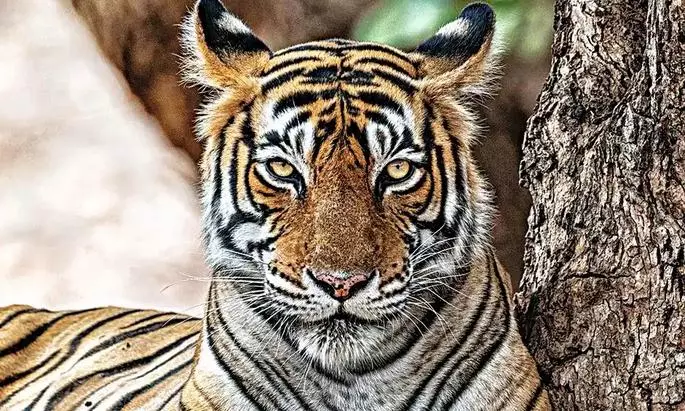
India’s relationship with the tiger has always been paradoxical. Once on the verge of extinction, India today holds more than 70% of the world’s wild tiger population. The tiger numbers had plummeted to just 1,411 in 2006. However, the tiger has been clawing its way back into Indian forests through one of the most ambitious conservation efforts in the world: Project Tiger. Five decades on, that project is now at a crossroads, confronting a landscape that no longer resembles the one it set out to protect.
Wild Encounters
The tiger, long the symbol of Indian royalty and colonial pursuit, has always carried the weight of metaphor: of power, wilderness, and vanishing grandeur. Yet beyond its myth lies a volatile reality. In the dry grasslands of Madhya Pradesh’s Satpura National Park, a tiger melts into shadow as quickly as it appeared into the sal forest.
RP Singh, a forest officer with over two decades of service in Satpura says, “The numbers make for a great headline but they can be dangerously misleading. Tigers are territorial. If we don’t have enough connected habitat, they end up trapped, inbreeding, or spilling into human spaces.”
India’s forests are now fragmented islands surrounded by farms, mines, and highways. As tiger populations grow within these ecological islands, dispersing individuals are increasingly crossing into villages and farmlands. These interactions are not peaceful. Pench National Park alone has had at least four human deaths from tiger attacks since March 2024.
Tigers: A Love Destroyed
For centuries, the big cat was a royal obsession – fetishised in Mughal miniatures and, later, trophies in British colonial bungalows. By the 1950s, it had been nearly loved to death. The tipping point came in the 1960s and 70s, when indiscriminate hunting, poaching for skin and bones, and rapid deforestation pushed tigers to the brink. “Tiger numbers really plummeted when parts were being sold to China,” explains Dr. Latika Nath, a wildlife biologist often called ‘India’s Tiger Princess.’ “It is due to the founding fathers of tiger conservation in India, whether it is HS Panwar or Kailash Sankhla that we have been able to do some groundbreaking work.”
Sankhala’s legacy is central to Project Tiger’s origin story. “Kailash Sankhala, a Forest Officer, travelled the length and breadth of India for two years to assess the state of the tiger and reported that the tiger was on the edge of extinction,” recalls conservationist Randhir Bittu Sahgal. Former Prime Minister Indira Gandhi appointed him (Sankhala) as the first Director of Project Tiger with full independence to choose his own trusted team, which chose nine ecologically diverse locations as India’s first Project Tiger Reserves. Rather than pure science, the team’s strategy was ‘rewilding through natural regeneration’. “Essentially ‘doing little and allowing little to be done,’ apart from strictest protection, isolation from humans and traditional soil and water conservation works,” says Sahgal.
Sahgal says that back then forests outside the tiger reserves were vast and interconnected. “That has changed. Though we have 58 Tiger Reserves today, many are islanded, and some have suffered
local extinction. Possibly 60% of the forests where tiger pug marks were present in 1973
have been lost, and with the climate crisis upon us this is the tiger’s and India’s greatest challenge today.”
The Turnaround
In many ways, Project Tiger has been a remarkable success. With over 3,000 tigers recorded in 2022, India now holds more than 70% of the world’s wild tiger population. Poaching has reduced, scientific monitoring has improved, and protected areas are now better staffed and equipped.
“India was fighting for climate change when Project Tiger was launched,” says Anish Andheria, President and CEO of Wildlife Conservation Trust. “Certainly not knowingly,
we did not have words, but anyone who fights to protect forests and grasslands aloof with their biodiversity is fighting for climate change.”
Man-Animal Conflict
According to The India Forum, an estimated 100 people are killed by tigers annually, with hundreds more affected by loss of livestock or forced relocation.
“This is not the tiger’s fault,” says Singh. “It’s looking for space, food and a mate. It is odd that humans tend to not understand or empathise with tigers. We are both at the top of the food chain, with very different areas of strength.”
Buffer zones – intended as cushions between protected areas and human settlements – have become flashpoints of conflict. With little institutional support and slow, inadequate compensation mechanisms, rural communities often bear the cost of conservation.
“People don’t hate tigers,” Singh adds, “They just do not understand them. I remember once asking a child about whether they thought a tiger was majestic, and he simply said that tigers are just for the entertainment of tourists.”
Andheria cautions that the legal and policy frameworks supporting tiger conservation remain vulnerable. “Unfortunately, fragmentation of corridors has only gone up,” he says. “The laws in place can be diluted or reversed. We can’t spend time convincing people who do not want to be convinced about this sort of thing. Tigers will not survive unless people make an effort. States where tiger numbers are high – such as Madhya Pradesh, Karnataka and Maharashtra – are a symbol of the amount of work that has been done over the past 20 years.”
Rethinking Project Tiger
Fifty years after its launch, Project Tiger stands as a legacy institution – but one in need of reform. Critics argue that a tiger-centric conservation model often excludes the very people living closest to forests. “Project Tiger needs a redesign,” says Singh. “You cannot protect a species in a silo. Conservation must work with people, not against them. Especially the communities who’ve lived alongside tigers far longer than any biologist or bureaucrat.”
Sahgal echoes this, emphasizing the original spirit of trust and simplicity. “As a metaphor for all of nature, saving the tiger, its ecosystem and all species therein is our best option to deal with India’s worst climate impacts, while protecting our food, economic and social
security. Project Tiger was the world’s first to-scale rewilding initiative and all we did was follow the original strategy: Nature knows best.”
The Road Ahead
The next frontier in tiger conservation is connectivity. “We build roads and cities without accounting for the needs of wildlife. Then we blame the animal when it turns up where it shouldn't be,” says Nath. Climate change adds to the strain. Rising temperatures, erratic rainfall, and shifting vegetation zones are already altering prey availability and habitat structure in many tiger-bearing landscapes.
Yet amid the pressure, India’s conservation movement continues to innovate. Camera-trap AI, community watch groups, ecological restoration of corridors, and education initiatives are bringing new energy into old questions.
Nath says, “It’s a circle of ecology, culture, politics, and history. If we break that circle, no number will save the tiger.”
From the Terai grasslands in Uttarakhand to the mangroves of Sundarbans, from the teak forests of Central India to the dry deciduous scrub of Rajasthan, India’s tiger landscapes remain some of the most biodiverse and contested spaces in the country. The question now is not whether the tiger will survive, but whether it can live free!

