Sticker Shock: When Tourism Turns Into Vandalism

A tourist’s sticker in Leh has become a flashpoint, but it is only the most visible sign of a quieter crisis, as unchecked tourism steadily erodes the Himalayas’ delicate ecology
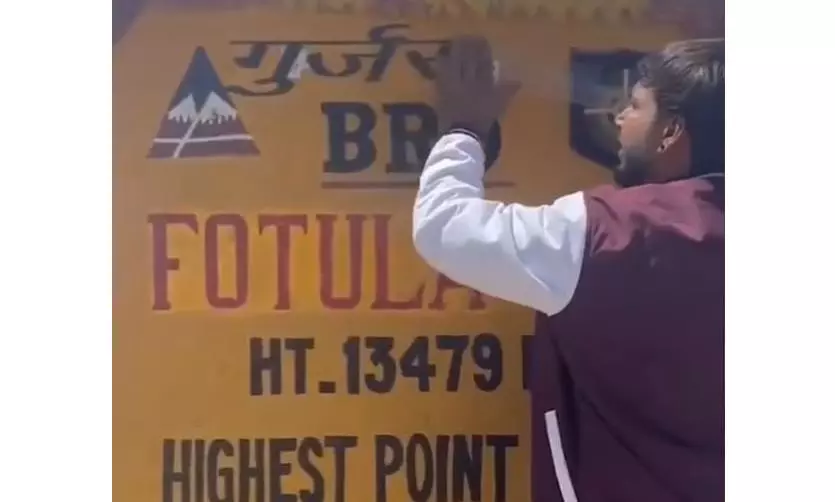
A viral video showing a tourist pasting a ‘Gurjar’ sticker on a signboard at one of Leh’s highest points has reignited anger over unruly tourism in fragile Himalayan regions. The incident has sharpened calls for civic sense, stricter enforcement, and accountability, as locals and experts warn that performative behaviour is steadily eroding both landscape and legacy.
What looks like a minor provocation is, to many residents and conservationists, a symptom of something far more corrosive: a growing culture of performative travel where presence matters less than proof, and stewardship is sacrificed for visibility.
Ladakh is not an exception. Across India, easier access has come with diminishing restraint and a growing disregard for shared spaces.
The New Disorder at High Altitude
For those who work on the ground, the sticker incident is not an anomaly. Vandana Vijay, Founder and CEO of Offbeat Tracks, says such behaviour has become increasingly routine across the Himalayas. She points to recent incidents that reveal a worrying disregard for rules and local life — tourists stopping inside the Atal Tunnel to dance and film videos, blocking traffic in a tightly regulated passage; loud music blaring through the night at high-altitude camps along the Manali–Leh highway; vehicles driven straight into sensitive zones such as Pangong Tso. “Social media may expose this behaviour,” Vijay says, “But it doesn’t deter it. What’s missing is fear of consequence. Without swift crackdowns and uncompromising enforcement, these acts will only escalate.”
The damage, experts warn, rarely ends with the individual offender.
Uday Krishna Peddireddi, businessman, conservationist, and Founding Trustee at Vata Foundation, recalls how a single act of vandalism by Indian tourists in Bhutan—the defacing of a sacred stupa—triggered a policy shift. “Bhutan introduced a daily permit fee for Indian visitors, a rule that had not existed earlier. When a few people behave irresponsibly, the entire tourist community pays the price,” he says. Improved road access into Ladakh, Uday notes, has brought opportunity but also misuse. “The real failure is that culprits often face negligible penalties, if any, while gaining exactly what they want—online attention. Unless there are real consequences, including strong action by social media platforms, this behaviour will multiply.”
The Quieter Vandalism No One Films
Yet for some observers, the fixation on stickers risks obscuring a more enduring threat. Archana Singh, Founder of Travel See Write, argues that Ladakh’s crisis is less about what tourists paste and more about what they leave behind. Plastic waste, she says, has become the region’s silent antagonist, piling up at dumping sites outside Leh and scattered across once-pristine locations. “The sticker is only the loudest symptom,” Singh says. “The real damage is quieter — plastic bottles, food wrappers, disposable waste brought in by people chasing ‘untouched beauty.’ I’ve seen a chips wrapper tossed casually at Pangong Lake. That plastic will outlive the photograph taken there. The mountains don’t care about identity stickers but they are choking on our waste.”
Tourist Perspective: When Ego Travels Too
Pruthu Mehta, a frequent visitor to the Himalayas, says confrontation has become an unfortunate part of travelling responsibly in Ladakh. “I’ve personally argued with tourists throwing chips wrappers at Pangong Tso. People come to these fragile places without realising there’s no municipality here to clean up after them. When tourists paste stickers on landmarks, it’s almost as if they believe they’re marking territory. I’ve tried telling people not to do this many times. But instead of understanding, their egos kick in. They argue back. That’s when you realise this isn’t ignorance alone; it’s entitlement. Tour operators have a responsibility here. Tourists must be briefed properly about what not to do, about how delicate the ecosystem is. Education isn’t optional in places like this. It’s essential.”
