To preserve traditional Indian painting, the artist began recreating mural-inspired images on canvas
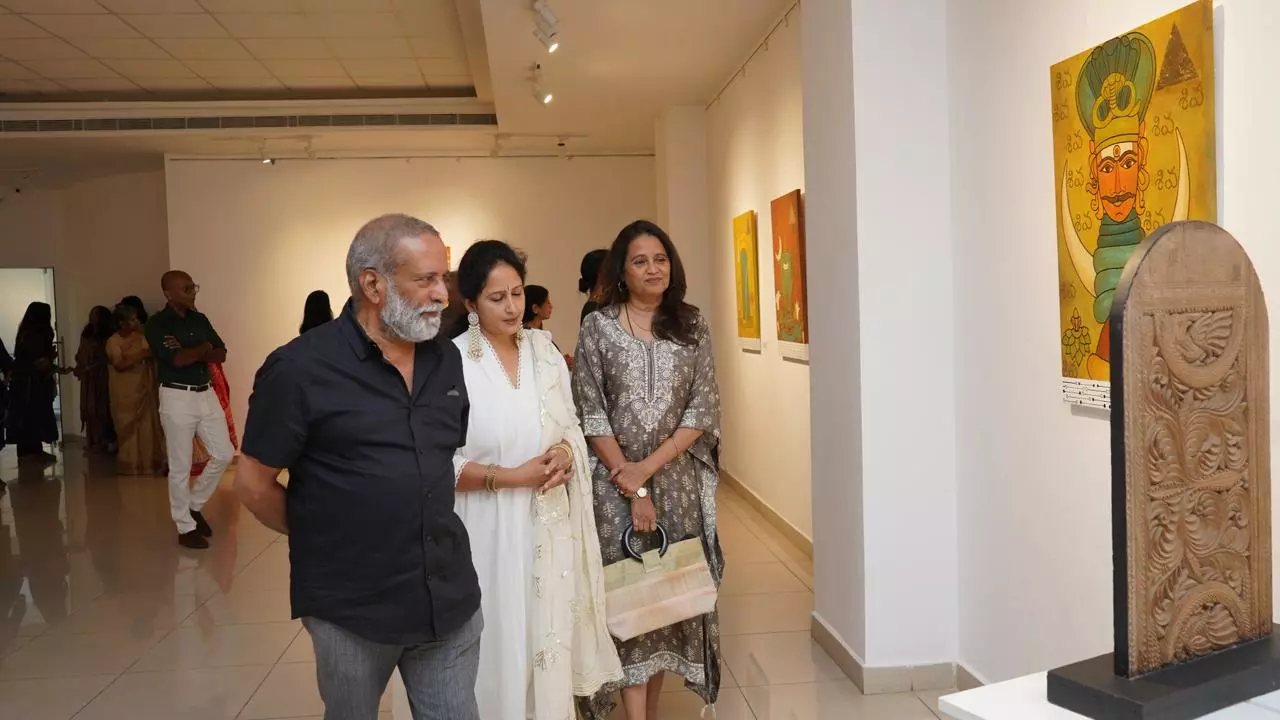
In 2009, Hyderabad-based visual artist Shilpa Kasu took her daughter to her native village of Pennaluru near Kanchipuram to show her the lovely old temples and murals that she grew up with. However, the visit ended with the artist returning in tears to learn that all the murals had been whitewashed by people who had no clue about their artistic and heritage value.
She recalls, “It was heartbreaking to see all these age-old treasures vanish, as these were a part of my roots and memories, which I was very keen to showcase to the future generations, as it is our shared history and culture.”
Keen to ensure that the traditional Indian style of painting be preserved for the future, the artist started to paint images inspired by traditional murals on canvas. Her first ever solo show at the State Art Gallery recently, Shivoham, showcases over 70 works of art ranging from paintings (in acrylic and watercolors), installations, sculptures, and photographs – all of them carrying a different avatar of Lord Shiva.
Ranging from lingodbhava (the form representing the emergence of linga) to Adi Kumbeshwara (representing the tree of life) and many other avatars, through her works she captures both the form and formless aspects of the deity. Asked why she paints images of Lord Shiva, she responds, “Shiva is very close to my heart, as he is the one who is nonbiased, and both devas and asuras are blessed by him. I see him as someone who will accept every soul without judgment.”
Echoes of the divine
Research is an integral part of the artist’s work. She explains, “I have visited many old temples in the South Indian states, and in many temples, there are scriptures that give us a description of the deity. Combing through the archives of the Archeological Survey of India, I find a lot of material, which I then use to create my work.”
The artist also takes a lot of images of murals that she notices on her trips and does reverse engineering to recreate them on canvas, apart from speaking to scholars to understand any missing nuances. She has also used the Gomukhi and Devanagari scripts where they pertain to the description of the image and used them in her works.
One of the most captivating aspects of her work is the lilting use of colors. Soft-hued red, blue, and yellow add a tinge of peace to the canvases. She shares, “Most temple murals use earthen colors to envelop the images in an aura of serenity. These simple vegetable and natural dyes have withstood the test of time, including the ravages of time and natural factors like water and soot. I try to use similar colors wherever possible.”
Largely self-taught, Shilpa has studied temple murals for more than two decades. With a BFA from Tamil Nadu University of Fine Arts, Chennai, her work creates a dialogue between organic and traditional symbols that reflect the faith of ancient times.
With her work acquired with private collectors in China, Sri Lanka, and the Netherlands, Shilpa’s passion ensures that the focus is on quality and not quantity. Her main aim is to ensure that India’s rich culture is preserved. She adds, “I want to showcase that South Indian mural art is a great form of fine art.

