Many youngsters are breaking away from notifications and discovering a new world in books
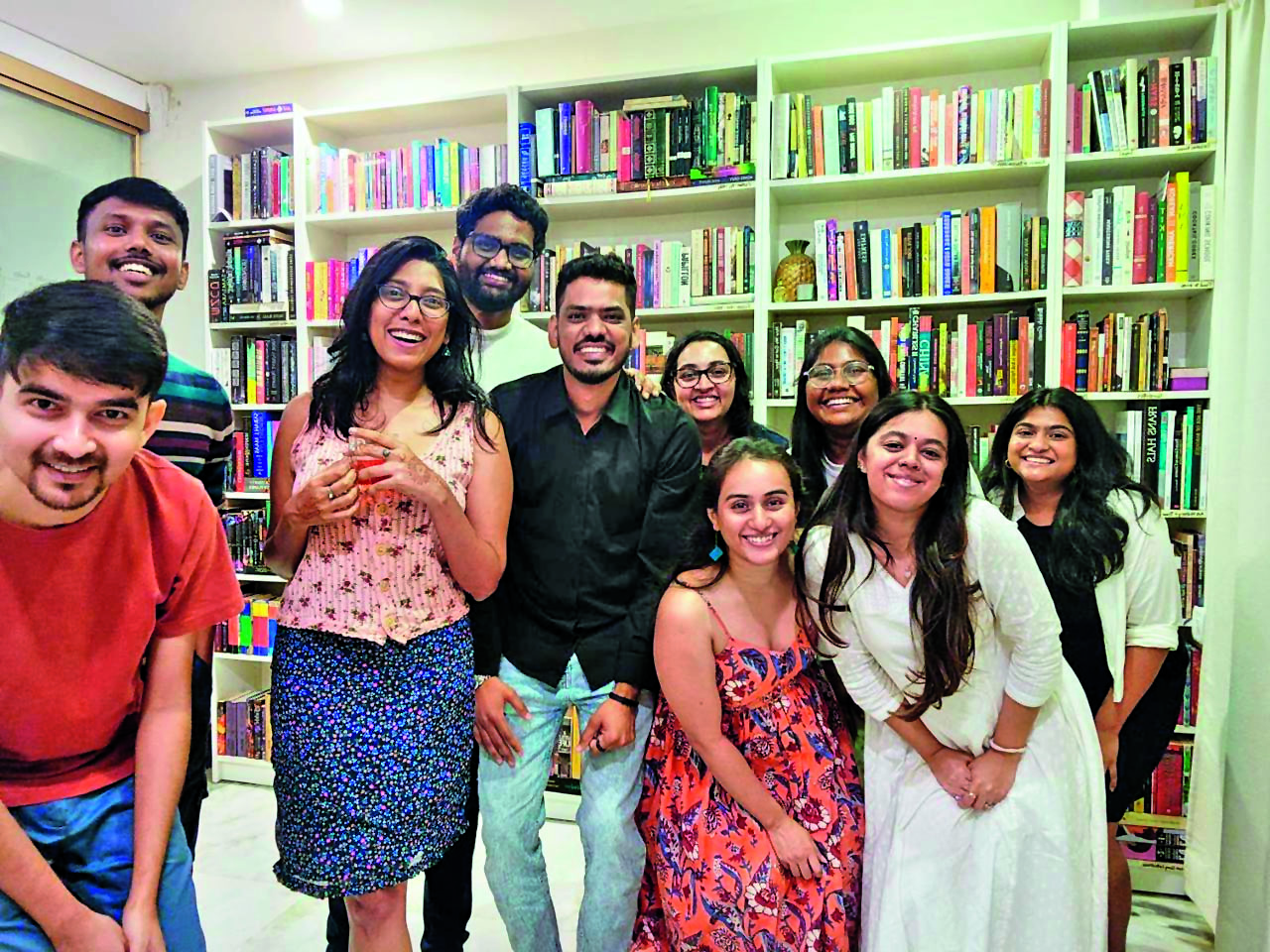
In the digital age where entertainment is available at the click (or touch) of a button, books have fallen off the popularity charts. Social media has wired our brains in such a way that being away from screens has become a Herculean task. Despite this, a few youngsters from the city are swimming against the tide and are making time to read in gardens, at their homes or book clubs. What makes them pick up books in the era of disappearing book shops and short attention spans? We find outthe reasons behind the quiet reading revolution:
‘Want to experience things slow’
Everything is quick.Quick groceries, quick food, quick dopamine. Our current generation needs everything quick that they are slowly losing the beauty of experiencing things as they are supposed to be. Social media has a very big role to play in this, and it went to such an extent that our attention span to observe and experience is no longer an emotion but a statistic for a creator to create more dopamine addicted content. Well, what is going to change that? Books stand a tiny chance of preserving the beauty of experiencing things slowly, the way they are supposed to be.
Sathwik Maanthini, founder of Communitie Book Club, and a chef
‘Books help you form deeper connections’
Social media was supposed to make our lives easier, instantaneous. But often, we also end up feeling isolated by it. I believe books are a better medium for forming the kind of connections we crave. It’s slower, yes, but it’s also deeper. Books let you discover perspectives that are similar to yours, so you feel less alone in the world. But they also let you explore narratives that are vastly different. It’s one of the few times in your life you get to truly put yourself in someone else’s shoes and experience the world through their eyes. Books let you escape. Or they help you realize that things are cyclical. That you’re not the only one who has ever felt this way. I think the pandemic helped people return to reading. It gave them the space to rediscover it. People began craving a slower pace of life. As we keep learning time and time again: more is not always better. That’s why reading will never go out of vogue.
Sanjana Datla, technology consultant
‘Books - the first social networks’
I consider books to be the first social networks. They connected humans across centuries with ideas and stories. Despite all the shiny things that social media brings us, I still feel I need room to breathe and to think and to get lost in a story or an idea, and books give me that.They don’t demand your attention with notifications, likes, and comments. They just quietly invite you in. You engage with it at your own pace. Even in our book club, apart from reading stories, we also gather around to argue about endings and fall in love with characters who don't have Instagram. It feels like a connection that is not guided by an algorithm. There is a misconception that reading is an isolated activity and our book club breaks that idea every week.We have a wonderful community built around the act of reading and sharing stories. In fact, on May 11, we are organising an all day event, ‘Cover to Cover- A lit Fest’, at T-Works to celebrate stories and literature.
- Shreya P, policy research.
‘Books nurture deeper understanding of the world’
After a long, weary day, one might find deeper comfort not in notifications, but in a quiet dialogue with Shakespeare, Tagore, Orwell, Ramdhari Singh Dinkar, Amrita Pritam, Khalil Gibran, or Toni Morrison. These books exist in a timeless space —unfiltered by algorithms or digital trends. As someone who began as a tech graduate and later transitioned to literature, I have come to appreciate how prophetic and powerful literature can be. Works like Orwell’s 1984 warned us decades ago about the psychological grip of technology and surveillance—warnings that feel even more relevant today. Reading such literature doesn’t just connect us to the past; it sharpens our awareness of the present. It nurtures empathy, self-reflection, and a deeper understanding of the world around us—qualities that are increasingly essential in a tech-driven age.
Suysha Agarwal, Assistant Professor of English at MGIT
‘Books teach you something new’
I have been an avid reader since childhood, and I find peace in books. You always learn something new from a book irrespective of the genre you read. I am a curator in the Hyderabad Reads community and I see more and more people joining us every day.
Books give us a chance to disengage from social media. When I'm reading a book, I completely go offline. But there are other people who are slowly breaking up with screens. They do not read an entire book at a stretch, but keep taking breaks at 15-20 pages. Many of them are corporate employees who are pressed for time. So when they come here, they read a few pages and then they stop. And again, next week, they continue from that page.
— Biswarupa Barik, co-curator, Hyderabad Reads
‘Helps to reduce stress’
Even in this digital era, reading offers many benefits. It helps open your mind to new perspective and ideas, it helps sharpens memory and vocabulary. For me, it helps me travel to new places without travelling, and reduce stress.
— Mohammed Nusrath Quadri, co-curator, Hyderabad Reads

