‘Rao Bahadur Deliberately Unfolds Its Mystery’

Venkatesh Maha discusses the making of his latest psychological drama, and why it continues to spark conversations beyond the theatre
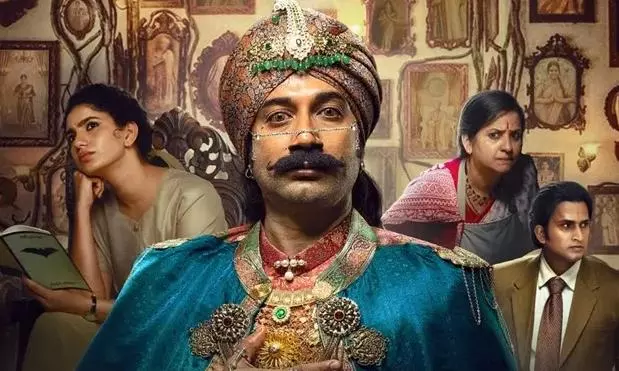
Director Venkatesh Maha discusses the layered storytelling of his upcoming film Rao Bahadur, its exploration of conditioning, colourism, doubt and patriarchy, and why he believes the film will continue to inspire fresh interpretations.
Absolutely. I always believed Rao Bahadur would spark discussions. The film is meant to leave you with questions. Most rewarding of all is that people are interpreting it in different ways and uncovering hidden details and easter eggs. In fact, the psychological drama begins after you’ve finished watching it. People enjoy stories that offer food for thought. I experienced this with C/o Kancharapalem. Before Rao Bahadur released, I told my producers it would generate such discussions.
Was the slow first half it a deliberate narrative choice?
Yes. Psychological dramas aren’t meant to spoon-feed audiences. When you watch a film by M. Night Shyamalan or Christopher Nolan, you don’t expect every answer immediately. You wait for the story to unfold. I think Telugu audiences haven’t had many films recently that require patience. We’ve become accustomed to narratives that explain everything quickly. Rao Bahadur deliberately unfolds its mystery gradually. Why do we hesitate when something new emerges from our culture?
Is there any criticism that you agree with?
I agree that the first half is lengthy. But I wouldn’t call it slow or boring. There’s a difference. Everything in the first half has a payoff later. For example, The vasectomy and the Mahabharata references aren’t incidental-they reinforce the protagonist’s struggle with lineage, identity and the film’s central theme.
However, many women have connected deeply with the first half as it spends considerable time with the female lead. The film explores multiple perspectives rather than a single protagonist’s point of view.
What was the writing process like?
I began with the themes, not the plot. The film is built on four core ideas: human beings are essentially the same, conditioning shapes reality, reality itself is an illusion, and fear and suspicion become our demons. Every scene and dialogue stems from these themes.
How did the idea of Rao bahadur emerge?
The seed came from the real-life story of the man who played Ghantasala in C/o Kancharapalem. Though he has East Asian facial features, he’s completely rooted in Kancharapalem. He speaks fluent Telugu, has lived there since infancy after being brought from Burma during the war, and is no different from anyone else in the community. Meeting him made me realise that our physical appearance is only the outer layer. Beyond that, our emotions, thoughts and humanity are the same.
Many are calling this one of Satyadev’s finest performances?
Satyadev is one of our finest actors. We spent nearly 40 days understanding Rao Bahadur’s psychology, fears and inner world before rehearsing any scenes. Once we cracked the character’s mind, the performance fell into place.
Tell us about finding the palace’s location.
We were looking for an abandoned palace because active palaces come with several restrictions and costs. After researching online, my team and I travelled to Odisha and found one. It was completely abandoned except for a watchman’s room. We cleaned the entire palace ourselves before shooting there. Even structurally, it suited central ideas in the movie. The spiral staircase, for instance, represents the DNA structure, and as such, tied into themes of lineage and identity. We kept returning to that image throughout the narrative.