Away from loud auditoriums and splashy launches, the city is embracing the baithak — an intimate format where listening takes centre stage
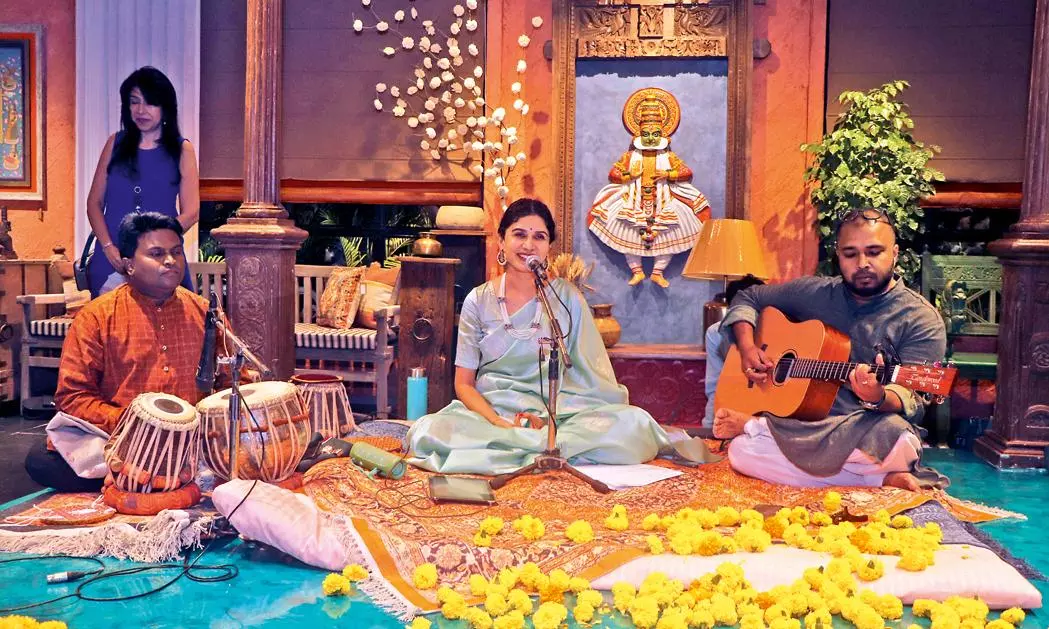
Hosted in thoughtfully designed spaces rather than formal concert halls, these gatherings favour closeness over scale, attention over amplification.
Classical baithaks are quietly gaining ground in Hyderabad, inviting both artistes and audiences to lean in. Hosted in thoughtfully designed spaces rather than formal concert halls, these gatherings favour closeness over scale, attention over amplification. The appeal lies in their restraint: a vocalist, a single instrument, and an audience that listens without distraction.
For many hosts and performers, the baithak is less a trend than a return — to a time when music unfolded without barriers, when performers and listeners shared the same floor, the same silences, the same breath.
A CURATOR’S CALLING
Among those shaping the revival is Rajveer Kaur, whose work bridges craft, culture and community. As the founder of The Nomad Lab, her interest in baithaks stems from a desire to return to formats rooted in Indian classical traditions. “When I curated my first baithak with Aadyam Handwoven in 2023, alongside artist Ananya Gaur, it wasn’t about staging an event,” she says. “It was about reviving a way of experiencing music—intimate, immersive and deeply human.”
Historically, baithaks moved from royal courts and mehfils into homes and curated spaces precisely because they dissolve distance. “There’s no elevated stage, no hierarchy,” Kaur explains. “Music isn’t performed at you — it’s shared with you.”
THE AUDIENCE LEARNS TO SLOW DOWN
What surprised Kaur most in Hyderabad was the audience’s readiness to adapt. Traditional baithaks involve floor seating and attentive stillness — a listening culture unfamiliar to many. “At the first few gatherings, people chose chairs or stood,” she says. “But gradually, they leaned in. More sat on the floor. More stayed till the end. The listening deepened.” Rather than exclusivity, the format began to create a shared ritual. “A baithak asks the audience to slow down,” Kaur reflects. “And that invitation, surprisingly, has been warmly accepted.”
FROM MUSIC TO EXPERIENCE
For textile revivalist and designer Gaurang Shah, the baithak is instinctive rather than experimental. At Gaurang Kitchen, music flows alongside food and conversation. “I grew up listening to Hindustani classical music and attending baithaks,” he says. “When immersive music began getting lost to louder formats, I wanted to bring that experience back,” says Gaurang adding, “While designing Gaurang Kitchen, I created a space where intimate baithaks could happen naturally , with music, conversation and forgotten recipes coming together. These ticketed evenings are open to all, and over time we also plan to include Carnatic classical music. For me, a baithak is about slowing down and truly listening, to music, to food, and to each other.”
THE PERFORMER’S VIEW
Classical vocalist Harini Rao, who has both performed at and hosted baithaks, believes proximity is the format’s quiet power. “The design itself creates a bond,” she says. “You’re not projecting to the back row—you’re singing to the people right in front of you.” While some gatherings remain private, many are accessible and ticketed, offering newcomers a gentle entry into classical and semi-classical forms. Increasingly, fusion baithaks—where classical music converses with jazz, rock or Western instrumentation—are also finding eager listeners.
A HYDERABADI INTERPRETATION
Is Hyderabad developing its own baithak culture? Kaur believes so. “Cities like Delhi and Mumbai have long-established baithak circuits tied to patronage and classical networks,” she says. “Hyderabad’s version feels more organic.” Rooted in the city’s love for poetry, ghazals, qawwalis and storytelling, Hyderabad’s baithaks are less about replicating another city’s model and more about integration. Community warmth, curious audiences and a growing appetite for attentive gatherings are shaping a format that feels fluid and inclusive. What’s emerging is not nostalgia, but evolution — a shift away from loud, one-dimensional launches towards experiences that privilege slowness, presence and narrative.
Where culture slows down
Classical baithaks are drawing artistes and audiences into curated, intimate settings
The format allows close engagement, minimal sound and creative freedom
Experiential spaces like Gaurang Kitchen and Raw Mango are integrating music with previews and trunk shows
Luxury and craft are moving towards slower, narrative-led launches
Fusion formats—classical blended with jazz, rock and contemporary styles—are gaining ground
Hyderabad’s baithak culture is emerging as distinct, fluid and quietly inclusive
( Source : Deccan Chronicle )

Next Story