Nature’s Palette for Your Palate

In a bid to avoid artificial food dyes, chefs and food industry experts are scouting for nature’s edible colouring palette — from pond and plants
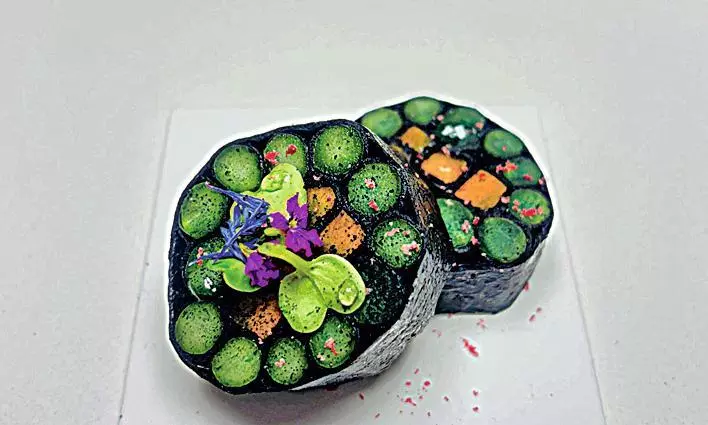
A kaleidoscope of colour has always danced across India’s plates: The golden glow of turmeric-laced dals, the vermilion oil of Kashmiri chillies, the gleaming green of spinach, even the trick of steeping chickpeas with tea bags to lend them the beauty of brown. These hues were never mere decoration. They carried medicine, ritual, and memory.
But somewhere between the rush of industrialisation and the rise of convenience, that spectrum dimmed. The British, with their cheap imports, helped usher in synthetic dyes — bright, stable, affordable, but increasingly shown to be toxic. Neon jalebis, fluorescent peas, and candy-coloured sherbets became normal. The bond between food’s colour and its source was severed.
Now, a rediscovery is stirring — one that comes from ponds: microalgae.
Colour Codes
From spirulina, with its deep blue-green phycocyanin, to Dunaliella salina, rich in beta-carotene, and Haematococcus pluvialis, the source of the reddish-orange antioxidant astaxanthin, algae are being championed as natural successors to synthetic dyes. Globally, food technologists, investors, and chefs are betting on these humble organisms to bring colour back with integrity. India, with its layered culinary heritage and rising appetite for clean labels, is emerging as a contender.
“I see this as a natural evolution. Our grandmothers used haldi and kesar — now we have spirulina and astaxanthin. It’s the same story, just with a new cast. They carry wellness, purpose, and sustainability in every gram, just like haldi in tea or tulsi in milk once did. It feels like we are taking back control, choosing what nourishes us,” says Chef Sombir Chaudary, a culinary advisor.
Deeper Hues Views
Colour in food is not frivolous. It signals ripeness, safety, indulgence, nostalgia. A mithai that glows saffron is festive, a curry with the dullness of faded
spice feels incomplete. For centuries, cooks relied on plants, minerals, and fermentation for their palette, a repertoire tied closely to the seasons, geography, and rituals.
Synthetic dyes disrupted that relationship by offering a global shortcut. But with mounting research on their carcinogenic risks, consumer sentiment has turned. Today’s eaters — especially the younger urban eaters demand food that is both beautiful and transparent. Labels are being scrutinised in ways they weren’t even a decade ago.
This cultural and commercial shift is fertile ground for algae pigments. They promise a way to restore the natural link between colour and source, but with a contemporary edge of wellness and sustainability.
Colourful Food Science
Unlike synthetic dyes, which provide consistent, heat-stable shades, algae-derived pigments are more temperamental. They are sensitive to light, oxygen, and pH, often requiring advanced formulation to make them viable in industrial foods. This fragility is both their promise and their limitation: They are natural, but not always practical.
Here is where food science becomes crucial.
India has begun to scale spirulina production in controlled ponds, but premium Haemato-coccus and Dunaliella are still largely imported. This raises not only issues of cost but also of regulation and traceability. “While baking, microalgae lose their colour. Red becomes pink, and blue becomes extremely light blue. According to the hotel industry, we are not permitted to use blue,” says Chef Avin Thaliath.
Policy And Demand
In 2022, the Food Safety and Standards Authority of India (FSSAI) issued guidelines curbing excessive synthetic dyes in processed foods. Many interpreted it as a signal to explore natural alternatives.
For global brands with a foothold in India, the change has been both a challenge and an opportunity. Reformulating a jalebi or a cola without losing its brightness is no easy task, but it is increasingly demanded by regulators and consumers alike. “The catch is that natural pigments have their quirks. They are not plug-and-play like synthetic dyes,” notes Thaliath.
The Kitchen’s Dilemma
For chefs, however, algae pigments present a conundrum. Michelin-starred chef Suvir Saran remains cautious: “The truth is, we can’t really say how usable algae is in Indian kitchens. Our food is cooked hot, and microalgae often loses potency in fiery temperatures. Right now, it’s more in smoothies than in sabzis. I use them in New York, but it will take time before they ingratiate themselves into Indian food.”
This gap between aspiration and application is where experimentation is unfolding. In test kitchens and fermentation labs, chefs are asking whether spirulina can hold in a mithai, or whether astaxanthin might colour a sauce without fading under flame.
The Road Ahead
For India, algae-based colours are likely to first gain ground in confectionery, beverages, and nutraceuticals, sectors where consumers already equate colour with health. Over time, as stabilisation technologies advance and costs fall, the dream of everyday sabzis brightened with algae-derived hues may not be so distant.
Natural Shades
• The food industry across the world is moving away from artificial food colours.
• Scientists, culinary experts and chefs are looking for natural edible dyes and microalgae-derived pigments for food colouring.
• Spirulina (Arthrospira platensis) has vibrant blue and green pigments (phycocyanin)
• Dunaliella is rich in beta-carotene for orange-yellow hues
• Haematococcus pluvialis produces astaxanthin for red-orange colours
• Astaxanthin is a natural red pigment found in many sea creatures, including shrimp, trout, microalgae and yeast
