Look, Bollywood in Hollywood AIvatar

AI-made Hollywood versions of hit Indian movie are taking social media by storm, but many film buffs are unhappy with the rehashed cinema clips
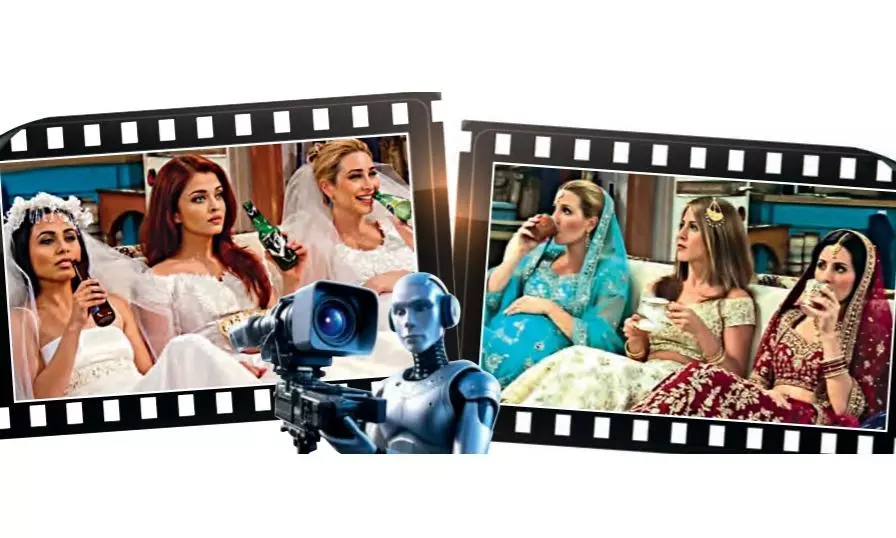
AI-generated recreations of classic Hindi films as glossy Hollywood-style productions are steadily taking over social media feeds, where familiar stories are reborn with darker lighting, restrained performances, and global casting fantasies. Viral clips imagine Sholay as a Quentin Tarantino-inspired Western, Mughal-e-Azam as a sweeping Christopher Nolan epic, and Dilwale Dulhania Le Jayenge as a brooding European-style romance headlined by contemporary Hollywood stars. These short, stylised trailers do not attempt to replace the originals, yet they inevitably provoke a larger question about what happens when cultural memory is filtered through artificial intelligence and Western cinematic aesthetics.
While many viewers treat these experiments as playful tributes, others see them as part of a deeper cultural shift in how global audiences consume and reinterpret nostalgia in the digital age.
The Allure of the Familiar, Reframed
“The fascination comes from recognition,” says film critic Rhea Singh, leaning into the idea that audiences are drawn to the comfort of what they know combined with the thrill of seeing it reimagined. “You are watching a story that is emotionally embedded in your memory, but the visual grammar has completely changed, and that tension creates excitement.”
She explains that mainstream Hindi cinema traditionally embraces heightened drama, elaborate musical sequences, saturated colour palettes, and theatrical dialogue delivery, whereas Hollywood storytelling often favours psychological realism, tonal restraint, and subdued aesthetics. “When AI overlays that re-strained, prestige-Hollywood tone onto Bolly-wood maximalism, it produces something visually seductive,” she adds, arguing that the contrast is precisely what makes these clips so shareable. According to Singh, the algorithm thrives on this balance of nostalgia and novelty because it taps into emotional memory while offering something that feels new enough to stop the scroll. “It feels like discovering an alternate cinematic universe,” she says, “one where the same characters inhabit a completely different storytelling tradition.”
Algorithmic Nostalgia & Cultural Hierarchies
Cultural studies scholar Dr. Meera Nair approaches the trend with caution. “We need to ask why Hollywood aesthetics are being treated as an upgrade,” she says, questioning the underlying hierarchy embedded in many of these recreations. “When a Hindi film is made darker, grittier, and more minimal to appear ‘international,’ we must consider whose standards of sophistication we are internalising.”
Dr. Nair emphasises that Bollywood’s musicality, melodrama, and vibrant visual language are not artistic excesses waiting to be corrected but deeply rooted narrative choices connected to Indian theatrical and mythological traditions. “These elements create a communal cinematic experience that prioritises emotional amplification,” she explains. “Stripping them away in favour of Western tonal restraint risks flattening cultural specificity.”
She also introduces the idea of what she calls algorithmic nostalgia. “AI can recombine visual surfaces,” she says, “but it cannot understand historical context.” A system might replicate costume silhouettes or recreate a dramatic close-up, but it cannot grasp why a dialogue from DDLJ resonated so powerfully with Indian audiences in the 1990s or how Lagaan intersected with conversations around colonial history and national identity. “Without context, you are left with aesthetic remixing rather than meaningful reinterpretation,” she concludes.
The Technology Powering the Trend
From a technical standpoint, the process appears deceptively simple. “The tools are far more accessible now,” explains AI enthusiast Arjun Malhotra, who has experimented with generative visual systems himself. “You can input a prompt asking for a Bollywood classic in the style of a particular Hollywood director, and the system will analyse thousands of visual patterns to produce something that feels convincing.”
Malhotra clarifies that generative models are trained on extensive datasets containing lighting styles, camera movements, genre conventions, and editing rhythms from across global cinema. “What you’re seeing is not invention in the traditional sense,” he says. “It is a highly sophisticated recombination.”
However, he acknowledges the unresolved legal and ethical grey zones. “When you begin using recognisable faces, copyrighted storylines, or stylistic signatures, questions of ownership inevitably arise,” he notes. Likeness rights, intellectual property laws, and creative attribution are still evolving in response to rapidly advancing technology. “The law is playing catch-up,” he adds, suggesting that regulation has not yet fully adapted to the speed of AI development. Still, Malhotra insists that technology itself remains neutral. “AI can be a playground for experimentation,” he says, “but it can also become a tool for derivative content designed purely for virality. The intention behind its use makes all the difference.”
Fans, Fandom & Remix Gen
For many viewers, the debate feels far less ideological and far more celebratory. “I don’t see it as disrespectful,” says Neva Fernandes (26), a Bollywood enthusiast. “When I watch an AI version of a film I grew up with, it feels like creative fan art rather than erasure.”
Fernandes believes the strength of these narratives lies precisely in their adaptability. “If a story can survive being placed in a completely different aesthetic world and still make sense, that proves its universality,” she argues.
To her, the originals remain sacred and untouched, while the AI recreations function as imaginative what-if scenarios.
The younger generation is deeply immersed in remix culture, where alternate universes, fan edits, and speculative crossovers are a natural extension of fandom.
Yet critics maintain that true cultural exchange should move in multiple directions. While Hindi films are frequently imagined through Hollywood’s visual framework, fewer viral trends attempt to reinterpret Hollywood blockbusters within Bollywood’s unapologetically musical and melodramatic tradition. The imbalance suggests that one aesthetic continues to be perceived as mainstream while the other remains exoticised.
Originality in the Age of Artificial Creativity
The larger concern ultimately circles back to originality. “AI is brilliant at recognising patterns,” says Kapoor, “but it cannot replicate lived experience.” She argues that the emotional and political contexts that shaped landmark films cannot be generated through prompts alone. The collective memory of audiences watching these films in packed theatres is inseparable from the cultural moment in which they were released.
Malhotra echoes this sentiment, noting that generative systems are designed to recombine what already exists rather than originate new artistic movements. “The next defining cinematic moment will not come from an algorithm,” he says. “It will come from a filmmaker responding to the urgencies of their time.”
As AI continues to reshape visual culture, the reimagining of Hindi classics as Hollywood productions reveals both the fluidity and fragility of cultural storytelling in a globalised digital era. While AI may alter surfaces and aesthetics, the emotional core of these films remains rooted in the communities, histories, and lived experiences that first gave them meaning.
