Int’l Luxe Houses ‘Fleece’ And Chill With Pashmina

Pashmina, the cultural heirloom of Kashmir, is facing aesthetic colonisation with some Western fashion houses trimming the original embellished textile with pared-back palettes, clean lines, and muted branding
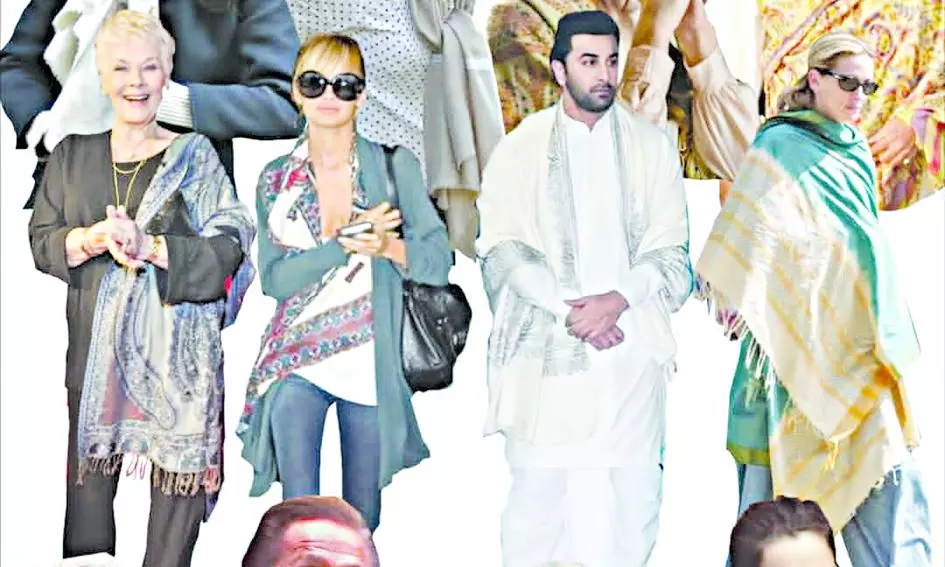
A craft born in the mountains of Kashmir. For centuries, Pashmina has been more than a fabric. It has been a cultural heirloom, woven into the history of Kashmir and carried with ceremonial pride through Indian courts, Mughal ateliers and bustling Himalayan trade routes. Traditionally hand-spun from the delicate underfleece of Changthangi goats, the shawl’s journey from raw fibre to finished piece is slow, human and intimate. Every step has belonged to artisans whose skills are inherited, not acquired, and whose work forms an unbroken thread between generations. Yet even as this craft has endured political turmoil, climate challenges and waves of industrial counterfeits, it now faces a new, quieter threat: aesthetic colonisation.
Soft Shawl Power
From Mughal splendour to minimalist muse, pashmina has been a cynosure of all eyes for centuries. Today, Western luxury houses and Scand-inavian design studios have reimagined Pashmina as a symbol of “neutral elegance.” In the global fashion lexicon, the fabric has been recast into pared-back palettes, clean lines and muted branding. What was once a richly embellished textile associated with royal patronage has been trimmed down to match an international taste shaped by minimalism and uniformity.
This rebranding has travelled far. On Copenhagen runways, Pashmina is often described in marketing language that emphasises purity and restraint rather than heritage and labour. And while fashion evolves naturally, the concern here is not reinvention but replacement: the displacement of cultural identity by a commercially profitable aesthetic that claims universality.
Voices from the Looms
For the people working closest to the fabric, the shift is more than cosmetic. Mohan Luthra, a textile merchant, explains how foreign buyers often demand simplified designs. “They want plain colours because it suits their brand image,” he says. “But our traditional patterns carry meaning. When they remove that, they remove our voice.”
Fabric researcher Rukmini Sharma notes that artisans feel pressured into anonymity even as their skills are celebrated. “The world praises the softness of the wool but forgets the hands behind it,” she says. “The weavers are told to adapt, but adapting sometimes feels like disappearing.”
View from the Closet
Even consumers who buy authentic Pashmina feel the shift. Shanti Devi (70), who owns several inherited Pashmina shawls, observes how the product’s narrative has been reframed. “My mother’s Pashmina was a story of Kashmir, not Copenhagen,” she says. “Now the same shawl is sold as a lifestyle accessory with no context. It feels like the world wants the fabric, but not the culture that created it.”
Aesthetic Colonisation
The story of Pashmina’s global reinvention forces a difficult question: is this simply cultural evolution, or does it echo the same extractive patterns of colonial history? The term “soft power” is often used to describe how culture spreads influence, but in this case, it may also describe how a soft wool becomes a tool for redefining a tradition without the consent of its keepers.
Many Indian artisans argue that the craft’s visual vocabulary has been softened to the point of erasure. Colour, motif and symbolic references have been stripped away to make the shawl fit neatly into European lifestyle narratives. The product remains, but the story has been overwritten.
When Luxury Becomes Loss
This transformation mirrors a wider trend in global fashion, where traditional crafts are often absorbed into minimalist European aesthetics that claim to be timeless or universal.
But the universality is selective. Instead of coexisting with its cultural origins, the craft is often declared “elevated” only after being stripped of the very markers that made it unique.
The result is a troubling paradox: the more Pashmina travels, the more it risks losing itself. Western brands benefit from the artisanal aura, while artisans lose ownership of the story.
The Way Forward
This is not an argument against global visibility, nor against the blending of styles that naturally occurs in fashion. Innovation is essential. But innovation must be rooted in respect. Preserving Pashmina’s cultural identity means acknowledging its lineage, crediting its makers and allowing the craft to evolve on its own terms rather than under external frameworks of taste. Pashmina does not need salvation through minimalism. It needs recognition that its strength lies in its complexity, not its reduction.
A Fabric That Remembers
As the world discusses sustainability and cultural ethics with new urgency, the Pashmina stands as a reminder that heritage crafts cannot be flattened into lifestyle trends without cost. The shawl has survived empires, climates and conflict. It deserves to survive global fashion, too — not as a blank canvas, but as the richly storied textile it has always been.
Shawl Wrong
· Some Western luxury houses and Scandinavian design studios have reimagined Pashmina as a symbol of “neutral elegance.
· Pashmina was once a richly embellished textile associated with royal patronage. It has been trimmed down to match an international taste shaped by minimalism and uniformity.
· In the global fashion lexicon, the fabric has been recast into pared-back palettes, clean lines and muted branding.