The launch lasted minutes. The dream took years. Skyroot co-founders Pawan Kumar Chandana and Naga Bharath Daka take us inside the sleepless nights, bold gambles and quiet sacrifices behind India’s first private rocket to reach orbit
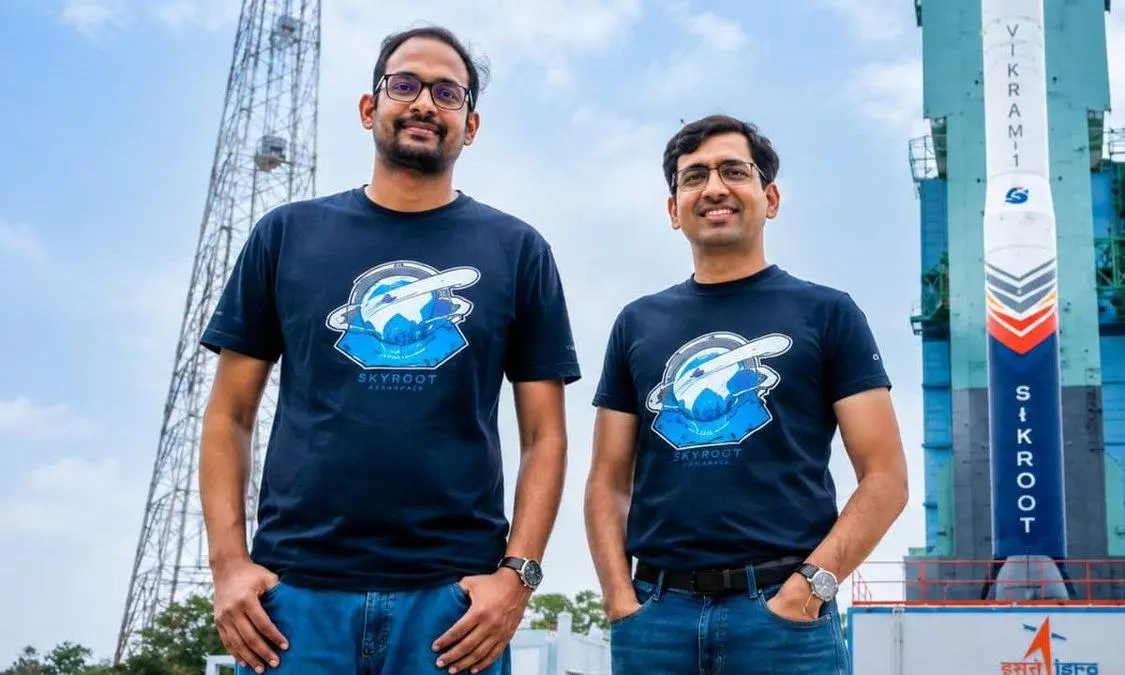
For a few breathtaking minutes, Pawan Kumar Chandana and Naga Bharath Daka weren’t founders or rocket scientists. They were simply two boys watching a dream leave Earth. As Vikram-1 thundered off the launch pad, every second felt like a cliffhanger. Ignition. Stage separation. Fairing deployment. Orbit. “Absolutely, we were two boys watching a dream take flight,” recalls Chandana in an exclusive conversation with Deccan Chronicle. “It felt like watching a suspense movie. Every few seconds brought another critical milestone and we watched with bated breath. We knew first flights are always tricky and failure is often the more likely outcome. But Vikram-1 simply refused to give up and reached orbit on its very first attempt, a rare achievement globally.” For the world, it was a launch that lasted minutes. For Chandana and his team, it was the culmination of years spent chasing what many believed was impossible.
Like many entrepreneurs, Chandana’s dream began in childhood. “I always wanted to become an entrepreneur. I was inspired by the impact entrepreneurs create, generating employment, advancing technology and building institutions that create long-term value for society.”
That ambition grew stronger at IIT Kharagpur, where startup culture was beginning to flourish. “I wanted to start a company straight out of college, but I hadn’t yet found the right idea or calling. Technology and core engineering have always been my passion, so I joined ISRO as a scientist. Looking back, that decision gave me the experience and conviction that eventually led to Skyroot.”
THE FRIENDSHIP THAT BUILT SKYROOT
Their contrasting personalities, Chandana says, became one of the company's biggest strengths. “We have many opposite personality traits, but that’s exactly what makes our partnership complementary and helps us make better decisions together. Our relationship, intellectual synergy and complementary skill sets have been one of the key success factors behind Skyroot.”
The bond extends beyond work. “Our families are very close too, and whenever we get the time, we go on vacations together. Building Skyroot has been a shared journey, not just for the two of us, but for our families as well.”
THE PARTNERSHIP BEHIND THE MISSION
“When you truly know the other person, you don’t judge or misunderstand them based on a few words. You understand their intent and what they value. That has been one of the biggest strengths of our partnership.”
Like every startup, Skyroot also faced moments when its future seemed uncertain. “One of our biggest challenges came during the early months of the Covid-19 pandemic,” Daka recalls. “Our planned Series A fundraise was delayed and we had barely four months of runway left. We kept believing, and fortunately visionary entrepreneurs came forward to back us just in time. The credit goes entirely to Team Skyroot, which kept pushing through every challenge until we crossed what always felt like a moving finish line.”
Even after Vikram-1 reached orbit, the enormity of the achievement didn’t register immediately. “For the first few hours, I was in a state of disbelief, and relief that it was finally over and the result was known,” he says. “It wasn’t until that night that the sheer significance of what we had achieved truly sank in. That's when the emotions finally kicked in.”
WHEN THE DREAM BECAME REAL
For Chandana, one moment stands above all others. “Definitely the launch. That’s when the dream became reality. Years of hard work, uncertainty and belief came together in those few minutes. That moment is etched in my memory forever.”
Behind those unforgettable minutes lay countless simulations, design reviews, engine tests and setbacks.
THE GAMBLE NO ONE SAW
THE NIGHTS THAT TESTED BELIEF
Behind the success were years of uncertainty. “There were many nights when I genuinely wondered whether Skyroot would survive. Entrepreneurship is a brutal journey, and building a rocket company makes it even more brutal because there is absolutely no room for error. Every challenge feels bigger when you’re trying to build something that has never been done before.” By launch day, however, fear had given way to faith. “We had spent years preparing for this moment and were mentally ready for every possible outcome. Whatever happened, we knew we had given it everything. Thankfully, the outcome turned out to be historic.”
THE PEOPLE WHO HELPED BUILD THE DREAM
Behind every rocket, Chandana says, is a family that quietly shoulders the sacrifices. “This journey simply wouldn’t have been possible without my family’s support. They accepted the constant travel, the long hours and the fact that even when I was home, my mind was often still at work. They also dealt with the stress and occasional crankiness that comes with trying to build a rocket company. Those sacrifices rarely make headlines, but they’re a huge part of every milestone.”
CURIOSITY OVER CONNECTIONS
His advice to aspiring engineers is simple. “If a 15-year-old from a small Indian town walked into Skyroot tomorrow, I wouldn’t look at where they came from or who they knew. I’d look for curiosity to learn and a passion for solving difficult problems. Those qualities matter far more than connections.”It is the philosophy that has shaped Skyroot, not privilege. Not pedigree. Just relentless curiosity.
THE NEXT IMPOSSIBLE DREAM
For Chandana, reaching orbit is only the beginning. “Five years from now, I hope international customers see Indian launch vehicles as platforms they can always trust and rely on. That’s the reputation we want to build—not just for Skyroot, but for India’s private space ecosystem. Our dream is to build large reusable rockets that truly open space for everyone. Reusability has the potential to transform access to space, making launches more frequent, affordable and sustainable.”
IF VIKRAM COULD SPEAK...
Before the conversation ends, Chandana is asked one final question. If Vikram-1 could speak after reaching orbit, what would it say? He smiles. “I did it! But I miss being with you all.” Perhaps no engineering report could have captured Skyroot’s journey better. A rocket fulfilled its mission. Two boys fulfilled a dream. And India’s private space story entered a bold new orbit.
Naga Bharath Daka (COO)
· Bachelor’s in Electrical Engineering and Master’s in Microelectronics & VLSI Design from IIT Madras
· Former ISRO scientist specialising in avionics and launch vehicle systems
· Leads operations and the guidance, navigation and control systems behind Skyroot’s rockets
Pawan Kumar Chandana (CEO)
· Dual degree in Mechanical Engineering from IIT Kharagpur
· Former ISRO scientist specialising in launch vehicle propulsion
· Leads Skyroot’s vision, strategy, technology and business growth
THE TWO MEN BEHIND SKYROOT
· Long before they became entrepreneurs, Pawan Kumar Chandana and Naga Bharath Daka were colleagues and roommates at ISRO, united by a shared dream of making space more accessible.
· Both IIT graduates, they left secure government careers in 2018 to co-found Skyroot Aerospace in Hyderabad, when India’s private space sector was still in its infancy.