Green Aquatic Warriors Clean Up Choked Rivers

As India’s rivers grow toxic, a grassroots revival powered by aquatic plants and ancient community wisdom offers a natural alternative to concrete fixes and chemical treatments.
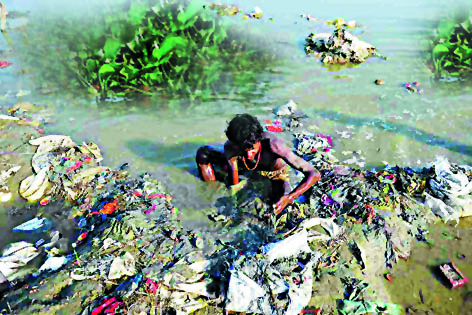
In the battle to cleanse India’s increasingly toxic rivers and water bodies, a quiet green revolution is taking root literally. Across ponds, lakes, wetlands, and even urban lakes, aquatic plants are being deployed to mop up pollution through a process called phytoremediation. But while the science shows promise, experts caution that these nature-based solutions require local wisdom, proper policy support, and above all, a shift in mindset away from the chemical treatments and concrete-heavy approaches.
Science Beneath the Surface
At its core, phytoremediation uses plants. Especially fast-growing aquatic species to absorb, accumulate, or break down pollutants in water. It’s been touted as a low-cost, eco-friendly alternative to expensive wastewater treatment systems.
“Aquatic plants like hyacinth, duckweed, and water lettuce reduce water pollution through the phytoremediation process,” says Ritu Mishra, a Researcher and Assistant Professor at Allahabad University.
“Water hyacinth is famous for its phytoaccumulation capacity. Duck-weed has a high efficiency in absorbing nutrients (nitrogen and phosphorus).”
These nutrient-absorbing abilities make phytoremediation particularly effective in water bodies choked by agricultural runoff. “Phytoreme-diation is more effective in stagnant water or slow-moving water bodies, as it requires more contact time,” she adds. “Phytoremediation is effective in nutrient-rich water bodies like ponds and lakes in agricultural fields.”
Indeed, the real-world applications are gaining ground. “In Delhi, an urban lake called Neela Hauz shows significant improvement in its water quality and aquatic ecosystem after the phytoremediation approach,” Mishra notes. “Water hyacinth is used in East Kolkata Wetlands (‘Bheris’), a unique ecosystem, to purify city sewage before it enters the Hooghly River.”
A Complex Path
Despite these success stories, experts acknowledge that phytoremediation is no silver bullet — especially for India’s sprawling, fast-flowing rivers.
“Despite being cost-effective, nature-based, solutions like phytoremediation and bioremediation are not very effective in treating large rivers because of their low efficiency,” says Sughosh Madhav, a research scholar at Jamia Millia Islamia. “Inorganic pollutants and plastic waste cannot be treated by nature-based solutions. Some-times, nature-based solutions are the cause of methane pollution and waterborne diseases if not handled properly.”
Mishra also underscores the risks and limitations. “Invasive species destroy the natural biodiversity of the aquatic ecosystem. Water hyacinth is a dominant species that replaces native species,” she warns. “Landfilling of contaminated biomass leads to soil and groundwater contamination. Burning biomass releases contaminants into the atmosphere.” Climate variability poses further challenges. “Climate change and seasonal variation reduce the efficacy of phytoremediation,” says Mishra. “Phytoremediation needs more time, and changing seasonal temperature and precipitation reduce its efficiency.”
River Rejuvenation
If aquatic plants are only part of the solution, what else is missing? “River cleaning actually starts from your home. Every home has to think — because all the waste we generate ultimately ends up in the river,” says Ranjan Panda, a water and climate expert of the country popularly known as the Water Man of Odisha.
“You cannot define a river rejuvenation plan just by constructing sewage treatment plants,” he insists. Panda, who leads the “Youth for Water India” campaign, believes real solutions begin far upstream. “Real nature-based solutions must start at the catchment and watershed level, not at the riverbank,” he says. “Riparian zones are completely forgotten in India. Without managing these, we cannot purify or revive rivers.” He also challenges India’s infrastructure-heavy approach, “Governments still operate with the belief that concrete infrastructure will save our rivers. That’s exactly what we’re trying to counter.”
Traditional Wisdom
What’s often missing in official strategies, experts say, is the power of local communities—those who have lived beside water bodies for generations. “I am a strong believer in community power and the strength of reviving natural resources through traditional knowledge of indigenous and local communities,” says Panda. “If we support local communities ecologically and economically, they will be the best guardians of our natural ecosystems.”
Madhav agrees, “Local people can contribute to river cleaning and conservation with their cultural practices and social norms. Their emotional attachment to water bodies will be helpful in the revival and conservation of water resources.”
He points to a shining example, “The revival of the Kali Bein River in Punjab by Sant Balbir Singh Seechewal and his followers is an excellent example of social participation in water conservation.”
Panda shares this sentiment. “My biggest hope is in the Forest Rights Act and the indigenous communities who live in and protect our forested watersheds. India still has many rural areas and natural forests—if we invest in these wisely, there’s still hope for true ecological restoration.”
Gaps in Governance
While the science and community will exist, implementation lags due to institutional inertia. “There is a need for a one water approach and joint operation by different agencies,” says Madhav. “Heavy fines and strict action should be taken against the polluter of rivers, wetlands, ponds and lakes. Policies require continuous monitoring of water resources.”
Mishra points out the lack of trained personnel. “There is no specific trained professional for handling this technology in the field,” she says. “There is a need for some pilot projects, especially in urban areas where expertsc are available.”
Policy innovation, she believes, can create the necessary framework. “Making government policies and frameworks that include phytoremediation-like technologies provides them with legal and administrative support.” She also suggests, “Corporations and Memoranda of Understanding (MOUs) between municipal corporations and academic institutes provide mutual benefits to both parties.”
Towards a Blended Future
While scientists and activists alike caution against overhyping phytoremediation, all agree it can be an essential part of a broader, more holistic approach.
“Constructed wetlands can be useful for the treatment of sewage before its discharge into water bodies,” says Mishra. “The collaboration between academics and municipal corporations can provide better results in lakes and ponds through phytoremediation. The Public-Private Partnership (PPP) model provides funds for the basic infrastructure and operational costs.”
Experts say that technology should complement, not replace natural methods of restoration. The roots of recovery may lie just as much in wetlands as in policies and pipelines, nurtured by plants, powered by people, and grounded in local knowledge.
