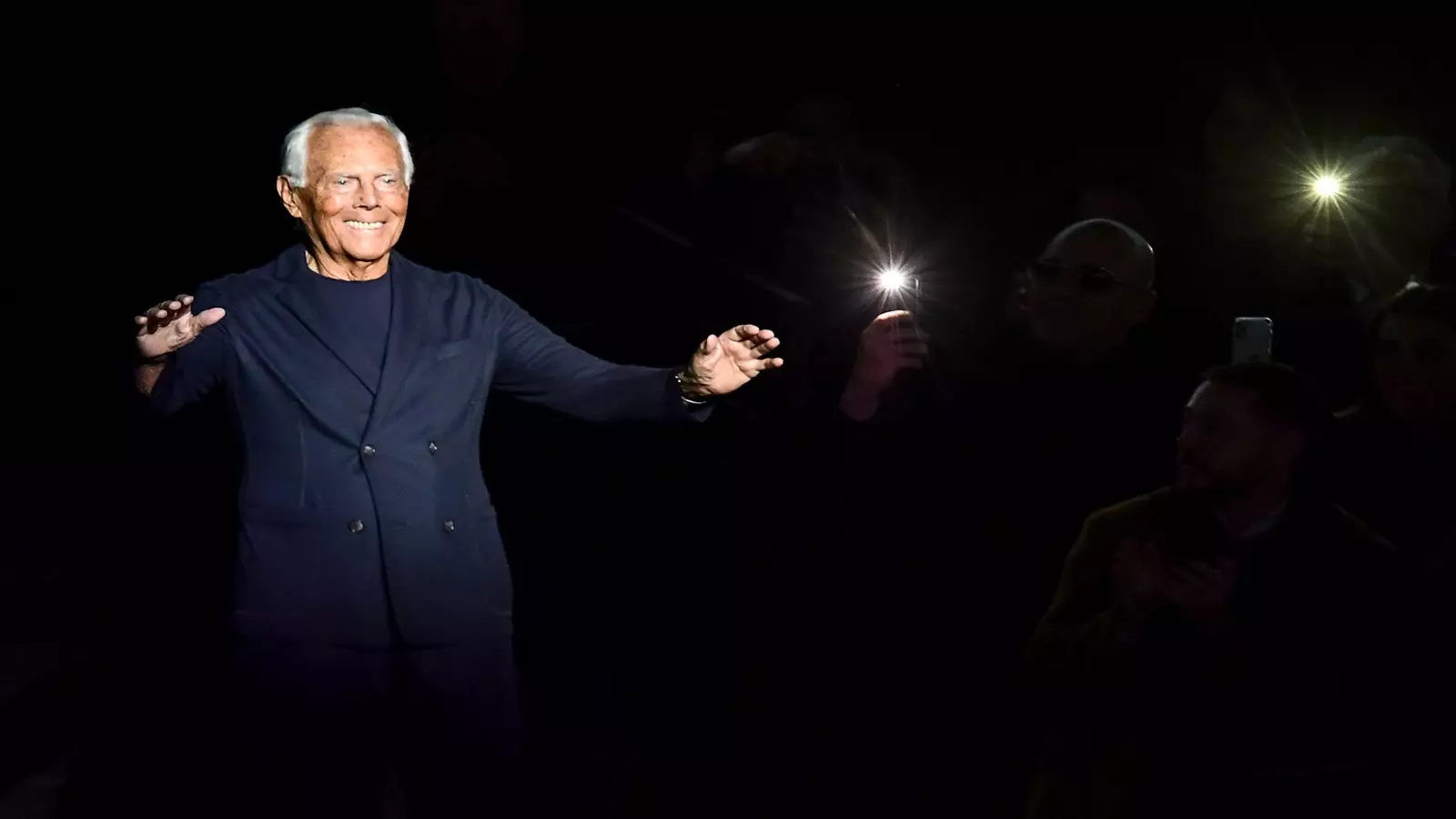
For more than five decades, Giorgio Armani redefined modern luxury with clean lines, muted palettes, and effortless tailoring. From Hollywood and Bollywood stars to world leaders, his signature style earned him the title ‘King Giorgio’ and a timeless place in fashion history
Hollywood Breakthrough
Born in Piacenza in 1934, Armani grew up in postwar hardship and briefly studied medicine before turning to fashion. After early work at Nino Cerruti, he launched Giorgio Armani S.p.A. in 1975 with Sergio Galeotti, rising swiftly to earn the title “King Giorgio.” Armani’s global moment came in 1980 when he dressed Richard Gere in American Gigolo. The sleek, softly tailored suits—free of padding and stiffness—redefined menswear for the decade. From there, Armani became Hollywood’s designer of choice, with his creations appearing on red carpets, in films, and on the shoulders of stars who wanted glamour without excess.
Power Dressing for Women
Armani was equally transformative for women. In 1978, Diane Keaton accepted her Annie Hall Oscar in a deconstructed Armani blazer and skirt, setting a new standard for red-carpet chic. Julia Roberts cemented the look at the 1990 Golden Globes in an oversized Armani suit that became an instant style moment. Political figures, too, gravitated toward his quiet authority—Hillary Clinton and Nancy Pelosi regularly wore Armani in Washington, while Italy’s first woman prime minister, Giorgia Meloni, often favoured his tailored suits.
The Heirs
Never married and without children, Armani lost his partner Sergio Galeotti to AIDS at 40. His empire is expected to pass to his nieces Silvana and Roberta, nephew Andrea Camerana, and longtime lieutenant Pantaleo Dell’Orco.
Global Legacy
Beyond the runway, Armani built a multibillion-dollar fashion empire bearing his name, spanning ready-to-wear, couture, home, and fragrance. He championed “quiet luxury” long before it became a buzzword, proving that elegance need not shout. His influence shaped the wardrobes of celebrities, leaders, and everyday professionals, leaving behind a timeless blueprint for modern style.
Armani’s fashion house generates about 2.3 billion euros ($2.7 billion) in annual turnover and remains a coveted brand despite industry headwinds. Forbes ranked him 208th among global billionaires in 2024, with a net worth of $12.1 billion—making him the third-richest Italian.
Beyond Fashion
Armani expanded into perfumes, eyewear, and labels like Emporio Armani and Armani Exchange, building a multibillion-euro empire. The designer also owned several bars, clubs, restaurants and his own basketball team, Olympia Milano. Armani opened more than 20 restaurants from Milan to Tokyo since 1998, and two hotels, one in Dubai in 2009 and another in Milan, in 2010. A sports fan, he designed for Chelsea, the England football team, and Italy’s 2012 Olympic squad.
I have always had the deepest respect and admiration for Giorgio Armani, not only as a designer who never strayed from his vision, but as a man who loved his family and friends, and his homeland in such a special way. Though he was an icon of the world of fashion, he lived with great humility and a love of living that inspired the way he worked and the way he lived. He created a world reflecting all the things he loved with a foreverness that will be his legacy.”
— Ralph Lauren, the American designer
“A true friend. A Legend,” followed by a broken heart emoji.
— Julia Roberts
“Heartbroken to hear about the passing of a legend. A true master of his craft.”
— Cindy Crawford, the supermodel
“The world lost a giant today. He made history and will be remembered forever.”
— Donatella Versace, Italian fashion designer
“The fashion world has lost a true legend in Giorgio Armani — a visionary designer whose legacy will live on forever. I feel honoured to have called him a friend.”
—Victoria Beckham, English fashion designer and former Spice Girl