From red carpets to streetside fashion, women are enjoying the spotlight with their feline friends roaming all over their sarees
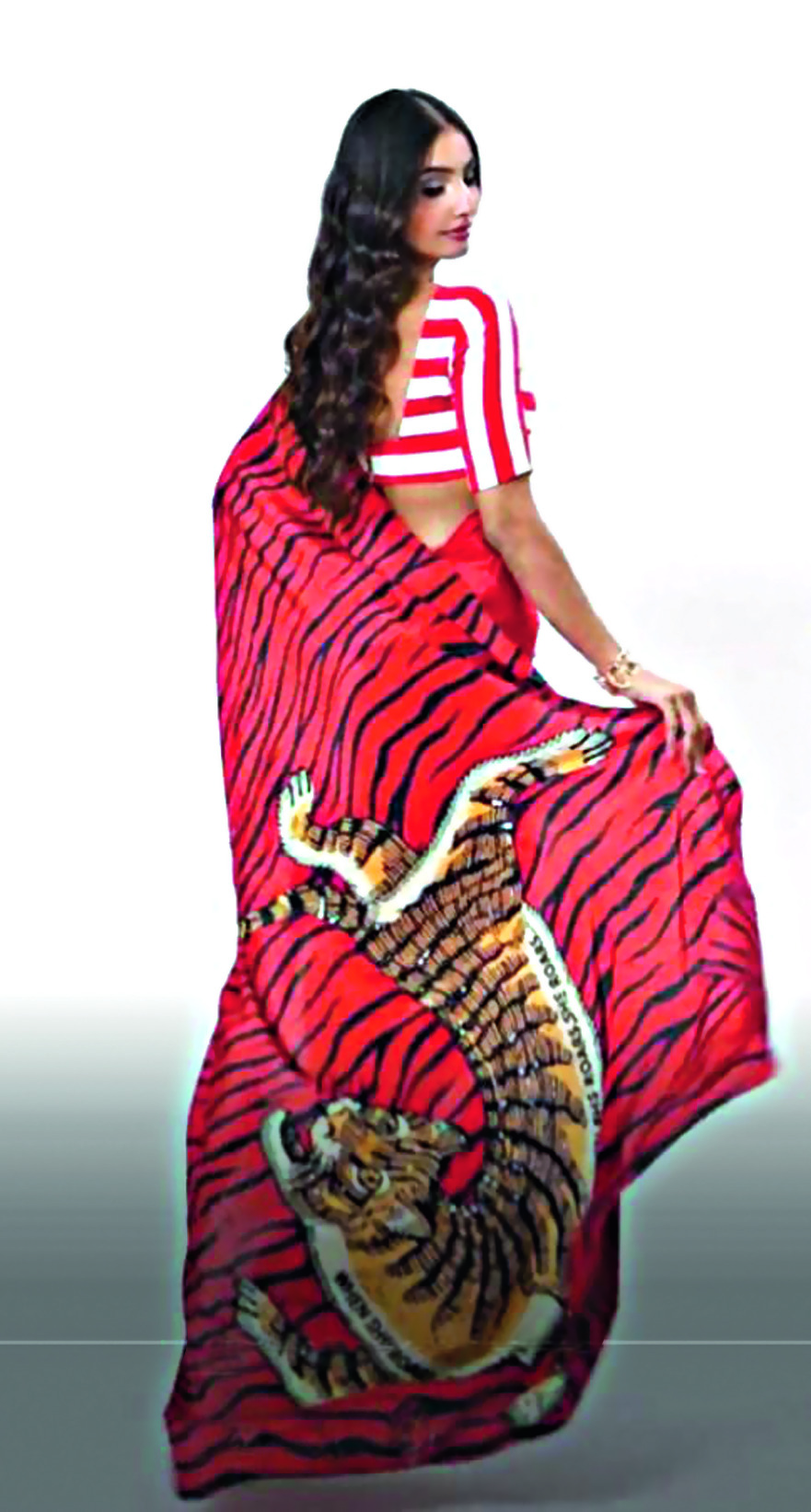
Forget florals for a minute. There’s a new creature prowling across the saree—and it has claws. The tiger has been turning up on Indian textiles for years, but lately, the big cat seems to have found a new swagger. It appears embroidered on pallus, woven into borders, hiding among flowers and leaves, or taking centre stage in all its striped glory. Sometimes it looks fierce. Sometimes surprisingly cute. And sometimes, it looks like it has just walked out of a very glamorous jungle and landed straight on a six-yard drape.
Tigers Tracks Textiles
Indian crafts have always had a soft spot for the natural world. Elephants, peacocks, fish, deer, birds and flowers have all made their way onto fabric. But the tiger has a certain presence. You don’t just notice it. It looks back at you. And there’s a reason for that.
For centuries, the tiger has been associated with strength, courage and power. In Indian mythology, it is closely linked with Goddess Durga, making the animal a particularly interesting symbol of feminine power. In folk and traditional art, meanwhile, the tiger has often been interpreted in wonderfully imaginative ways—sometimes as a recognisable big cat, sometimes as a slightly strange, exaggerated creature that is more fantasy than forest. And honestly, that is what makes tiger motifs so much fun.
Wildly Woven
Look closely at Indian textiles and you’ll realise there isn’t one standard tiger. Some are almost lifelike, complete with stripes, sharp eyes and a very serious expression. Others are reduced to a few clever lines and shapes. In traditional weaving and embroidery, the animal may be simplified to fit the craft’s visual language. In folk-inspired designs, it can become wonderfully graphic and decorative.
A designer might place one among oversized flowers, give it an unusual colour, or turn its stripes into an abstract pattern. Suddenly, you aren’t looking at a wildlife illustration. You’re looking at fashion.
And the saree gives a tiger plenty of room to roam. It can sit quietly on the border, appear dramatically on the pallu or stretch across the body of the drape. It can be the star of the show—or a little surprise that you notice only when the wearer moves.
Stylist Aditi Mehta adds, “If your saree has a big tiger on it, let it have its moment. You don’t need to compete with it. Keep the blouse simple and the jewellery edited. The whole point is to look like you’re wearing the tiger—not like the tiger is wearing you.”
Mane Event
What makes the tiger particularly appealing to contemporary fashion is that it can be glamorous without becoming too serious.
Put a tiger on a rich silk saree and suddenly it feels regal. Embroider it in metallic thread and it becomes eveningwear. Make it tiny and repeat it along a border, and it becomes playful. Change the colours and you’ve got an entirely different personality.
A traditional orange-and-black tiger feels bold and instantly recognisable. A black tiger embroidered on ivory can look almost like a sketch. A jewel-toned version can feel wonderfully OTT—in the best possible way. Designers are also playing with the idea of the tiger rather than simply copying one. Stripes, eyes, paws and silhouettes can all become design elements.
Stylist Nisha Shah states, “Don’t try to match everything to the tiger. If the saree has green, gold and orange, you don’t need all three colours in your accessories. Pick one detail and repeat it. A contrasting blouse can actually make the animal motif pop.”
Paw-some Drapes
Actors like Vidya Balan, Shilpa Shetty and Sobhita Dhulipala have embraced these fashion symbols, but the best ones don’t feel like symbols when you wear them. They feel like a mood. A tiger can say, “I’m feeling powerful,” without requiring you to announce it. And there is something deliciously unexpected about putting such a wild animal on something as elegant as a saree. The drape is graceful. The animal is all attitude.
It is perhaps why the motif can move so easily between an heirloom textile and a very modern wardrobe. Your grandmother might have had an animal motif on a handwoven saree; today, you might wear a contemporary version with a crop blouse and heels. Different styling. Same fascination.
There is also a more meaningful side to the obsession. The tiger is one of India’s most recognisable wild animals, and its presence in art and fashion can evoke the forests and wildlife that have inspired Indian visual culture for generations.
Stylist Priya Menon explains, “I love pairing an animal-motif saree with something slightly unexpected—maybe a clean metallic earring, a modern blouse or even a structured bag. It keeps the look from feeling too traditional. The trick is to balance the wildness of the print with something polished.” And perhaps that is the real reason the tiger continues to survive—and thrive—on Indian textiles.
Saree About That Tiger
It can be traditional without looking old-fashioned. It can be dramatic without being difficult. It can carry mythology, craft and history, and still look completely at home at a cocktail party. Most importantly, it has character.
So, the next time you see a tiger on a saree, don’t just look at the stripes. Look at how it has been imagined. Is it fierce or funny? Realistic or fantastical? Hidden in a jungle or boldly taking over the pallu?
Because Indian textiles have never simply copied nature. They have given it a personality. And right now, that personality has whiskers, stripes—and a rather fabulous sense of style.