Enterprising Housewives On 'Screen'

Many women entrepreneurs from small towns are reshaping e-commerce with social media platforms and bringing about change in society
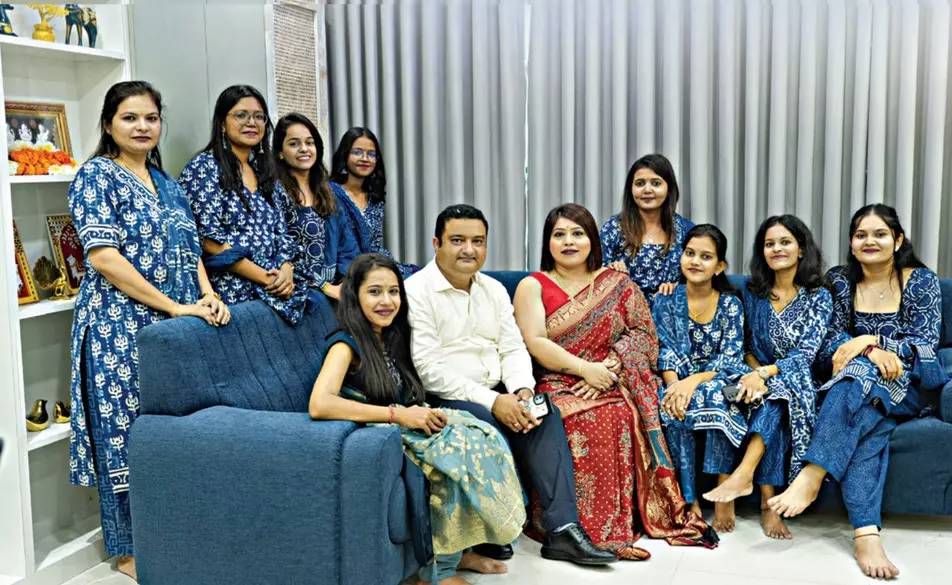
Sara Kadyan from Hisar, Haryana, a dentist who was crowned Mrs. India Worldwide 2018, helped a stranded weaver sell his orders during the pandemic. What began as a favour to distribute unsold sarees among relatives turned into a mission. Soon, with her sister-in-law Ritu Kadyan, she launched a brand (Noor Nayab) dedicated to authentic handlooms.
Sara now hosts three to four lives a day, each drawing 300–400 viewers. A single live often results in around 150+ orders per day. “Many weavers pass off polyester as pure kataan silk, which sells for barely half the price of real silk. But our customers know that when Noor Nayab calls something genuine, it truly is. That trust is our foundation,” Ritu adds.
Loss & Healing
On the other side of the country, in Jamnagar, Gujarat, Mourina Chatterjee was battling grief and loneliness. But it was during COVID-19, through FB Lives under the name ‘Aushima’s Collection’ that she found a second chance. Borrowing sarees from a local shopkeeper to showcase on camera, she began streaming daily. “My customers healed me. My business healed me. After my mother passed away, I was depressed. But the interaction, the comments, the trust my customers placed in me, those pulled me out,” she says.
Today, her FB page boasts over 5.3 lakh followers with an annual turnover in crores. She recalls, “A saree has no size. Anyone can wear it. It always looks graceful. My mother owned sarees from across India and could identify each by its weave. From her, I learned how to distinguish pure cotton, synthetics and authentic silk.”
Their commitment to authenticity is what allows women sitting miles away in small towns, villages, or tier-2 cities to confidently order clothes that they have only ever seen through a phone screen.
The Balancing Act
All these women juggle families, children, and their business ventures. In Fact, Mourina’s husband left his corporate job to support her venture full-time. Their evenings often revolve around packaging, dispatch, or brainstorming designs. “Now I have a team of 8–10 young people, mostly girls. We’ve created a space where women can work with dignity and peace,” she says. Unlike traditional retail, virtual business setups allow women to work around school timings, household chores or even bouts of personal struggle.
Bhavneet from Bathinda, Punjab, began humbly with just a handful of shirts and dupattas in 2022. A mathematics teacher by training, virtual commerce became her escape. She says, “First one order came, then more. I never thought of scaling or opening a boutique. I just want to keep doing good work.” Her story mirrors thousands of smaller sellers across India who may not have teams or studios, but who find joy and identity in a single successful order.
The New Bazaar
Virtual commerce platforms have transformed the lives of many artisans and enterprising women. “In India, if you’re not earning, people don’t recognise your contribution. But housewives work harder than anyone,” says Sara. In many ways, e-commerce has become India’s new bazaar. And women are emerging as its most dynamic buyers and sellers. The honesty, hard work, girt and resilience of these ‘enterprising women’ show that this is not just about clothes. It is about reclaiming agency, building communities, and proving that even through a screen, authenticity matters. From Hisar to Jamnagar to Bathinda, and other parts of India, the saree, the screen, and the seller have together woven a silent revolution, one draped in tradition, powered by trust, and carried forward by women who refuse to be confined.
