Indian couture week begins where every great Indian story starts — at home
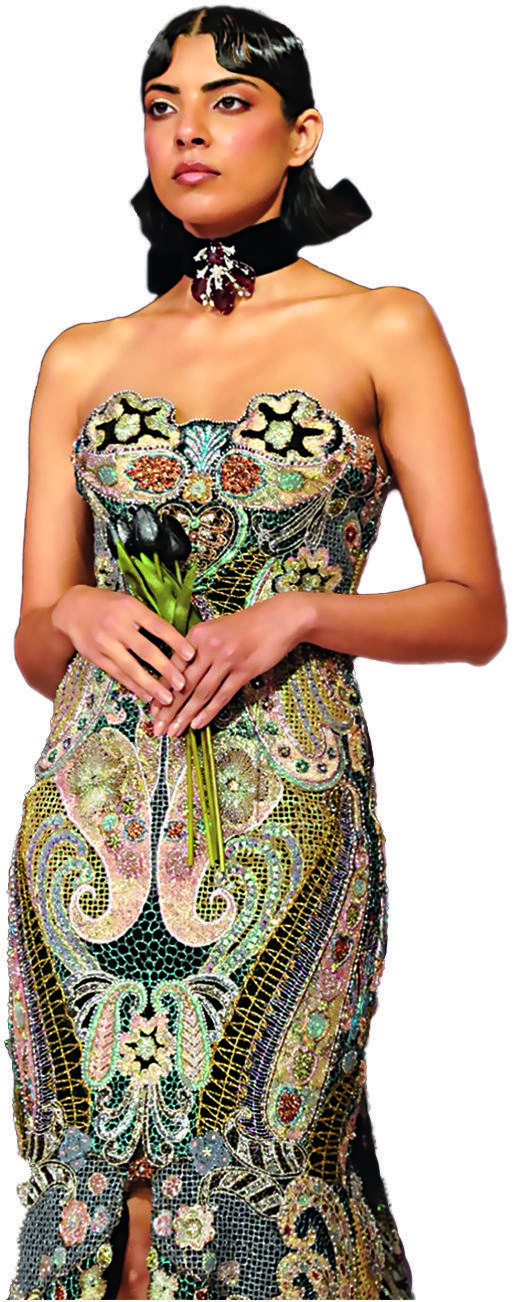
As Indian Couture Week opens in New Delhi, the conversation around Indian luxury is taking a decisive turn. Rather than looking outward for validation, a new generation of designers is looking inward—to India’s textiles, crafts, regional histories and inherited techniques—to define what contemporary couture can mean.
From Banarasi brocade and mirror work to appliqué and generations-old handcraft traditions, Indian fashion is increasingly positioning itself not as a participant in global luxury, but as one of its original sources. The runway is becoming an archive, carrying stories of communities, artisans and techniques that have survived through generations.
Evolution Of Glasswork
For designer Aisha Rao, the answer is not to keep Indian craftsmanship frozen in its historical form. Her approach centres on allowing traditional techniques to evolve while maintaining a clear relationship with their origins. “Tradition doesn’t have to be preserved by keeping it unchanged,” Rao says. “It can remain relevant by being questioned, experimented with and given a new context.”
Her work with appliqué illustrates that philosophy. The technique becomes more than decoration, creating depth, texture and new expressions on the garment. In the collection Priyasi, Rao pushed that exploration further through materials including BioResham and BioBadla, developed from textile remnants and thread offcuts.
The result is a contemporary couture language that treats heritage as a living resource rather than a museum object. Banarasi brocade, for instance, can move into unexpected silhouettes without losing the identity embedded within the textile itself.
When Heritage Gets Renamed
The renewed focus comes at a moment when Indian aesthetics are increasingly visible across international fashion and popular culture. A familiar Indian visual vocabulary can appear elsewhere and suddenly be described as “Scandinavian,” “Ibiza-coded,” “Mediterranean-rooted” or simply “global.” When the story is removed, the craft can very easily become just an aesthetic. The distinction matters. A mirror work embroidery distinctively and widely known sheesha embroidery surface is not merely a visual effect.
It carries a history. Calling it Boho chic just because calling it Indian makes you feel inferior or lesser is not fashion. Indian and Hindu art has always been stolen and never returned back be it Yoga, astrology, self-care et al. That stolen textile is not simply a material, it represents technique, geography and human labour. The inspiration that they take from India is visible in their work and their art but there’s no credit to the country rather they say it’s ’Spanish heritage’ or Scandinavian and whatnot.
The Value of Roots
In an industry where exclusivity has traditionally been measured through rarity, craftsmanship and price, designers are now pointing towards another form of value: transparency. “Indian craft has never needed to be made ‘global’ to have value,” Rao says. “Its depth and sophistication already exist within the culture and communities that have sustained it.”
For her, “reliability is becoming the new luxury”—knowing where something comes from, who made it, what went into it and why it exists. The global appetite for Indian fashion, therefore, need not be resisted. Instead, it can be met with greater specificity. The objective is not to prevent Indian craft from travelling, but to ensure that its identity travels with it.
Making the Hand Matter Again
Fashion designer Arpita Mehta sees Indian fashion as inseparable from memory, celebration and everyday cultural life. “There is so much emotion attached to what we wear here—it is connected to our memories, our families, our festivals and our rituals,” she says. Her relationship with mirror work reflects this philosophy. Mehta explores how its emotional and cultural associations can exist within contemporary silhouettes designed for the modern woman.
For her, the most important lesson for the next generation is the value of the hand. “There is something incredibly special about knowing that a piece has been created slowly, with skill, patience and an understanding of a technique that may have been passed down through generations.” In an era of accelerated production and instant accessibility, that slowness becomes its own luxury.
Indian Roots, Global Future
Indian designers are not rejecting global fashion. They are questioning the assumption that becoming global requires becoming less distinctly Indian. Rao argues that the future lies in building “from a strong sense of who we are, and then allowing that identity to travel.” Her collections combine traditional textiles and craft with contemporary silhouettes, unexpected materials and references from different artistic worlds.
Mehta shares the same fundamental belief: heritage survives when people can find new reasons to love it. “If we can make someone fall in love with a traditional technique through a contemporary silhouette or a new way of styling it,” she says, “then I think we’re helping that craft continue to live and evolve.”
That may ultimately be Indian couture’s most powerful proposition. The future of Indian luxury does not have to be invented elsewhere. It can begin at home — with the textile, the artisan, the technique, the memory and the story. And perhaps the most radical luxury statement of all is simply knowing what to call it.