Experts decipher Gen-Z’s ‘blank look’ even as parents and teachers worry about their ‘lack of social skills’
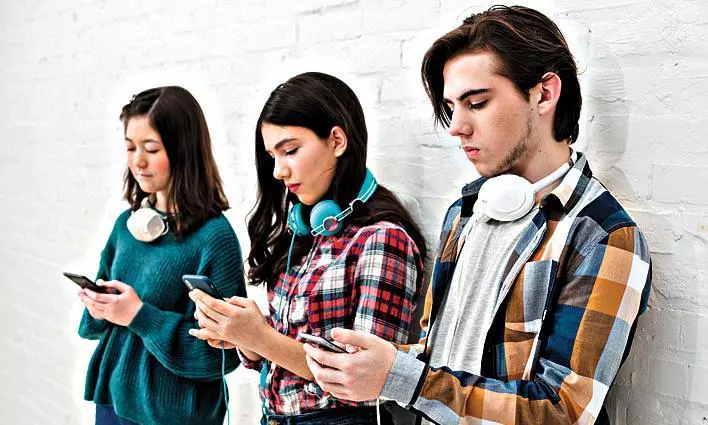
What is the Gen-Z stare? The ‘Gen-Z Stare’ is described as a prolonged, blank, and expressionless gaze in various social situations. Sometimes, there is ‘no eye contact’ but just a ‘bored look.’ Not to mention the occasional ‘thank you’ and awkward monosyllabic conversation. Social media is rife with parents and people sharing their experiences of dealing with the Gen-Z stare. On the professional front, the customer service industry, in particular, has been at a crossroads with the ‘Gen-Z stare.’ At airport shops, malls, and salons, many have noted that Gen-Z employees often give customers a ‘blank, deadpan look.’ Some allegedly don’t even respond to customers’ questions or exchange basic greetings, such as a “Hello” or a “Thank You.” Like it or not, it becomes an uncomfortable space for everyone and sends the wrong message.
Real Life Experiences
“Sometimes, when I am interacting with my child, I get a stare. The child is just looking through me. I’m physically there, but she’s looking somewhere else,” says Smitha Vijay, parent of a 17-year-old girl. Vijay likened the stare to a lack of interest, a checkpoint to understand that her child had completely zoned out.
In defence of the stare, Vaishnav Ramakrishnan, a Gen Z student, says, “I’m usually feeling detached for a purpose. Sometimes
I’m just tired, or I’m thinking about something, so I zone out. I mean no offence. I just want five minutes to myself.”
He notes that many adults misinterpret Gen Z’s need for space as rudeness. “Sometimes it is just awkward for me to hold eye contact, but that doesn’t mean I am not present in the conversation,” he says. Ramakrishnan asserts that the development of certain conversational patterns in the newer generation, like being more straightforward, has made many adults feel uncomfortable.
A Deeper Understanding
Priyasha Malhotra, a school counsellor, paints these patterns in a more positive light. “These kids know when to put down their boundaries – they’re very aware. A lot of people, teachers, family, friends, mistake their response to rudeness, instead of understanding that it comes from a place of vulnerability,” she says.
What has caused this behavioural shift? “The pandemic was a spark,” says Vijay. In her observation, the COVID-19 pandemic changed how adolescents socialised, bottling their entire life in the digital sphere. “This is an age when your child is still growing and developing, but the level of physical communication required has gone down drastically,” she says.
Ramakrishnan, echoes her sentiment, saying that the pandemic made it very difficult for him to converse with people.
“I was too much on the phone back then, so I got used to texting. Going face to face, I didn’t know what to say,” he says. According to him, it took a few months for him to ‘relearn’ socialisation.
Malhotra believes that the isolation caused by the pandemic may have limited the course of emotional experiences for Gen-Zers since conversations on text may not have given them enough space to empathetically connect.
Pros & Cons
Indu Singh, a psychologist, explains that adolescence is a very crucial period in a child’s life. “Learning about social and interpersonal skills does not happen overnight. It takes months and years for a child to hone his/her social skills. Unfortunately, many Gen-Z kids spent their formative years in isolation due to the pandemic lockdown,” Singh says.
Malhotra feels that students are very self-aware now – they’re more intrapersonal than interpersonal. “At this age, their prefrontal cortex isn’t fully developed yet. Kids in their adolescence are supposed to be more emotionally inclined. But, due to their access to social media at such a young age, they’re moving away from emotions. Instead, they’re intellectualising and rationalising their experiences,” she says.
Anushree Bhat, a college student, points out the positives due to the pandemic. She feels she didn’t interact with people, but it let her create her own space to feel secure in. While Malhotra agrees that boundary-setting was a positive outcome, she fears that many people struggle to make their boundaries more flexible by letting people in, but still holding their ground. “There is a lot of wisdom that comes from emotions, to identify and express what the students are feeling openly and communicatively. And given that this is my approach as a therapist, I help these kids try to find a balance,” she says.
The Deadpan Look
Minelli Pinto, an expressive arts facilitator, disagrees with labelling the ‘Stare’ as a quintessentially Gen-Z trait. Rather, she believes it to be an iteration of behaviour expressed by earlier generations. She says, “Every generation has had moments of zoning out at a party, staring out the window on a bus, or going inward in socially awkward or uncertain situations. It can be a response to not knowing what to say, a moment of observation, or simply being lost in your thoughts.”
Malhotra calls the ‘Gen-Z Stare’ a generalised term used in social media specifically. “Rather than this being a response to changing norms of communication, I think it is just a learned response to an intimidating conversation or situation. When you feel like you’ve been put on the spot, your nervous system activates the freeze state,” she says, asserting that this behaviour can be found in people across all age groups.
Looking Forward
Ramakrishnan feels that the entire ‘Gen-Z Stare’ thing comes from this generation’s pursuit towards nonchalance. He says, “Nobody wants to show that they care deeply about anything, and it’s time there’s a slight attitude shift now.” Bhat says that while people her age have tried countless times to express themselves to older adults, she feels they were shut down or judged intensely. “If you find it difficult to understand me, I will just not explain it to you,” she says.
According to Malhotra, the best strategy that parents and teachers can adopt is to create a safe space for the newer generation with purposeful listening rather than just reacting to them. “This is for the child to know that they are heard, and that they are being validated,” she says. Confidence leads to more open and clear communication. And perhaps the solution to the Gen-Z stare has always been plain, simple communication.

