Borrowed Ideas, Bird Couture & Frow Buzz

At Paris Haute Couture Week, the biggest spectacle wasn’t on the runway but elsewhere. Couture came wrapped in surreal latex fantasies, towering beanstalks, sculptural silhouettes and enough social media discourse to outlast the collections
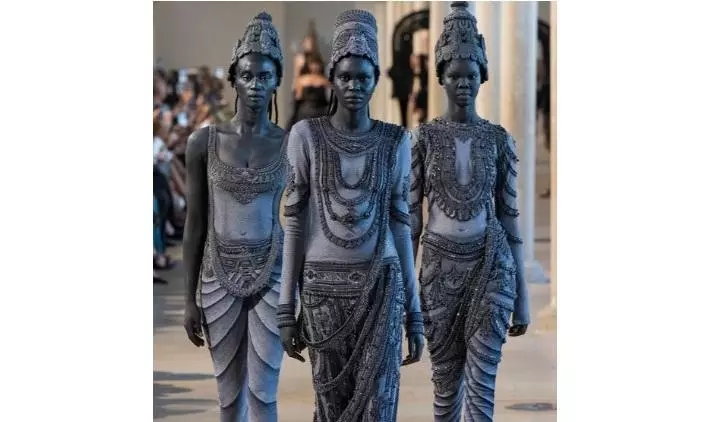
Paris Haute Couture Week has always traded in spectacle, but this Fall/Winter 2026-27 season, the front row stole the show before the first model even hit the runway. In fashion’s attention economy, controversy has become couture’s most dependable accessory — and social media is turning out to be its loudest front-row critic. Somewhere between Schiaparelli’s surreal theatrics, Chanel’s towering beanstalk fantasy and Jonathan Anderson’s sculptural couture for Dior, celebrities turned into performance art, while the internet busied itself dissecting everything from borrowed inspiration to feathered fashion statements.
When couture sparks a déjà vu
While veteran designer Tahiliani shared pictures of his old collections inspired by temple toros and apsaras and wrote on his social media, “India’s artistic legacy has always been at the heart of our journey. Inspired by the power and rhythm of Nataraja, we celebrate movement, craftsmanship, and culture - where every step of our studio’s evolution echoes tradition, reimagined for today.” (SIC)
Instagram promptly did what it does best. Fashion pages overflowed with side-by-side comparisons, accusations of plagiarism and debates over whether all three designers had simply arrived at the same cultural reference point. One senior fashion editor cheekily dubbed it “Devi déjà vu,” while fashion director Prasad Bidapa quipped in the comments, “Think they prayed at the same temple… God shared the boon between them.” What we saw at Paris Haute Couture week is undoubtedly beautiful and grand. I applaud that it brought the temple sculpting of India to limelight, remarked Aishwarya Lahariya, Cofounder and Designer at fashion label Jiwya. She says, “What it also did is reduce the detailing of mastery of incredible sculpting to borderline appropriation. Indian arts, sculptures, each stich and technique all deserve global space. Sadly, collectively we fail to credit the heritage and give them the reverence they deserve.”
Controversy aside, crafts in spotlight
For many industry observers, Mishra's collection remained one of couture week’s strongest artistic statements despite the chatter. Aditi Khandelwal, Founder of Kicky & Perky Jewellery, highlights, “For me, Mishra’s Devi collection was undoubtedly one of the defining moments this season. His interpretation of the divine feminine through Indian mythology, temple sculptures, and couture craftsmanship felt both deeply rooted in our heritage and remarkably contemporary. It was a powerful reminder that Indian artistry can hold its own on the global luxury stage.”
With social media putting runway collections at everyone's fingertips, design comparisons are inevitable. But while debates over inspiration and originality have grown louder, they shouldn't diminish Brand India, says fashion stylist Shrreeya Shorewala. She notes, “Fashion has always been built on influences. Designers draw from history, art, culture, archives, and each other. The real measure of creativity is how those influences are transformed into a distinct design language. When similarities are noticed, it’s natural for conversations to emerge, but it’s equally important to look at the broader body of work and a designer’s long-term contribution rather than judging a collection in isolation.”
Feathered drama takes flight
If borrowed inspiration dominated one conversation, Schiaparelli's front row ignited another. At PFW, Bad Bunny's braided hair accessory went viral, but non-binary actor Emma Corrin stole the spotlight in a bird-like sculptural jacket at Daniel Roseberry’s Schiaparelli show. Covered in dramatic plumage with exaggerated shoulders and a soaring collar, the sculptural look blurred the line between couture and costume, quickly igniting social media. Some questioned the feathers, others mocked its wearability, while fashion enthusiasts praised its bold theatricality. Perhaps that’s couture’s cleverest trick today. In an age of endless scrolling, the runway is no longer the only performance. The front row has become an extension of the show, where celebrities compete to create the image that outlives the collection itself.
