T20I Series Against S Africa Will Provide Opportunity To Finalize Selections: Varun Aaron

8 Nov 2025 10:28 PM IST8 Nov 2025 10:28 PM IST
"India will certainly be pleased with their options. They've gained valuable insights into their opponents, particularly Australia, who will be a serious contender in the World Cup."
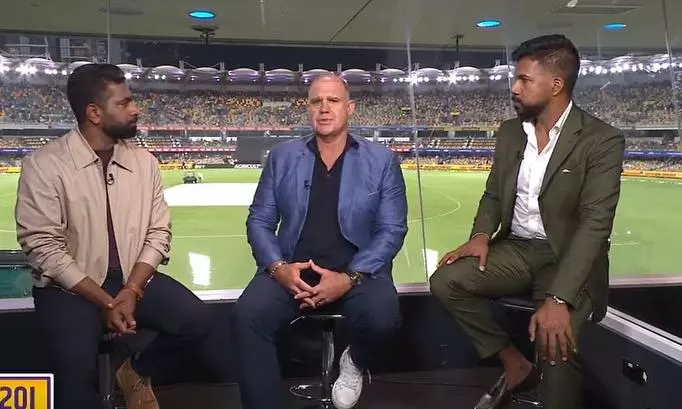
JioStar experts Matthew Hayden, Varun Aaron, and Abhishek Nayar shared their insights on India's consistent performances, team depth, challenges faced by Australia, and key tactical learnings from the series. (Photo by arrangement)
In the final T20I clash at Brisbane, the game was abandoned due to rain, resulting in India clinching the five-match series 2-1 against Australia. Speaking on JioStar’s post-match show ‘Cricket Live’, JioStar experts Matthew Hayden, Varun Aaron, and Abhishek Nayar shared their insights on India's consistent performances, team depth, challenges faced by Australia, and key tactical learnings from the series.
Speaking on ‘Cricket Live’, JioStar expert Matthew Hayden highlighted India's growth, adaptability, and strengths in the T20 format:
India will certainly be pleased with their options. They've gained valuable insights into their opponents, particularly Australia, who will be a serious contender in the World Cup. This series has been a learning curve for both teams. India appears to be figuring out how to tackle the off-pace bowling typically seen in international cricket, balancing between backing their power hitters and devising strategies to manage totals carefully—a style not usually associated with Australia. Credit to India for adapting quickly on these pitches and developing a solid rhythm and game plan in this intense format, which is arguably more challenging than longer versions due to the high-pressure nature of every ball. Suryakumar Yadav has been a steady presence at the top order, and while he aims to elevate his performances further before the World Cup, the bowling department is well-rounded. Their pace attack covers all bases, and the spin bowlers contribute not just with the ball but also in batting and fielding. The top order has demonstrated destructive potential, even with uncertainties like the absence of Sanju Samson. Overall, India is in a strong position with good problems to solve.
On the challenges and composition of Australia's batting order in the T20 format:
The situation is quite different now compared to Australia’s past when we had several high-quality left-handers, particularly at the top. They’d ideally like to maintain Travis Head at the top of the order, despite some doubts about his effectiveness against spin, even at test level, as shown during the Sri Lanka tour where he opened instead of Sam Konstas. Whether Head might shift to the middle order remains uncertain. Australia does have enough power in their lineup. Tim David, the very left-hander in question, has handled the pressure well, showing versatility to bat both up and down the order. Batting at number four, he provides additional flexibility and a power edge. Mitchell Marsh, like the others, also faces questions regarding adaptability against spin from right and left-handers. This team showed during their tour in India—with pitches that don’t turn much—that they struggled to find a consistent rhythm and pattern.
On the critical importance of the first six overs in the T20 format:
We often emphasize the significance of those first six overs, even during pre-match discussions. The key question usually is how many runs teams can score in that period, making it a crucial phase of the game. In conditions like those offshore and at the Gabba, which are generally good batting surfaces, pushing the limits, as India did, can lead to opportunities. If those chances are missed, as Australia experienced today, a team can quickly find itself struggling and trailing behind. It’s a delicate balance to maintain. However, in subcontinental conditions, everyone understands the necessity of building a strong foundation in the first six overs because that’s when the game truly begins to accelerate.
Speaking on ‘Cricket Live’, JioStar expert Varun Aaron shared his insights on India's evolving team composition during the IND-AUS T20I series:
As the series progressed, it became clear that India has more questions to answer due to experimenting with different players and positions. Heading into the World Cup at home, they will likely want to firm up their core playing XI to bring stability under pressure. The upcoming five-match T20 series against South Africa at home will provide a vital opportunity to finalize selections. Hardik Pandya’s return will strengthen the middle order significantly. On the bowling front, India has the flexibility to play with just one specialist fast bowler if desired, as there are multiple permutations to explore. Regarding Australia, I believe they need a left-handed batter in the middle order to better handle spin in subcontinental conditions. Currently, their side has too many right-handers, which poses a strategic disadvantage when playing against strong spin attacks like India’s.
Speaking on ‘Cricket Live’, JioStar expert Abhishek Nayar emphasized on the team's consistency despite frequent changes, and the stability in the bowling unit:
I believe it's a reflection of the immense talent within the team. We've observed that no matter who steps in, they are capable of delivering strong performances. That’s a testament to the high standards this Indian side has established. One crucial point is that while the batting order has seen many changes, the spin bowling department has remained largely consistent. There is a clear sense of solidity in how India's bowling attack is structured. Except for some rotation between Arshdeep Singh and Jasprit Bumrah, the core players remain mostly the same, just operating in slightly different roles. Players like Abhishek Sharma exemplify the talent nurtured through the IPL and the broader resurgence in Indian cricket, both men's and women's, backed by ongoing BCCI efforts. This abundance of skilled players means fierce competition for spots, with each individual eager to seize their chances and excel on the field. Overall, this depth and hunger contribute greatly to the strength of team India across white-ball formats and even Tests.
( Source : Deccan Chronicle )

Next Story