No Viksit Bharat Without Sports, Says Padma Bhushan Pullela Gopichand

21 Sept 2026 6:09 PM IST21 Sept 2026 6:09 PM IST
Drawing on four decades in the sport, Gopichand made the case for physical literacy as a national priority that sits beside reading and numeracy. “In thirty years, we have grown alphabetically and numerically.
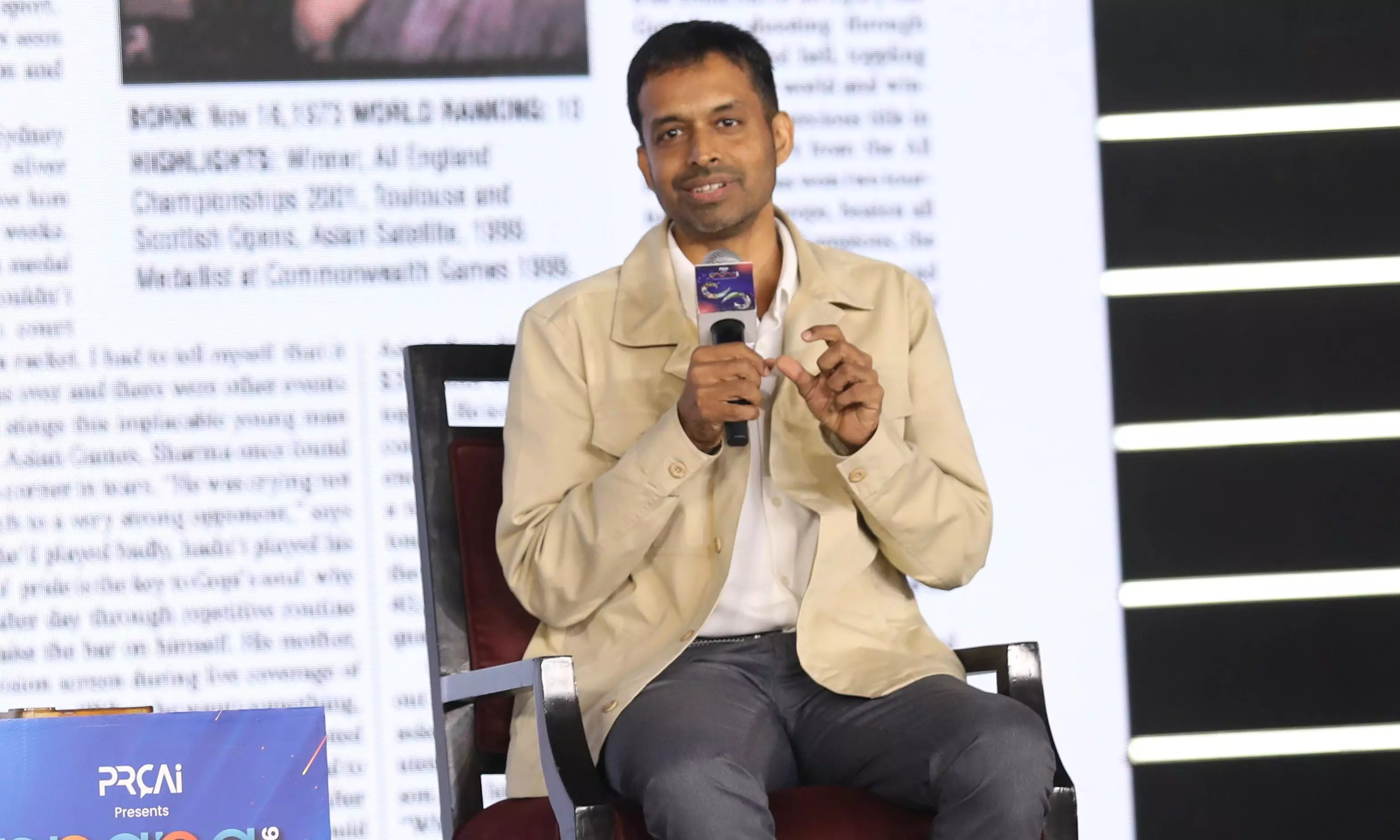
Padma Bhushan Pullela Gopichand at PRana 2026. (Photo by arrangement)
“For a Viksit Bharat to happen, sport may be the most important thing of all. Education without sport is incomplete,” said Padma Bhushan Pullela Gopichand, Chief National Coach, Indian Badminton at PRana 2026, India Inside: Shaping Reputation from Within.
The Public Relations Consultants Association of India (PRCAI) hosted the third edition of Brand India Reputation Summit and Story Convention - PRana. Amidst 15 renowned speakers categorized at catalysts, pragmatists and pathfinders, Gopichand was a pathfinder speaker in fireside dialogue with veteran sports journalist Sharda Ugra, on the theme “The Soft Power That Keeps India on the Bench,” offering India’s business leaders a fresh perspective to think about sport and making the case that India’s reputation in sport will be built less by medals and more by whether every child in the country has the chance to play.
PRana 2026, India Inside: Shaping Reputation from Within, was held at The Leela Hotel Ambience, Gurugram where it convened 250 senior leaders, including the CXO community and communication practitioners, alongside more than 15 eminent voices from business, culture, governance, technology and sport.
Excerpts from Fireside Dialogue:
Physical literacy, alongside the alphabet
Drawing on four decades in the sport, Gopichand made the case for physical literacy as a national priority that sits beside reading and numeracy. “In thirty years, we have grown alphabetically and numerically. But physically, as a nation, we have gone down. Our parents and grandparents are fitter, with more movement vocabulary than our children,” he said. The everyday markers he cited, from rising childhood obesity to the prevalence of flat feet among urban children, point to a simple opportunity - help every child run, throw and play to the full extent of their ability.
Beyond medals: sport for every child
His central reframing was on how India measures sporting success. A rising medal count is welcome, yet the deeper measure is access at the base of the pyramid, since even mature sporting cultures have found that elite performance alone does not lift the fitness of a whole population. “Medals are one story. The real story is the bottom of the pyramid, and making sure every child can play,” he said. The value of sport, in his telling, is that it lets a child play, lose in public and learn resilience early, so that public setbacks later in life are easier to meet.
“Teach me how to catch”
Gopichand traced his own shift in thinking to a thirteen-year-old trainee who, after missing a catch, came back to ask him simply to teach her how to catch. “A thirteen-year-old once asked me, ‘Sir, can you please teach me how to catch?’ That one question widened my perspective on sport and on life,” he said. The moment widened his focus from the naturally gifted to every child in the room. “It is not only about the first child in the class. The last child in the class should also have a positive experience of sport and want to stay active for life,” he said.
Access, and the everyday child
He was warm and candid about the realities that shape who stays in sport. He recalled his own schooldays, often out of the mathematics class even as the school announced his tournament wins over the public address system, and young athletes in the early 2000s who could not continue because of what their families could not afford, a reminder that access, not talent alone, often decides who continues. “With AI, a child may manage life without mathematics. But if children start to hate physical activity, they pay for it for life,” he said.
From playgrounds to a hyperlocal sporting economy
Gopichand closed on where investment should go. “When we build playgrounds and sporting infrastructure, we spend less later on hospitals and nursing homes,” he said. The model he favored is hyperlocal. “You do not need a large sponsor for every team. The neighborhood shopkeeper, the paanwala, should be proud to back a local side,” he said, pointing to community and district records chased and broken year on year. He also flagged an open opportunity in home-grown sports science, since much of India’s current research is borrowed from studies of other populations, and recalled that his father’s 1964 school certificate once recorded push-ups and a hundred-meter time, evidence of an era that valued physical capacity and a standard worth rebuilding.
( Source : Deccan Chronicle )

Next Story