Women Gig Workers Dare to Take on World

The city around them still asks that question in different ways. The resistance that cuts deeper does not come from customers
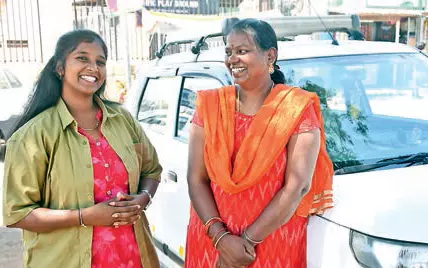
"Aaneka, karne ka aur darne ka nahi." That is how Alivelu, a cab driver in Hyderabad, describes the choice to step into a job many still consider unsuitable for women, and the stubborn courage that keeps her going despites the fear.
She has been driving for Uber for three years through Hyderabad's traffic and heat and the occasional 12-hour day, but getting to those 12 hour days took longer than most people know. She spent nearly a decade working security at a hospital and then as a Zomato delivery worker. "The salary was small," she says. "Fees, rent and everything kept increasing.”
She decided to learn driving. Lunch breaks became lessons at a driving school and the first challenge arrived before she even began when she decided to buy a car. "My CIBIL score was good,” she says. "Still the show-room people told me they would not give a taxi plate to a woman. Only a home plate." She kept trying. One showroom turned her away. Another did the same. The third finally agreed. The car came with loans and installments. The road came with its own costs.
"If I earn ₹3,000 in a day after working 12 hours, around 1,500 goes for fuel. Then there is servicing, tires, oil changes, something or the other. Further, cab aggregators run on ratings. Decline a ride and the rating drops and when the rating drops, the work thins out.
Another woman begins her day hours earlier. Rahima Begum wakes up at 5.30 am. Breakfast must be cooked before she leaves. Urban Company bookings begin around am and she steps out at 7.30, burqa clad.
"My husband died of cancer six months ago. After that I had to start working." Sweeping, mopping. bathroom cleaning, dusting and sometimes laundry. Houses change but the routine remains the same. "I earn around eight thousand rupees in fifteen days. Most of it goes to expenses."
Ratings matter here as well. "If customers give bad ratings, the company cuts a hefty percentage because of that.” She walks to work because there is no vehicle at home and driving lessons cost Rs 5,000.
"Mujboori insaan ko sab kuch sikha deti hai," she says. Compulsion teaches everything to a woman who had barely stepped out prior to this.
Another woman drives a truck and carries cargo around the city and sometimes outside. "I keep driving up to 100 km stretches and a couple of times drove to Odisha Vijayawada, Karnataka and more," says Archana, who had to step up and learn driving a truck after her father, a driver himself, had an industrial accident that took three fingers on one hand. He could not work after that, and her mother couldn't either. She was the youngest of four sisters and stepped in while continuing her education. Archana begins work around seven in the morning. Bookings appear throughout the day and the last trip can arrive at 10 pm, sometimes 11 pm or midnight.
All the three women carry two shifts which include work outside and work at home.
"People say this is not women's work, Alivelu says. "But women fly planes. They drive trains. They drive buses. Why should women be scared?"
The city around them still asks that question in different ways. The resistance that cuts deeper does not come from customers. Many male drivers tell them that women are taking their business. Alivelu was turned away from showrooms but she does not linger on it. She lists instead that women fly planes, women drive trains and trucks and school buses, women are in law and medicine and the police. "We work inside the house and out side. So tell me what exactly it is that women cannot do? And why should we be held back?"
And that is where another side of the city also appears. Passengers who greet a woman driver with excitement. Riders who ask for her again. Followers who watch Archana's driving videos online. Women who ask. how to enter the same field. Both Archana and Alivelu have over 40,000 and 50,000 followers on instagram, many female viewers watching them. with hope, hope to step out, hope to become financially independent and hope to do better in life. "More women should come, and not worry about what people say, said Alivelu, adding, "Aaneka, karne ka aur darne ka nahi."
