Geography of Dissent: What Protest Spaces Do to People

This feature is part of a series on third spaces and their evolving role in urban communities
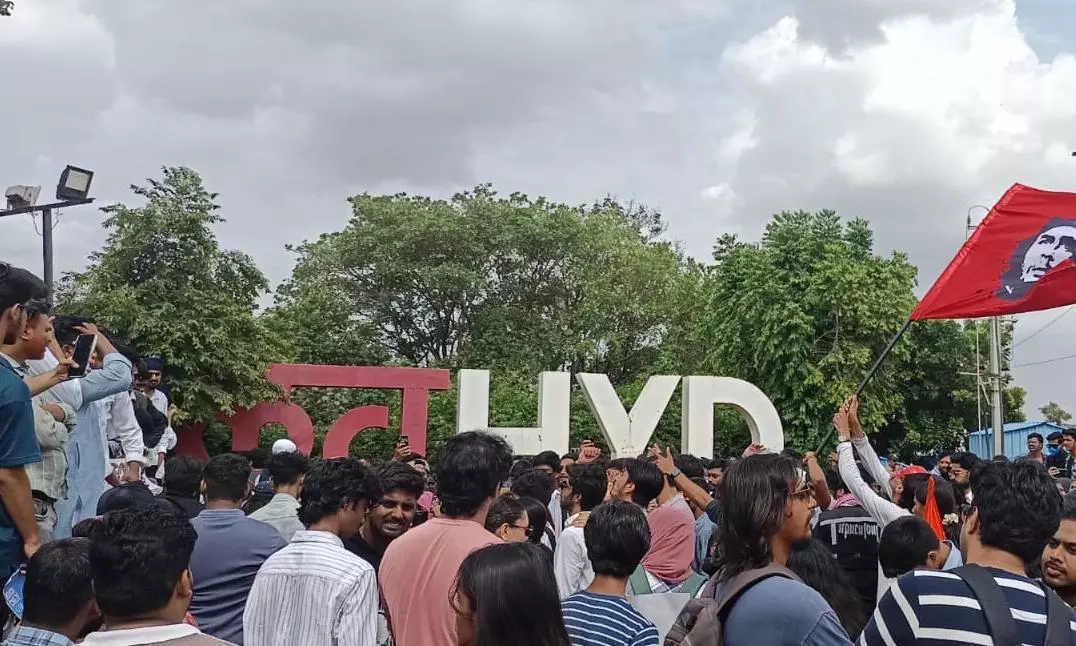
After the controversy regarding state highhandedness at the Cockroach Janta Party-led Chalo Sansad march in Delhi, protesters gathered in different places across the country. Patna, Bengaluru, Thiruvananthapuram, and Hyderabad. In effect, it was Jantar Mantar's recreation, and all it needed was people to come together.
In a single day, Hyderabad saw multiple protests at different parts of the city. At Sundarayya Vignana Kendram, Independent Artists Collective held an artists gathering in solidarity. Disha Students Organisation and Naujawan Bharat Sabha called for a protest demonstration at People's Plaza, Necklace Road. Students of University of Hyderabad, students led a march in solidarity, inside their campus while educational institutions like NALSAR University of Law and JNTU also held events in solidarity.
At People's Plaza near Necklace Road, despite heavy rain throughout the evening, protesters remained steadfast at both venues, raising slogans and holding placards as they voiced their concerns over student welfare and recent events in the national capital.
On 21st, at the Ambedkar statue in Tank Bund, protesters organised a candlelight vigil in memory of students who allegedly died by suicide following examination-related controversies. As rain intensified and candles were repeatedly extinguished, participants switched on the torchlights on their mobile phones and held them out in a symbolic display of solidarity.
The same spaces erupted in celebration when days later Union minister Dharmendra Pradhan resigned his post, as protesters demanded. Strangers and friends alike danced as rain soaked them, and the venue. Some knew each other already through protests. Some had only joined the celebration that day because they had to go for jobs on weekdays.
Protest and gender
Urban sociologist Ray Oldenburg, who coined the term third space, a space that is neither home nor work place, argued that they are places where people meet as equals. Reality is messier. Tea shops, playgrounds and street corners remain overwhelmingly male spaces, where men occupy public space with greater ease than women.
In the chai shops, play grounds, ponds, sunset rocks - we do almost always see a gender disparity. Men outnumber any other gender, and outweigh the audacity with which they occupy the space. In protest sites, this question is almost always flipped on its head.
When Gen Z took to the streets, and millennials and boomers joined, it had all kinds of people. Young women, older women, trans women, shy women, working women, pregnant women, audacious women, angry women. In Jantar Mantar too, women occupied the space audaciously. Made reels. Slept on the footpath. Shared chai with strangers.
They called out the transphobic and misogyny their fellow protesters sometimes exhibited. They claimed the space, corrected the arguments, and stayed put.
Designated to protest
In Hyderabad, Dharna Chowk near Indira Park is the city’s designated protest space, much like Jantar Mantar in Delhi. It was not created out of democratic generosity, which is the case with most designated protest spaces. Protest at the centre of any city which is trying to brand itself as an investment friendly place is not an ideal collage of images.
The most transformative protests in recent history, though, have happened not in managed venues but in the gaps: unplanned, undesignated spaces chosen for reasons that had nothing to do with administrative convenience.
When people arrive at a protest - whether at a maidan in Hyderabad, a street corner in Warangal, or in front of a collector's office somewhere in the Deccan - they bring with them the same need that drives them to the chai stall or the community well. The protest space is a third space because it does exactly what Oldenburg's barbershop does: it converts isolation into community.
Hyderabad knows this. The city's political memory is soaked in it.
The Telangana statehood movement was not primarily a Dharna Chowk movement. It lived in tea stalls and college canteens and village squares and union halls. The dharnas and bandhs were visible eruptions of something building in the informal social fabric of the region for years. Dr. Mamta Mantri, whose edited volume Cities and Protests: Perspectives in Spatial Criticism examines exactly this dynamic across Indian cities, puts it plainly in the book's foreword, written from the Singhu border during the farmers' protest: "When official sites of protest are out of bounds, common people use available spaces to register their dissent." She was watching farmers build a proto-city at a highway junction because Delhi had refused to let them in. The designated space had failed them, and so they made their own.
A 2023 study in the British Journal of Sociology tracking the political attitudes of people found that people who lived near the occupation became measurably more liberal and more pro-democracy afterwards - not despite the inconveniences caused by the protest, but through it. The researchers called it the "on-site effect”- direct physical exposure to protest, to state repression, and to protesters changes how people think, and those changes last.
Meanwhile, a latest public interest litigation in Supreme Court is contending that Jantar Mantar in the national capital was no longer a suitable venue for protests due to inconvenience to residents and disruption of essential services.
Oldenburg wrote that in totalitarian societies, the ruling power is acutely aware of the political danger of informal gathering. India's protest history is, underneath all its specific campaigns and demands and victories and defeats, a history of people finding each other. A third world country which has been plundered of its resources, of shared traumas from colonialism, casteism, sexism and every other form of power hierarchies, is also one that remembers how to come together in rebellion.
What designated protest sites can do is manage the venue. Not what happens between the democratic community inside it and around it.
This feature is part of a series on third spaces and their evolving role in urban communities.