It is easy to forget that Kafka never saw himself as a prophet of dread.
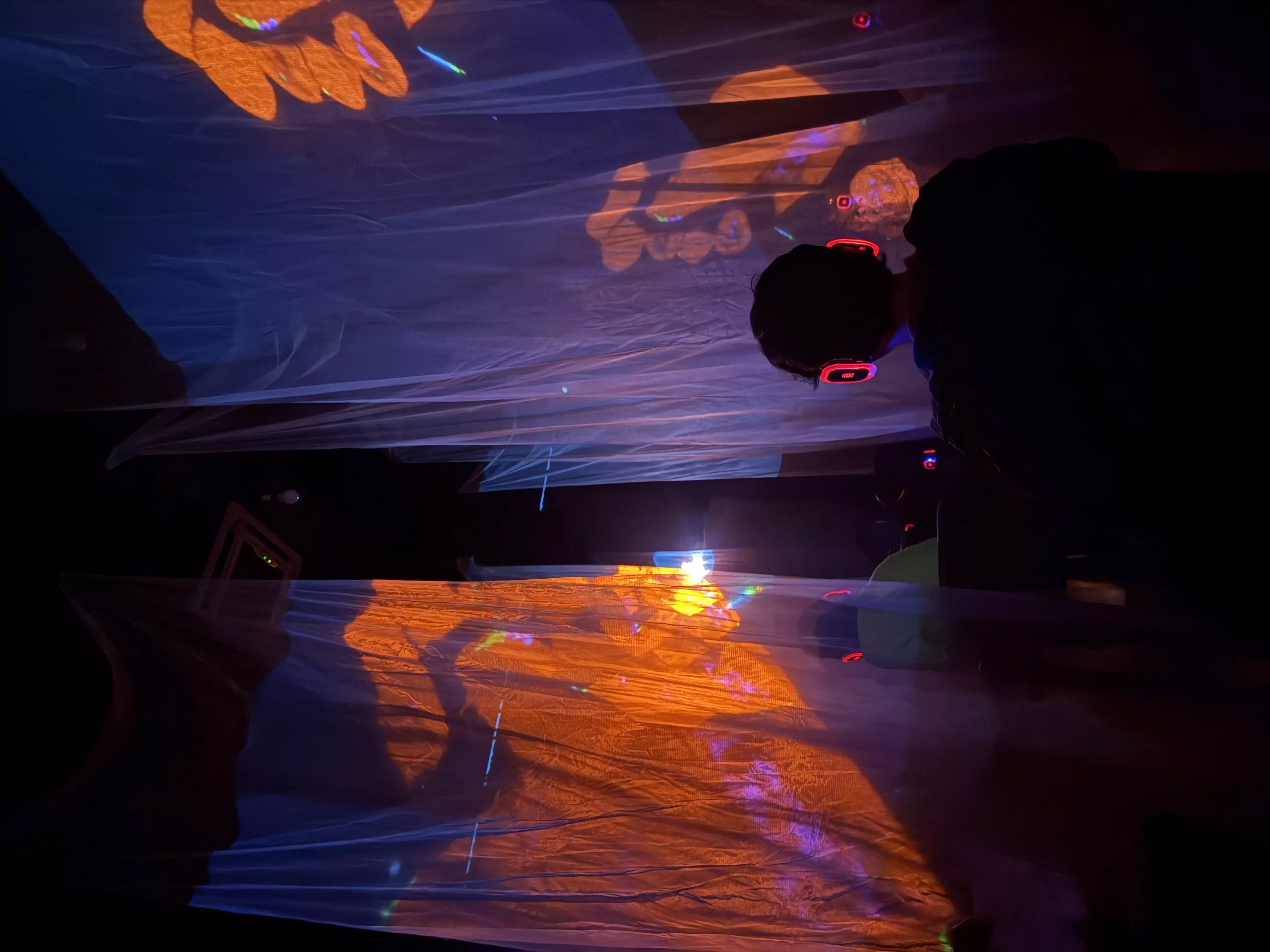
Hyderabad: “Someone must have been telling lies about Josef K.” The line greets you like a warning and a wink. White drapes cut the room into corridors, projections skate across, cold red lights leak into your sightline, and headphones lock you into your own trial with strangers sitting in odd directions, all alone in the crowd. This is not your usual theatre; this is a morbid daydream staged by Kaivalya Plays at Rangbhoomi Spaces in Hyderabad. It is a trap, a trap Kafka would have enjoyed a bit too much.
The production, titled "I, Josef," has been created by Kaivalya Plays in collaboration with the Goethe-Institut. It reimagines Franz Kafka’s The Trial as a headphone installation with projections, part of Kafka@101 that commemorates 101 years since his death. “It is experiential and immersive,” said Amita Desai, founder director of Goethe-Zentrum Hyderabad and honorary consul of Germany, adding that audiences here rarely encounter theatre where they themselves sit inside the performance space.
It is easy to forget that Kafka never saw himself as a prophet of dread, but his unfinished novels and surreal stories have outlived him, so much so that his name now slips into daily speech whenever something feels absurd or inescapable. “This text looks almost Kafkaesque,” as Amita Desai put it, a measure of how his writing has coloured the imagination of Europe and beyond, even in a Rangbhoomi theatre room in Hyderabad.
At Rangbhoomi, the absurdity began with the seating. Strangers looked in different directions, and there was no sense of a common front. Red curtains and gauze turned the room into a fractured court. What seemed faintly comic soon gave way to dread once the headphones filled with voices that arrived without bodies, but only as art projections.
The piece is directed by Gaurav Singh Nijjer, whose note describes it as an experiment that relies on the spectator’s imagination as much as the soundscape. “Kafka’s world is opaque, unyielding, entangled in legal absurdity,” he wrote, and this staging makes that clear by keeping clarity always just out of reach. The pamphlet explains it as a 45-minute binaural immersion, with first-person narration drawing listeners into Josef K.’s arrest, his uncle and advocate, and finally the chaplain who offers no solace.
If Kafka kept his stories unfinished, Kaivalya Plays seems intent on leaving gaps for audiences to fill. The Delhi-based collective, run by Varun Anand and Gaurav Singh Nijjer, has staged works that mix languages and lean heavily on technology. “We wanted to see what reaction could be evoked from people,” said Reet Chattopadhyay, pointing out that earlier productions had used projections as live partners for actors. The idea, he said, was not to offer a single interpretation of Kafka but to see what images surfaced in the minds of the audience.
Next door, an exhibition traced Kafka’s life through Nicolas Mahler’s spare drawings and fragments of his diaries. Cartoons of Gregor Samsa as a beetle sat beside Kafka’s jottings on his cinema visits, reminders that even in his morbid imagination, there was humour and a taste for the ordinary. It was an apt companion to I, Josef, which had turned The Trial into a chamber of sound and projection. Together, they suggested why Kafka remains contemporary. And this week, in Hyderabad, Kafka looks beautiful again, which is to say his world feels terrible and true.

