Women’s Empowerment Key to Nation’s Growth: Revanth Reddy

CM announces 100% electric RTC buses by December 2026, outlines Musi River revival and pollution-control measures at International Women’s Day event.
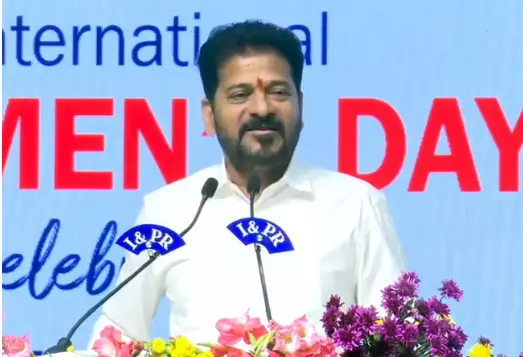
Hyderabad: Telangana Chief Minister A. Revanth Reddy on Sunday said the state government has drawn up comprehensive plans to ensure Hyderabad does not face the dangerous urban challenges seen in major metropolitan cities across India and to develop it into a world-class city.
Speaking at an International Women’s Day programme held at Jyotirao Phule Bhavan, the Chief Minister said the government is determined to protect Hyderabad’s livability while transforming it into a city that can compete with the best in the world.
As part of pollution-control measures, Revanth Reddy announced that all RTC buses operating in Hyderabad will be converted to electric vehicles by December 9, 2026. Currently, around 2,800 diesel buses operate under Telangana State Road Transport Corporation, and the government has already introduced 500 electric buses. The remaining diesel buses will be shifted to areas outside the Outer Ring Road and replaced with EV buses within the city.
The Chief Minister said the government has also introduced a zero-tax policy to promote electric vehicles and is preparing plans to convert nearly two lakh autos in the city into electric vehicles through retrofitting. In addition, single-use plastic will be completely banned and red and orange category polluting industries will be relocated outside the city limits.
Referring to urban challenges faced by other metropolitan cities, he said Mumbai struggles during heavy rains, Delhi faces severe air pollution, Bengaluru deals with traffic congestion, and Chennai faces flooding during monsoons. “Hyderabad should not face such conditions in the future or become unlivable,” he said.
Revanth Reddy also highlighted the government’s plans to rejuvenate the Musi River through the Musi Riverfront project, similar to riverfront development initiatives undertaken for the Yamuna River, Ganges River and Sabarmati River. He said the project will follow buffer zone guidelines framed in 2012 in accordance with directions from the Supreme Court of India and the National Green Tribunal.
Under these rules, construction is not permitted within 10 metres along drains and 50 metres along rivers. The Chief Minister said displaced families affected by the Musi rejuvenation project will receive adequate compensation or alternative arrangements.
He also clarified that misinformation was being spread about the cost of the Gandhi Sarovar project under the first phase of the riverfront development. According to the government, around ₹70 crore will be spent on a Gandhi statue and about ₹200 crore on the knowledge centre and surrounding development works. A detailed presentation on the project will be given on March 13, he said.
The Chief Minister stressed that Telangana aims to become a $1 trillion economy by 2034 and a $3 trillion economy by 2047. He said the state, which accounts for about 2.5 per cent of India’s population, already contributes nearly five per cent to the national GDP.
Revanth Reddy also emphasised the role of women in economic development and assured that women journalists will be given special recognition. Committees will be set up in print and electronic media organisations to ensure safety and protection for women employees.
Deputy Chief Minister Mallu Bhatti Vikramarka, ministers including Ponguleti Srinivasa Reddy, Konda Surekha and Ponnam Prabhakar, along with Mohammed Azharuddin, Telangana Media Academy chairman Srinivas Reddy, IPR commissioner C.H. Priyanka and several women journalists attended the programme.
