
While devotees arrive with baskets of jaggery to offer, many are equally eager to take a small piece back home.
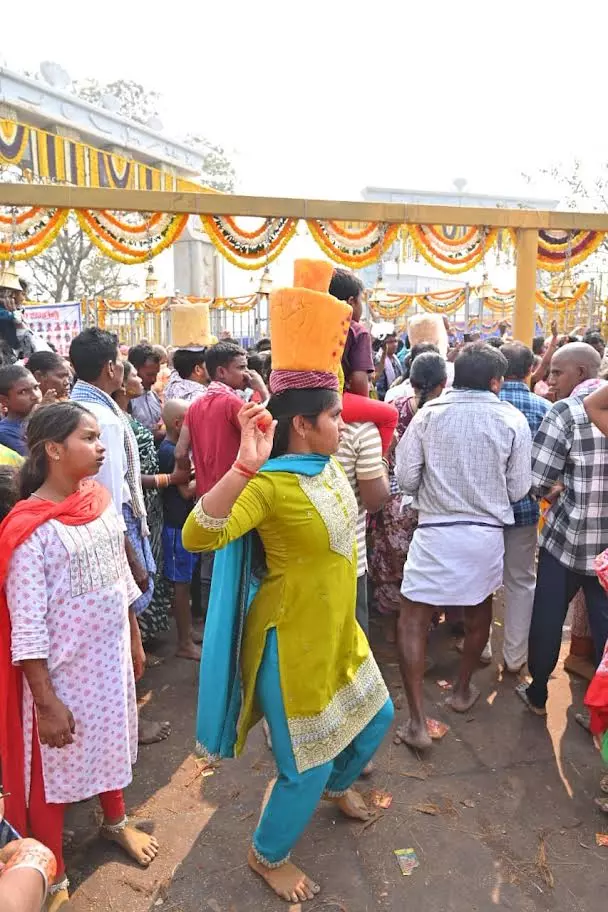
A woman devotee carrying jaggery to offer to Sammakka Saralamma deities.
Mulugu: At the Sammakka-Saralamma Medaram Maha-Jathara, the most precious offering is neither diamonds nor gold, silk, or money commonly presented at other temples. Instead, devotees offer jaggery, locally revered as Bangaram (gold). Tonnes of jaggery are presented to the tribal goddesses Sammakka and Saralamma, creating a spectacle of faith rooted in ancient legend and traditional wisdom, unmatched anywhere else in the world.
The tradition of calling jaggery Bangaram traces its origin to a popular folklore. According to legend, a poor devotee once wept before the goddess, distressed that he could not afford the gold ornaments offered by wealthy pilgrims. That night, Sammakka appeared in his dream and comforted him, saying, “Your jaggery is my gold. Offer it with devotion, and your prayers will be answered.” Since then, devotees have followed the ritual of Tulabharam, weighing themselves against blocks of jaggery and offering an equivalent weight as a symbol of complete surrender.
One of the most talked-about beliefs at Medaram relates to a striking natural phenomenon. Despite hundreds of tonnes of jaggery being piled at the sacred altars (gaddelu) and carried by devotees in long queues for hours, flies are conspicuously absent. Devotees believe this reflects the divine presence of the goddesses and the purity of the prasadam, also helping prevent the spread of disease during the massive congregation.
Beyond its spiritual symbolism, jaggery also has historical and medicinal significance. Adivasi elders say that in earlier times, when pilgrims travelled long distances on foot through dense forests, jaggery served as an instant source of energy. With the Medaram forest turning extremely dusty during the jatara, tribal wisdom holds that consuming jaggery helps clear the respiratory tract, acting as a natural detoxifier for millions camping in the open.
While devotees arrive with baskets of jaggery to offer, many are equally eager to take a small piece back home. As the goddesses return to the forest during Vana Pravesham at the end of the festival, devotees often scramble for a pinch of this sacred “gold,” which is preserved at home throughout the year and believed to bring health and prosperity until the next jatara.
( Source : Deccan Chronicle )


Next Story