Walls That Speak: Street Artist Siddharth Gohil Back in Hyderabad

Siddharth Gohil brings abstract public art to Hyderabad’s Wall Art India
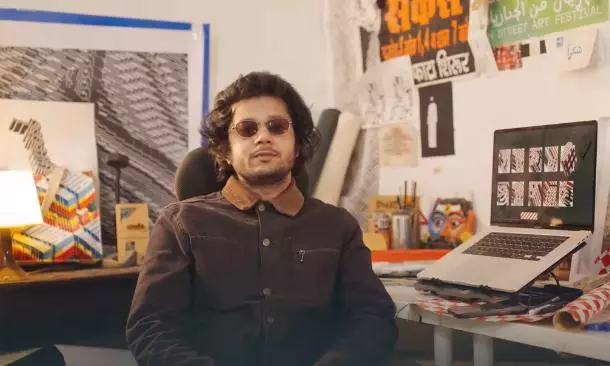
Hyderabad: A ladder leans against the wall at the third-floor entrance of Alliance Française Hyderabad. Siddharth Gohil, also known as Khatra, balances on its narrow rung, stretching upward, pressing a roller into a sweep of teal that arcs across the white surface. A crumpled blue tarpaulin lies beneath him. The door beside the wall reads “Music Room.” He pauses, steps back, and studies the curve.
“When you’re painting a huge surface, it should talk to the people,” he says. “It should be for the public. You’re putting something in a public space for people to interact, it is to democratise art.”
Gohil is in Hyderabad for the fifth edition of Wall Art India. This wall at the Alliance Française is the fifth mural completed under the initiative here, one for each edition. The walls of this Banjara Hills institute have become layered with memories of great muralists from across the world. This time, it is Baroda-based Gohil adding his mark.
He recalls his earlier stint in Hyderabad at the 2016 street art festival in Maqta. At the end of it, he and a friend painted a wall inspired by a local man they had spotted. “We painted him brushing his teeth, but the brush had one bristle, and he had one tooth,” he laughs. Playful, rooted in observation, it became an inside joke with the neighbourhood.
“Hyderabad has immense potential to have public art projects where street art can be one medium. It has a very different landscape and geography,” he says. “Normal public doesn’t always have access to art galleries. This sort of art form can really make an impact and make art more democratic.”
For Gohil, democracy is not abstract. A surface must respond to where it stands. He researches before arriving in a city, but the wall itself alters things. Up close, his current mural is a field of layered shapes, spreading around the doorway, pushing colour toward the ceiling.
“Here I chose abstraction as a medium,” he explains. “It has patterns inspired by French and Indian textiles, more based in Telangana and France, and layered in intricate ways so it becomes a playful composition at the entrance.”
Textile is not incidental. His interest in letters began early. “I used to cut letters from radium material from the back of cars and experiment with that.” Later, at the Faculty of Fine Arts at MSU Baroda, he studied applied arts and design, digitised fonts, and became attentive to the hand-painted signboards that once defined Indian streets. “Indian hand-painted typography on the streets is disappearing because of flex printers and commercialisation. This art form has become very rare.”
He does not shy away from the political nature of street art, born out of resistance in many places. “Sometimes I do see my work as political,” he says. “Some works I’ve produced were not part of any organisation, it was just my opinion and what I felt was right to do at that moment, especially in Delhi, I remember doing a lot of political art.”
Also in Delhi, as part of the India Art Fair residency programme, he designed a 100-metre-long carpet for the outdoor area. Typographic and expansive, it lay on the floor. Here in Hyderabad, the surface is vertical and contained within a corridor, but he resists fixed readings. “I just want viewers to have fun, and to have their own meditation, individually. To try to find patterns that resemble something in their day-to-day life.
