Voter Rights Forum Demands 3-Month Extension for Sir 2026

Public consultation urges simpler procedures, an awareness drive and extension of SIR deadline
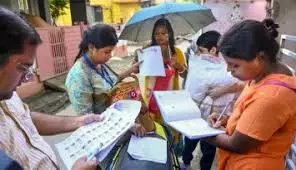
Hyderabad: The Telangana Voter Rights Forum (TVRF) that has held a public consultation on SIR 2026 called for urgent measures to prevent exclusion of eligible voters.
During the consultation, retired Supreme Court judge Justice Sudershan Reddy alleged that the special intensive revision (SIR) of electoral roll in its current form was “taking us back into the colonial era, where the Empire decided who could vote.” He noted: “The voter ID personifies the right to equality described in the Constitution.”
Justice Sudershan Reddy was speaking at the public consultation organised by the Telangana Voter Rights Forum (TVRF) to review the implementation of the SIR process here on Saturday.
Describing the early history of voter enumeration, Justice Sudershan Reddy said Indians were recognised as voters before the process of citizenship was fully debated as Dr B.R. Ambedkar’s demand for universal adult franchise was implemented by enumerating voters from the remotest habitations by the time Constitution was adopted in 1950.
Speaking at the event, MLC Prof. M. Kodandram said that SIR was not voter registration but citizenship registration form. Telangana Education Commission chairman Akunuri Murali pointed out that of the 11 documents, only the permanent residence certificate (PRC) was accessible to the poor, marginalised and women. Akunuri said the TVRF had requested the state government to explore ways of issuing the PRC to voters who have no other documentation.
In its representation, the TVRF expressed its concern at the complexity of the SIR process and the possibility of a large number of voters losing their constitutional right to vote.
Representatives of several civil society organisations, grassroots volunteers, community leaders, and individuals working directly with voters shared field-level experiences and highlighted a range of practical difficulties being faced by electors in completing the enumeration process.
They said inadequate public awareness, procedural complexity, of procuring supporting documentation, inconsistent implementation across polling areas, and the limited availability of BLOs were creating barriers for many eligible voters to register. Participants expressed particular concern that large numbers of economically weaker households, migrant workers, elderly persons, women, and people employed in the unorganised sector may face difficulties in producing the prescribed documents, increasing the risk of exclusion from the electoral rolls.
The forum's principal demands to the Chief Electoral Officer included an intensive multilingual public awareness campaign, strengthened the role of BLOs, publicising their contact details and timings, and organising periodic Booth Sabhas to facilitate community verification and address voter grievances.
The forum also sought dedicated voter helplines operating from 9 am to 9 pm and local voter help desks through local civic bodies and postponement of the SIR deadline by three months.
